
That's where things get expensive. Gallup estimates replacement costs at 40% of salary for frontline employees and up to 200% for managers. Meanwhile, willful FLSA violations carry civil penalties up to $2,515 per violation — and those add up fast.
This guide walks through the 9 foundational HR basics every small business needs to manage, how to approach each one, and how to structure HR as your team grows.
Key Takeaways
- HR covers the full employee lifecycle — hiring, onboarding, compliance, payroll, and offboarding
- Even businesses with fewer than 10 employees face real federal and state labor law obligations
- The 9 HR basics form your minimum viable HR foundation — skipping one creates gaps that compound
- Small businesses can manage HR in-house, outsource specific functions, or use a PEO — with different cost and compliance trade-offs for each
- Getting HR fundamentals right early prevents the compliance gaps and people problems that derail growth
What Is HR Management for Small Businesses?
HR management is the set of practices, policies, and processes a business uses to hire, manage, develop, and retain employees — while staying legally compliant. It's not just paperwork. It's the operating system for how a business treats its people.
For small businesses, HR typically starts as an owner-managed function. The owner handles hiring, onboarding, payroll, and compliance alongside everything else. Over time, that becomes unsustainable. The business must eventually bring on a dedicated HR person, outsource specific functions, or adopt a Professional Employer Organization (PEO) model.
The key reframe: HR isn't a large-company luxury. A 5-person team still needs basic HR hygiene:
- Documented policies employees can reference
- Correct worker classification (employee vs. contractor)
- Accurate, timely payroll
- A clear process for handling performance issues and exits
The earlier those systems are in place, the fewer costly surprises a growing business faces.
Why HR Basics Matter More Than Most Small Business Owners Realize
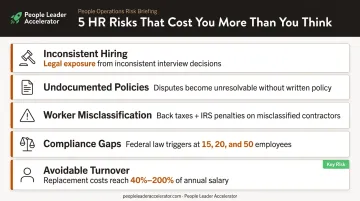
Without HR basics in place, specific and costly problems emerge:
- Inconsistent hiring that creates legal exposure under equal opportunity guidelines
- Undocumented policies that make disputes nearly impossible to resolve without legal help
- Worker misclassification that triggers back taxes, IRS penalties, and potential audits — federal income-tax withholding liability alone can hit 3% of wages when required information returns weren't filed
- Compliance gaps as headcount crosses thresholds (15, 20, 50 employees) and new federal laws kick in
- Avoidable turnover at 40%–200% of salary per departure, depending on the role
Most of these problems are preventable — and the fix is rarely expensive. A clear written policy, a structured onboarding process, or a classification review done before a complaint is filed costs a fraction of what remediation, legal fees, or back taxes will. The nine basics covered below address each of these risk areas directly.
The 9 HR Basics Every Small Business Should Manage
Each of these nine areas represents a real accountability — not something you can skip because you don't have an HR department yet.
1. Legal Compliance
Legal compliance is the foundation. Small businesses need to know which federal and state labor laws apply to them — and those requirements shift as headcount grows.
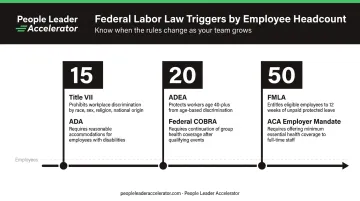
Key federal thresholds to track:
| Law | Employee Threshold |
|---|---|
| Title VII, ADA | 15+ employees |
| ADEA (age discrimination) | 20+ employees |
| Federal COBRA | 20+ employees |
| FMLA, ACA employer mandate | 50+ employees |
Worker classification is one of the highest-risk areas. Misclassifying an employee as an independent contractor can trigger back taxes, penalties, and IRS audits. Review classifications regularly using DOL guidance on employment relationships.
2. Workers' Compensation Coverage
Workers' comp is state-regulated, and requirements vary significantly:
- Georgia: Required at 3 or more workers
- Alabama: Exempts employers with fewer than 5 employees (with some exceptions)
- Texas: Most private employers are not required to carry coverage, but non-subscribers lose standard legal protections against employee injury lawsuits and must provide written notice of no coverage
Failing to carry required coverage where it's mandated can result in fines, civil liability, and in some states, criminal charges. Check your state's specific rules — don't assume federal rules are the only ones that apply.
3. Employee Handbook
The employee handbook sets baseline expectations for employment: at-will status, anti-harassment and anti-discrimination policies, PTO, conduct standards, and benefits. Modern handbooks should also address remote work, data security, and AI usage.
Two critical steps most small businesses skip:
- Have a business attorney review it before distributing — to confirm compliance with current federal, state, and local law
- Collect signed acknowledgment from every employee — this becomes your evidence if a policy dispute arises
Update the handbook whenever laws change or the business grows into a new compliance tier.
4. Recruiting and Onboarding
SHRM estimates the average cost per hire at nearly $4,700 — with many employers estimating total hiring costs at 3–4 times the position's salary. A bad hire compounds that cost further. A structured, consistent hiring process — using the same criteria across all candidates — both improves outcomes and keeps you aligned with equal opportunity requirements.
Onboarding is more than paperwork. A structured first week — one that communicates job expectations, connects new hires to the team, and gives them a clear path to contribute — directly reduces early turnover.
The difference between a thoughtful onboarding program and a pile of forms on day one shows up in 90-day retention numbers.
5. Employee Compensation and Benefits
Start with salary benchmarking. U.S. employers reported a mean total salary-increase budget of 3.9% for 2024 (WorldatWork), and Gallup's 2024 data shows pay and benefits account for 16% of primary reasons employees leave — the largest single category.
Benefits that matter most to employees:
- Health and wellness coverage
- Financial well-being (401k, FSA)
- Paid time off
- Professional development
One legal note: in many states, accrued PTO is treated as earned wages. That means you need a clearly documented policy on PTO payout at termination — check your state law before setting any policy.
People Leader Accelerator offers compensation benchmarking frameworks that HR leaders and growing businesses can use as a starting point for structuring competitive pay.
6. Payroll
Payroll is non-negotiable — accurate, on-time payment is both a legal obligation and a trust foundation. Errors here erode employee confidence fast.
What feeds into error-free payroll:
- Correct worker classification (employee vs. contractor)
- Clean, up-to-date employee records
- Properly calculated withholdings, garnishments, and benefit deductions
- Compliance with FLSA overtime rules (1.5x regular rate for hours over 40/week)
IRS failure-to-deposit penalties range from 2% to 15% depending on how late the deposit is, and they escalate quickly. Most small businesses use payroll software or an outsourced payroll service to stay compliant.
When evaluating options, look for:
- Tax filing support
- Worker classification guidance
- Integration with your benefits and time-tracking systems
7. Performance Management
Performance management isn't just an annual review. Modern best practice involves:
- Regular check-ins (monthly or quarterly, not just December)
- Goal updates tied to business priorities
- Informal feedback that addresses issues while they're small
Consistent performance tracking informs decisions on raises, promotions, and development. It also creates documentation that supports coaching conversations — and, when necessary, termination decisions that are defensible.
People Leader Accelerator hosts community events focused on performance reviews and merit planning — practical sessions where HR leaders work through cycle design and calibration together.
8. Terminations
How a business handles employee exits — voluntary or involuntary — matters legally and culturally. Key requirements:
- Documentation: Written termination letter with clear rationale, signed by the employee if possible
- Final pay: State laws vary significantly. California requires earned wages immediately at discharge. Colorado requires payment of earned, vested wages immediately with some payroll-unit exceptions. Know your state's rule before the conversation happens.
- COBRA notices: Federal COBRA applies to employers with 20+ employees. The employer-to-plan notice is due within 30 days; the plan administrator then has 14 days to send the election notice. Some states (California, New York) have mini-COBRA laws for employers with 2–19 employees.
- Accrued PTO: Whether it's payable at termination depends on state law and your written policy — document this clearly in advance.
9. HR Reporting
HR reporting turns day-to-day employee data into decisions. Without it, you're managing by intuition instead of information.
Useful metrics to track:
- Hiring activity and time-to-fill
- Compensation trends vs. market benchmarks
- Performance distribution across teams
- Turnover rates by department and tenure
Most HR software platforms include built-in reporting. Reviewing these reports regularly — not just pulling them — is what drives proactive decisions about headcount, compensation adjustments, and team structure before problems compound.
How to Structure HR in Your Small Business
Three models work for small businesses, and the right one depends on size, risk tolerance, and budget:
| Model | Best For | What It Covers |
|---|---|---|
| In-house HR | 25–50+ employees | An HR generalist supported by software handles all functions |
| HR outsourcing | 10–30 employees | Specific functions (payroll, compliance) handed off to specialists |
| PEO arrangement | 10–49 employees | Co-employment model covering most HR responsibilities; ~two-thirds of PEO clients have 10–49 employees (NAPEO) |
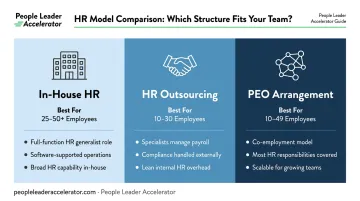
SHRM notes that HR delegation typically begins around the 10th employee, with a dedicated HR hire typically justified between 40–100 employees.
Regardless of which model you choose, someone in the business needs to own HR competence — not just HR tools. Businesses that manage HR well tend to have someone who understands the strategic frameworks behind the tools — not just how to run the software, but how to make sound people decisions when circumstances get complicated.
For in-house HR leaders building that competency, People Leader Accelerator offers programs designed for first-time and growing HR practitioners — practical frameworks for managing people in fast-moving environments.
Once you have the strategic foundation in place, software selection becomes straightforward. Choose a platform that covers your immediate needs — payroll, onboarding, time tracking, compliance — and resist building complex systems before your team is large enough to justify them.
Common HR Mistakes Small Businesses Make
The most common mistake is building HR systems reactively. That means writing the handbook after the first harassment complaint, documenting performance only when preparing for termination, and addressing compliance only after an audit notice arrives.
Three other frequent errors:
- Misclassifying workers as contractors to reduce costs. When corrected retroactively, the tax liability, penalties, and back wages often dwarf the original savings.
- Applying policies inconsistently across employees. The EEOC's small-business guidance is explicit: managers must consistently enforce discrimination rules and policies. Inconsistent enforcement is one of the most common roots of discrimination exposure.
- Over-investing in HR technology before the processes exist to support it. A $500/month HRIS doesn't help if no one has documented the policies the system is supposed to enforce.
The flip side is just as damaging: focusing too heavily on compliance paperwork while neglecting the human judgment side of HR — training managers, building culture, and giving consistent feedback. Systems matter, but they don't replace the work of actually developing people.
Frequently Asked Questions
What is business HR?
Business HR refers to the function within a company responsible for managing its workforce — covering hiring, compliance, compensation, performance, and employee relations. It exists in every business that has employees, regardless of whether there's a formal HR department or a dedicated HR person.
What is the difference between HR and business HR?
"HR" broadly refers to the function or department. An HR Business Partner (HRBP), sometimes called "Business HR," works directly with business leaders to align HR strategy with organizational goals — a more strategic role than traditional administrative or transactional HR.
What are the 4 types of HR?
The four commonly referenced HR functional areas are: recruitment and talent acquisition, compensation and benefits, training and development, and compliance/employee relations. Small businesses often handle all four within one role, one outsourced function, or a combination of both.
When does a small business need to hire a dedicated HR person?
Most practitioners recommend bringing on a dedicated HR professional around 25–40 employees — or earlier if the owner's time spent on HR tasks is noticeably pulling them away from core business operations. The SHRM-cited benchmark puts the usual trigger between 40–100 employees.
Can a small business owner handle HR on their own?
Yes, and many do in the early stages. As the team grows, compliance complexity, payroll demands, and employee relations issues multiply. HR software helps manage the operational load; investing in development resources helps whoever is running HR stay ahead of problems rather than reacting to them.