

The confusion is understandable. In smaller companies, one person often does both jobs simultaneously. But as organizations scale, the distinction becomes critical — and getting it wrong is expensive.
This article breaks down exactly what separates these two roles: clear definitions, a side-by-side comparison, and practical guidance on which role fits your organization's stage or your career goals.
Key Takeaways
- HR Managers own day-to-day operations — recruiting, compliance, employee relations, and benefits administration
- HRBPs function as strategic advisors, aligning talent strategy and workforce planning with business goals
- The core difference is orientation: HR Managers focus on the present; HRBPs plan ahead
- Scaling organizations typically need both roles running simultaneously
- Most HRBPs built their foundation as HR Managers or generalists
HR Business Partner vs. HR Manager: Quick Comparison
Neither role is superior — they serve different organizational needs. Here's how they compare across five dimensions:
| Dimension | HR Business Partner | HR Manager |
|---|---|---|
| Primary Focus | Workforce strategy, org design, executive advisory | Recruiting, compliance, employee relations, benefits |
| Time Horizon | 6 months to 3 years | Daily to quarterly |
| Key Stakeholders | C-suite, department heads, business unit leaders | Employees, frontline managers |
| Success Metrics | Talent pipeline health, retention of high performers, org change outcomes | Time-to-hire, compliance rates, employee satisfaction scores |
| Typical Reporting Line | VP of People, CHRO, or directly to business unit leader | HR Director, VP of People, or directly to senior leadership |
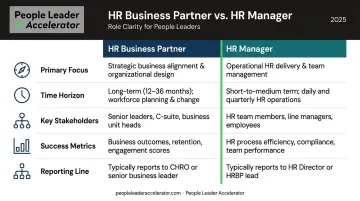
This table is a simplified snapshot. The sections below add the nuance that matters in practice. Worth noting: in organizations under 75 employees, these responsibilities frequently overlap within a single generalist or HR Manager role. The clean separation above is largely a feature of larger companies.
What Is an HR Business Partner?
An HRBP is a senior HR professional who functions as an internal consultant — embedded within or closely partnering with a specific business unit — translating business objectives into people strategies rather than administering HR processes.
The Origin of the HRBP Model
The concept traces back to Dave Ulrich's 1997 book Human Resource Champions, which helped define the HR business partner through roles and outcomes rather than administrative tasks. His framework described HR as a three-part operating model: shared transactional services, centers of expertise, and HR business partners embedded in business units. Organizations widely adopted this structure through the 2000s and 2010s, and the model continues to evolve — McKinsey found that over 90% of CHROs at large organizations expected significant HR operating model change within two to three years, with 85% prioritizing a refocus of their business partner roles.
Core HRBP Responsibilities
- Anticipate talent needs through workforce planning and succession work
- Structure teams to execute business strategy via organizational design
- Build bench strength for critical roles across the talent pipeline
- Guide leaders through restructuring, rapid growth, and change
- Advise senior leaders on the people implications of major decisions
- Use workforce data and people analytics to inform strategic choices
Skills That Set HRBPs Apart
Business acumen sits at the top of the list — understanding P&L, revenue drivers, and market dynamics. But SHRM's competency framework also identifies analytical aptitude and consultation skills as core to the role: collecting and analyzing data to inform decisions, and working with partners to design and implement solutions. These are learnable through deliberate development, not just accumulated experience.
How the HRBP Role Works in Practice
Those skills play out concretely in day-to-day work. Consider an HRBP at a 100-person tech company partnering with the VP of Engineering ahead of a major product launch. Six months out, they're analyzing skill gaps on the engineering team, benchmarking compensation for specialized roles that don't yet exist, and designing a retention strategy for senior engineers who will be critical during the crunch. The VP gets strategic people advice; the HRBP surfaces risks before they become fires.

Typical HRBP stakeholders are C-suite executives and department heads. HRBPs rarely manage large HR teams — their influence flows through advisory relationships, not direct authority.
What Is an HR Manager?
An HR Manager oversees the full operational spectrum of HR within an organization — ensuring that processes around hiring, onboarding, compliance, compensation, performance management, and employee relations run consistently and correctly.
The generalist label is accurate. A strong HR Manager might handle a benefits enrollment question in the morning, an employee relations matter at lunch, and a state law policy update by end of day.
According to the Bureau of Labor Statistics, HR Managers plan, coordinate, and direct an organization's administrative HR functions while also serving as the link between management and employees.
Core HR Manager Responsibilities
- Runs hiring processes and integrates new hires — consistent onboarding directly reduces early attrition
- Addresses conflicts, disciplinary matters, and employee concerns
- Manages benefits and compensation programs, including vendor relationships
- Stays current with employment law and maintains accurate compliance records
- Builds and administers training and development programs
- Maintains HRIS data integrity and generates operational reports
Essential HR Manager Skills
- Employment law knowledge across relevant jurisdictions
- Process design and documentation
- People management (HR Managers often lead a small HR team)
- Vendor and systems management
- Crisis handling under time pressure
The HR Manager's most underrated skill is prioritization. With a wide range of competing demands, dropping a compliance obligation while handling an employee relations issue is a real risk — experienced HR Managers develop systems to prevent it. That same discipline for managing competing priorities is what makes the role effective in practice.
How the HR Manager Role Works in Practice
Picture an HR Manager at a 50-person company managing five open requisitions simultaneously while updating the employee handbook to reflect a new state employment law. One afternoon brings a candidate offer negotiation; the next brings an employee concern that needs a documented response. The role is broad and fast-moving by design.
Employees and frontline managers are the HR Manager's primary stakeholders. Two qualities define effectiveness here:
- Responsiveness — being the first person anyone calls with an HR question
- Trust — building credibility so people bring issues early, before they escalate
Key Differences Between an HR Business Partner and an HR Manager
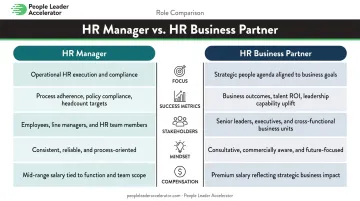
The two roles diverge across five core dimensions. Here's how they compare — and why the distinction matters for career planning and org design.
| Dimension | HR Manager | HR Business Partner |
|---|---|---|
| Focus | Broad operational ownership | Strategic, forward-looking advisory |
| Measured by | Efficiency metrics | Business outcomes |
| Stakeholders | Employees, frontline managers | Department heads, C-suite |
| Mindset | Process-oriented, compliance-focused | Consultative, data-driven |
| Compensation | Median ~$136K (BLS 2023) | Higher; varies by industry/company size |
Specialization vs. Generalism
HR Managers own a wide range of day-to-day functions and must be competent across all of them. HRBPs narrow their focus to high-leverage, forward-looking work: workforce strategy, organizational design, and executive advisory. Neither approach is better; they serve different organizational needs.
Goals and Success Metrics
HR Managers are measured on operational efficiency: time-to-hire, compliance rates, employee satisfaction, and process consistency. HRBPs are measured on business outcomes: talent pipeline health, retention of high performers, revenue per employee, and the success of organizational change initiatives. Gartner research shows HRBPs spend nearly 19 hours per week on employee issues and over 16 hours on operations — only about 9 hours on strategic work — which reflects the gap between what the role is designed to do and how it actually gets used in many organizations.
Stakeholder Relationships
HR Managers interact primarily with employees and frontline managers, acting as a trusted resource for day-to-day people needs. HRBPs sit in business strategy conversations with department heads and the C-suite, advising on the people implications of business decisions.
Mindset and Approach
HR Managers bring a structured, process-oriented, compliance-conscious mindset. HRBPs bring a consultative, data-driven approach: comfortable with ambiguity, skilled at influencing without direct authority.
Salary and Seniority
Compensation reflects the scope difference. According to BLS May 2023 data, HR Manager earnings break down as follows:
- 25th percentile: $103,340
- National median: $136,350
- 75th percentile: $182,120
- Mean in Computer Systems Design: $183,570
HRBPs typically earn more, particularly in tech and PE-backed companies where people strategy is tied directly to valuations and growth targets. Compensation for both roles scales significantly with company size, industry, and scope of responsibility.
Which Role Is Right for You?
By Company Stage
| Company Size | Recommended Approach |
|---|---|
| Under 50 employees | HR generalist or HR Manager to build foundational processes |
| 75–150 employees | HR Manager plus fractional HRBP for workforce planning |
| 150+ employees | Dedicated HR Managers (operations) and HRBPs assigned to business units |
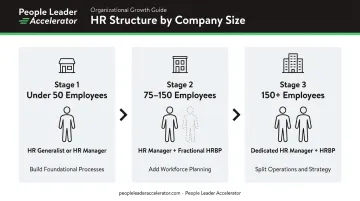
The inflection point is around 75–150 employees, when strategic workforce planning becomes critical but operational HR still needs full attention. Trying to do both with one person creates bandwidth strain that eventually breaks something.
By Career Goal
Choose the HR Manager path if you:
- Thrive on systems, process improvement, and operational precision
- Want to be the trusted resource employees and managers rely on
- Find satisfaction in keeping complex HR machinery running smoothly
Pursue the HRBP path if you:
- Want to sit in business strategy conversations and influence senior leaders
- Are drawn to connecting people decisions to revenue and organizational outcomes
- Are comfortable with ambiguity and working without direct authority
Most HRBPs built their foundation as HR Managers first. The transition isn't just a title change; it requires deliberate development in business acumen, people analytics, and executive communication skills that go well beyond accumulated operational experience.
For HR Managers working toward that transition, People Leader Accelerator offers practitioner-led programs designed to bridge this gap. Faculty including Andrew Bartlow (co-author of Scaling for Success: People Priorities for High-Growth Organizations) and Marie Szuts (former people leader at Figma) bring direct experience scaling HR functions in high-growth environments.
PLA's digital toolkit covers the core HRBP competencies directly:
- 75-page People Analytics guide
- Strategic People Planning framework
- Compensation Benchmarking resources
- Organizational Culture toolkit
These tools give HR professionals concrete ways to build strategic fluency alongside their operational experience.
Frequently Asked Questions
What position is higher than HR Manager?
The HRBP is generally considered more senior and strategic than an HR Manager. Above both sit roles like HR Director, VP of People, and Chief People Officer. That said, seniority varies considerably by org size — in a 200-person company, an HR Manager may hold responsibilities that a large enterprise would assign to a Director.
Are HRBP and HR the same?
All HRBPs are HR professionals, but not all HR professionals are HRBPs. An HRBP is a specific, strategic function within the broader HR field — distinct from generalist or operational HR Manager roles in both scope and orientation.
Can an HR Manager become an HR Business Partner?
Yes — most HRBPs started as HR Managers or generalists. The transition requires building business acumen, data interpretation skills, and executive advisory capabilities on top of an operational HR foundation. It's a deliberate development path, not something that happens automatically with time in role.
Do HR Business Partners have direct reports?
Typically, no. HRBPs exert influence through advisory relationships with business leaders rather than through direct authority over HR staff. Some senior HRBPs manage a small team, but the role is defined by organizational influence, not headcount responsibility.
Which role pays more: HRBP or HR Manager?
HRBPs generally earn more, reflecting their strategic scope. HR Managers have a national median of $136,350 (BLS 2023 data), while HRBP compensation typically exceeds that range — particularly at senior levels in tech and PE-backed companies. Both figures vary meaningfully by industry and company size.
Do small companies need an HRBP or an HR Manager?
Companies under 75 employees should prioritize an HR Manager or generalist first to establish compliant, functional HR operations. HRBP-level strategic work can be introduced through fractional support or as the organization scales toward 100–150 employees.