
Introduction
Most HR teams at growing organizations share the same frustration: the work that actually matters—workforce planning, talent strategy, culture—keeps getting pushed aside by a constant flood of payroll questions, benefits inquiries, and onboarding paperwork.
Mercer's research puts a number on this problem. Strategic partnering accounts for only about 13% of HR's time, and transactional/recordkeeping work declined by just 5–7% when comparing benchmarks before and after 2015. The transaction burden isn't going away on its own.
The HR shared services model exists to solve this. By consolidating routine, high-volume work into a centralized, structured service layer, it frees the rest of HR to operate strategically rather than reactively.
What follows covers what that model actually looks like, who benefits most from it, and five essentials that determine whether it delivers real value—or just creates a new layer of administrative complexity.
Key Takeaways
- HR shared services centralizes transactional work so strategic HR can focus on workforce planning and business impact
- The tiered delivery model (Tier 0–3) is the operational backbone that routes requests to the right level of support
- Scope clarity and governance prevent shared services from becoming a catch-all that underperforms
- Process design must come before tool selection — technology enables scale only when built on sound workflows
- Change management is consistently the most overlooked factor in implementation, and the one most likely to determine success
What Is the HR Shared Services Model?
As CIPD defines it, HR shared services organizes HR activities within a wider HR operating model by concentrating administrative activities in a centralized hub that supports strategic HR business partners and centers of expertise.
Two misconceptions come up repeatedly in practice:
- It's not outsourcing. Shared services is an internal delivery model. The organization retains full ownership and control. Outsourcing transfers those processes to an external provider—a meaningful structural difference.
- It's also not an informal help desk. A true shared services model runs on standardized processes, service-level agreements, and clear accountability—not an ad hoc inbox where HR responds whenever someone asks.
The Tiered Delivery Structure
Gartner's research on HR service delivery describes a multitier framework where each level handles a defined category of work. In practice, that looks like:
| Tier | Who Handles It | What It Covers |
|---|---|---|
| Tier 0 | Employee self-service portal | FAQs, policy lookups, simple requests |
| Tier 1 | Shared services team | Routine transactions, standard inquiries |
| Tier 2 | HR specialists | Complex or escalated cases |
| Tier 3 | HRBPs / Centers of Excellence | Workforce planning, strategic HR |
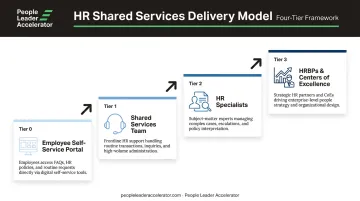
Each tier exists to protect the capacity of the one above it. When Tier 0 and Tier 1 handle the volume, HRBPs and specialists stay focused on work that actually requires their expertise.
Who Benefits Most from HR Shared Services?
Not every organization needs a shared services model. The ones that benefit most share a recognizable profile:
- 500+ employees with enough HR volume to justify centralization
- Multiple departments or locations where HR effort is being duplicated across business units
- High-growth organizations scaling faster than their HR headcount can keep pace with
- Companies managing both volume and strategy simultaneously—where HR is expected to advise on talent while also processing hundreds of routine requests each month
That last scenario is where shared services becomes a structural necessity, not just an efficiency preference. When HR is simultaneously fielding leave requests and being asked to advise on a workforce restructuring, the function can't do both well without a deliberate structure. Shared services is that structure—it decides which work gets centralized so strategic capacity isn't crowded out by transactional volume.
5 Essentials for an Effective HR Shared Services Model
Essential 1: Clarify Scope and Service Boundaries
Scope ambiguity is where shared services models go wrong most often. Without clear boundaries, the shared services team becomes a catch-all—and catch-alls don't do anything particularly well.
The core decision: What belongs in shared services, and what doesn't?
A practical framework:
- Centralize tasks that are high-volume, rule-based, and standardized—payroll inquiries, benefits administration, onboarding coordination, employee data changes, leave requests, compliance reporting, document generation
- Keep distributed tasks that require judgment, relationship context, or legal complexity—employee relations issues, performance conversations, sensitive terminations
Scope isn't static. As the model matures, organizations often expand shared services to include recruiting coordination, people analytics support, and L&D administration. Start narrow, deliver well, then expand.
Essential 2: Build a Tiered Delivery Structure
The tiered model isn't just an org chart—it's a routing logic that keeps requests from flowing to the wrong level.
Tier 0 is worth the most attention. When the self-service layer is well-designed—clear, current, easy to navigate—a significant portion of HR inquiries never require human handling. When it's poorly designed, employees bypass it entirely and flood Tier 1 with requests that should have been self-served.
The strategic payoff compounds at Tier 3: every inquiry resolved at Tier 0 or 1 is one fewer interruption to an HR business partner who should be focused on workforce planning, leadership development, or organizational design.
Build the tiers in sequence. Tier 0 first—a robust knowledge base and self-service portal. Then Tier 1 processes. Escalation protocols to Tier 2. And explicit guardrails around what reaches Tier 3.
Essential 3: Use Technology and Automation Strategically
The right technology stack determines whether your tiered model handles volume efficiently or collapses under it. Key capabilities:
- Workflow automation — routes tickets, triggers onboarding tasks, tracks SLA compliance without manual oversight
- Self-service portals — give employees 24/7 access to answers, forms, and status updates
- AI-powered tools — handle common Tier 0/1 queries without human intervention
On AI: Gartner found that 38% of HR leaders were piloting, planning, or had implemented GenAI in early 2024, up from 19% just eight months prior. Among those exploring use cases, 43% prioritized employee-facing HR service-delivery chatbots—precisely the Tier 0/1 applications most relevant to shared services.
One critical caution: technology doesn't fix broken processes. Automating a poorly designed workflow doesn't solve the problem—it produces errors faster. Process design must precede tool selection, not follow it.
Essential 4: Establish Governance, SLAs, and Accountability Metrics
Governance is what keeps a shared services model from slowly drifting back toward chaos.
Core governance elements:
- Defined SLAs for each request type (standard vs. urgent vs. complex)
- Clear escalation protocols with documented ownership at each tier
- A service catalog that someone owns, maintains, and updates
- A review cadence for continuous improvement
Key metrics to track:
| Metric | Why It Matters |
|---|---|
| First-contact resolution rate | Measures how often requests are resolved without escalation |
| Average resolution time | Tracks efficiency and identifies bottlenecks |
| SLA compliance rate | Reveals whether commitments are being met |
| Tier 0 deflection rate | Shows how effectively self-service is working |
| Cost per HR transaction | Enables ROI analysis over time |
| Employee satisfaction scores | Captures the experience on the receiving end |
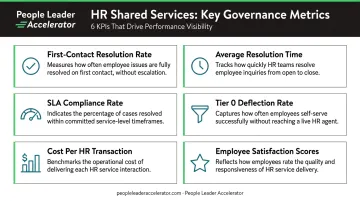
These metrics only drive improvement when reviewed on a structured cadence—monthly for operational metrics, quarterly for trend analysis. Schedule the review before you launch the model, not after problems surface.
Essential 5: Lead the Change with Strategic Intent
The most common reason HR shared services models underperform has nothing to do with technology or process design. It's change management—and the absence of it.
The resistance is predictable:
- Employees accustomed to direct HR access resist the new model
- HR staff may feel like they're being deprioritized or replaced
- Managers find workarounds that bypass the system entirely
These aren't technical problems. They're leadership problems.
Effective change leadership in this context looks like:
- Lock in executive sponsorship before launch—visible leadership commitment neutralizes most early resistance
- Explain the rationale to employees and managers directly: what changes, why it's better, and what stays the same
- Run a scoped pilot before full rollout so real friction surfaces at manageable scale
- Build a feedback loop with a named owner who is empowered to act on what it surfaces
This kind of organizational complexity is where HR leaders either demonstrate strategic value or get stuck in execution. Andrew Bartlow, co-author of Scaling for Success: People Priorities for High Growth Organizations and Core Faculty at People Leader Accelerator, has spent 25 years working through transformations like this one. PLA's programs give HR professionals the frameworks and leadership depth to drive these changes—not just implement them.
Common Pitfalls That Undermine HR Shared Services
Even well-intentioned implementations fail. The most common failure modes:
Trying to centralize everything at once. Migrating all HR processes into shared services simultaneously leads to implementation collapse and a loss of organizational trust that takes years to rebuild. Start with a defined set of high-volume, standardized processes. Prove the model. Then expand.
Under-investing in Tier 0. If the self-service layer is hard to find, out of date, or poorly organized, employees ignore it. All those requests flow straight to Tier 1 instead, creating exactly the volume problem the model was designed to prevent. Tier 0 is not a one-time build; it requires ongoing maintenance.
Ignoring the cultural shift. HR staff must reorient from doing to enabling. Employees must adapt to a new service model. Neither shift happens automatically. Without deliberate attention to the people side of this transition, implementations stall, generate internal friction, or collapse entirely when leadership changes.
Frequently Asked Questions
What is the difference between HR and HR shared services?
HR as a function covers all people-related activities across the organization. HR shared services is a specific delivery model within HR that centralizes transactional and administrative tasks into one team, freeing the rest of HR to focus on strategic and relationship-intensive work.
What are the most common HR shared services tasks?
Typical tasks include payroll inquiries, benefits administration, onboarding coordination, employee data changes, leave requests, document requests, compliance reporting, and HR help desk support—generally any high-volume, standardized process.
What skills do you need for HR shared services?
Operational skills include process management, SLA tracking, HRIS proficiency, and data accuracy. Soft skills like customer service orientation and clear communication matter equally. For those leading the function, change management and strategic thinking round out the core competencies.
Is HR shared services the same as outsourcing?
No. HR shared services is an internal model where the organization retains full ownership of HR delivery. Outsourcing transfers those processes to an external provider. Hybrid models that combine both do exist, but the structures and accountability frameworks are distinct.
What is the tiered model in HR shared services?
Most models use four tiers:
- Tier 0: Employee self-service portal
- Tier 1: Shared services team handling routine requests
- Tier 2: HR specialists for complex or escalated cases
- Tier 3: Strategic HR (HRBPs and Centers of Excellence) for workforce planning and leadership support
How do you measure the success of an HR shared services model?
Key metrics include first-contact resolution rate, SLA compliance, average resolution time, Tier 0 deflection rate, cost per HR transaction, and employee satisfaction. These metrics only matter when reviewed regularly and tied to concrete follow-through.