Introduction
HR leaders face a real tension: the expectation to function as strategic business partners while simultaneously managing an expanding pile of tools, compliance requirements, and people processes. HR technology sits right at the center of that tension — it can either amplify your capacity or consume it, depending on how thoughtfully you approach it.
The stakes are significant. Grand View Research valued the global HR software market at $16.4 billion in 2023, with a projected 12.2% CAGR through 2030. Yet according to Gartner, only 24% of HR functions are actually maximizing the business value of their HR technology. That gap — between investment and impact — is what this guide addresses.
What follows is a practical breakdown of what HR technology is, how its major categories work, how to evaluate and choose the right stack, and what's shaping its future. The goal is better decisions — about the tools you already have and the ones you're considering.
Key Takeaways
- HR technology spans a broad spectrum, from core payroll systems to AI-powered workforce planning tools
- HRIS, HRMS, and HCM describe different capability levels, not interchangeable systems
- Only 24% of HR functions maximize their tech's business value — implementation and adoption matter as much as selection
- A coherent, integrated stack consistently outperforms a larger, disconnected one
- Analytics remains the most underdeveloped capability area — and one of the highest-opportunity gaps covered in this guide
What Is HR Technology? Definition, Scope, and Key Terms
HR technology is the umbrella term for all digital tools — software, platforms, and applications — that support HR work across the employee lifecycle, from recruiting through offboarding. Without it, HR teams spend their time on manual processes. Deployed well, it frees them to focus on work that actually moves the organization forward.
HRIS vs. HRMS vs. HCM: Clearing Up the Confusion
Three terms dominate HR tech conversations, and they're frequently used interchangeably — which creates real confusion when evaluating vendors:
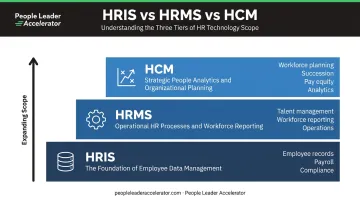
- HRIS (Human Resource Information System): The foundational layer. Focuses on core employee data, records management, payroll, and basic compliance.
- HRMS (Human Resource Management System): Expands the HRIS foundation to include talent management, workforce reporting, and broader operational processes.
- HCM (Human Capital Management): The broadest category — covering the full workforce lifecycle including analytics, succession planning, pay equity, and engagement.
Think of it as three tiers: HRIS handles the data foundation, HRMS adds operational management, and HCM extends into strategic workforce planning. In practice, most modern platforms blur these distinctions. As both Oracle and ADP note, vendors apply these labels inconsistently. The more productive question is what problems you need the platform to solve, not what the vendor calls it.
How HR Technology Evolved
The field didn't start as a strategic function. A brief timeline:
| Era | What Defined It |
|---|---|
| 1970s–1980s | Payroll-focused systems built on ERP architectures; PeopleSoft emerged with job architecture and records management |
| 2000s–2010s | Cloud-based platforms expanded capabilities; HCM terminology gained prominence |
| 2020s | AI integration, skills intelligence, and predictive analytics entered mainstream HR workflows |
The trajectory has been consistent: from administrative automation toward predictive, strategic capability. That shift is still underway, and most organizations are somewhere in the middle of it.
HR Tech vs. an HR Tech Stack
One distinction worth making: "HR technology" refers to the category broadly, while an "HR tech stack" is the specific combination of tools your organization uses together. According to HR.com's 2025 survey, 62% of organizations use 2–4 paid solutions from different providers, while only 15% rely on a single platform. Building a coherent, well-integrated stack is often more consequential than any individual tool decision.
Key Categories of HR Technology
HR tech can be organized by function across the employee lifecycle. Some organizations use an all-in-one HCM platform; others take a best-of-breed approach with specialized tools connected through integrations. Neither is universally superior — the right architecture depends on your size, complexity, and the maturity of your existing processes.
Core HR and Workforce Administration
This is the foundational layer: HRIS or HCM platforms that store employee records, process payroll, manage benefits administration, track time and attendance, and maintain compliance documentation. It's typically the "system of record" — the anchor that every other tool in your stack connects to.
If this layer is unreliable or poorly structured, everything built on top of it becomes suspect. Getting core HR right is the prerequisite for everything else.
Talent Acquisition and Management
This category covers two distinct but connected functions:
- Recruiting tools (ATS): Applicant tracking, job posting distribution, candidate screening, and interview coordination
- Talent management tools: Performance management, goal-setting frameworks, succession planning, and internal mobility programs
The most effective organizations connect these — using hiring data to inform development paths and using performance data to refine hiring criteria. When they operate in silos, you lose the full picture over time of how talent moves through the organization.
Employee Experience, Engagement, and Learning
This category has expanded significantly and now includes:
- Engagement and feedback platforms: Pulse surveys, recognition tools, and always-on listening capabilities
- Learning management systems (LMS): Delivering personalized training, tracking development completion, and increasingly using AI to recommend content
- Self-service portals give employees direct access to their own information, cutting the volume of routine HR requests
AI-driven personalization is most visible here — tailoring learning paths and recognition experiences to individual employees rather than pushing uniform content to everyone.
People Analytics and Reporting
People analytics tools function as a cross-cutting layer that aggregates data from other systems to:
- Surface workforce trends and flag emerging risks
- Identify turnover risk before it becomes attrition
- Map skills gaps against strategic priorities
- Benchmark compensation against market data
This is where HR moves from reporting what happened to predicting what's coming.
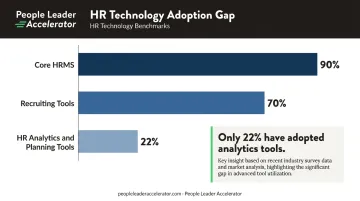
Despite its strategic value, analytics remains the most underdeveloped area in most organizations. Sapient Insights' survey of over 3,300 organizations found only 22% have adopted HR analytics and planning tools — compared to 90% for core HRMS and 70% for recruiting.
Closing that gap requires more than purchasing analytics software — it requires the skill to interpret outputs and act on them. PLA's People Analytics – Full Guide is built for exactly that: helping HR leaders move from tracking metrics to making decisions that influence the business.
What HR Technology Actually Does: Core Benefits for Strategic HR Leaders
The practical case for HR technology rests on four distinct value drivers.
Freeing Capacity Through Automation
The McKinsey HR Monitor 2025, based on nearly 2,000 companies, found that HR professionals estimate roughly one-third of HR tasks could be automated through GenAI. High-performing organizations in that benchmark reduced HR staffing ratios from approximately 1 per 70 employees to 1 per 200 — not through software alone, but through a combination of automation and process redesign.
The implication: automation's real value isn't headcount reduction. It's redirecting human judgment toward work that requires it.
Enabling Better Decisions
Centralized workforce data, real-time reporting, and predictive analytics fundamentally change what HR can contribute to business conversations. Instead of answering "what happened last quarter," HR leaders can now act earlier:
Centralized workforce data, real-time reporting, and predictive analytics fundamentally change what HR can contribute to business conversations. Instead of answering "what happened last quarter," HR leaders can act earlier:
- Surface turnover risk before people resign
- Identify skills gaps before they block a product launch
- Forecast hiring demand before it becomes urgent
- Bring workforce data into strategic planning conversations in real time
This shift from reactive to proactive defines strategic HR partnering. It's only possible when the underlying data is accurate, integrated, and accessible.
Improving the Employee Experience
HR technology directly affects how employees experience the organization day-to-day:
- Self-service tools reduce friction around routine requests (pay stubs, benefits changes, time-off approvals)
- Onboarding software creates structure during a high-stakes period for new hire retention
- Recognition platforms build connection in distributed or hybrid environments
SHRM's research found organizations using advanced HR technologies reported 20% better employee satisfaction and 21% higher productivity compared to those without. The relationship is correlational, though consistent across multiple studies.
Reducing Compliance and Security Risk
HR systems hold some of the most sensitive data in any organization: compensation, identity documents, health information, and performance records. IBM's 2024 Cost of a Data Breach report put the average enterprise breach cost at $4.88 million — a figure that establishes the financial exposure surrounding systems with poor access controls or inadequate security design.
Built-in compliance features, automated regulatory updates, audit trails, and role-based access controls aren't just IT requirements. For HR leaders at high-growth companies managing rapid headcount expansion, they're operational safeguards against material legal and financial risk.
How to Evaluate and Choose the Right HR Tech Stack
The most common mistake in HR tech selection is starting with vendor demos instead of internal diagnosis. Start with your own processes — then bring in the market.
Start With Your Processes, Not the Market
Before evaluating any tool, audit current HR workflows to identify:
- Where manual workarounds have become routine
- Where data lives in disconnected systems
- Where reporting requests take too long or produce inconsistent results
- What specific outcomes you need to change (time-to-hire, onboarding completion rates, attrition, manager effectiveness scores)
PLA's "Demystifying the HR Tech Stack" workshop, featuring Shelby Wolpa of Wolpa Consulting, is built around exactly this principle: selecting what solves your specific problem rather than chasing vendor hype or market trends.
Evaluate Vendors Against the Right Criteria
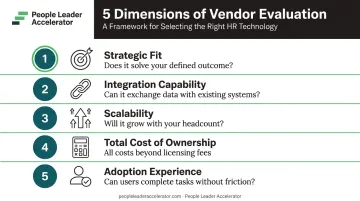
Once you've defined what you need, assess vendors across five dimensions:
- Strategic fit — Does this address the specific business or workforce outcome you defined?
- Integration capability — Can it exchange accurate data with your existing systems? (HR.com found missing integrations were the leading barrier for 46% of organizations)
- Scalability — Will it handle your headcount, geography, and workflow complexity as you grow?
- Total cost of ownership — Include implementation, integration work, internal staffing, training, and ongoing support — not just licensing fees
- Adoption experience — Can employees and managers complete priority tasks without friction?
Involve IT, finance, and actual end-users in the evaluation. Stress-test integration claims with real data before signing a contract.
Treat Implementation as Change Management
A technical rollout that ignores adoption will underperform. Sapient Insights found organizations using adaptive change management were 2x more likely to exceed implementation expectations.
A practical implementation sequence for most growing organizations:
- Core HR and payroll foundation first
- Recruiting and onboarding layer second
- Performance management and engagement tools third
- Analytics and advanced capabilities last
Each phase should include training, a feedback loop, and clear adoption metrics before moving to the next.
Common Challenges When Implementing HR Technology
Most HR tech implementations that underperform share the same root causes. Three show up repeatedly.
Low User Adoption
The technology works; nobody uses it properly. This is the most common failure mode, and it almost always traces back to insufficient change management — not technical defects. Employees adopt new systems when they experience less friction, not more. Involving end-users in the selection process and running pilots before full deployment reduces resistance significantly.
Data Quality Problems
Even well-designed analytics platforms produce unreliable outputs when the underlying data is incomplete, inconsistent, or siloed. 32% of HR.com respondents reported difficulty extracting accurate data from their existing systems.
Data cleanup has to happen before migration, not after. Clean and standardize records first, then establish clear data governance ownership before going live. Assigning a named data owner to each critical dataset is a structural fix, not a technical one.
Over-Tooling and Integration Risk
Sapient Insights' research found organizations averaging 16.24 HR solutions — a number that signals accumulation rather than architecture. Each additional disconnected tool creates new integration risks, reporting inconsistencies, and maintenance overhead.
That tool sprawl becomes a more serious problem as AI embeds into those workflows — because each AI-assisted system introduces its own compliance exposure:
- Bias risk: The EEOC has clarified that federal employment-discrimination law applies when automated systems influence hiring decisions. Biased training data can create unlawful disparate impact.
- Regulatory exposure: The EU AI Act classifies AI used for recruitment and worker management as high-risk, requiring documentation, human oversight, and audit trails.
These aren't edge cases — they're active regulatory considerations for any organization using AI-assisted screening or performance tools.
HR Technology Trends Shaping the Future of Work
AI's Deepening Role
Gartner's January 2024 survey of 179 HR leaders found 38% were piloting, planning, or had implemented GenAI — up from 19% just six months earlier. Current applications include:
- Resume screening and candidate shortlisting
- HR service chatbots for employee self-service
- Personalized learning recommendations
- Predictive attrition models
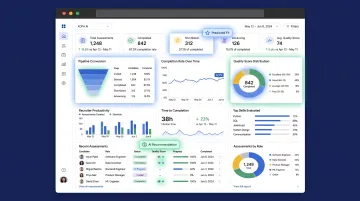
Not all AI use cases carry the same risk. AI as an automation tool handles routine tasks with minimal judgment required. AI as a decision-support tool surfaces insights that inform hiring, promotions, or workforce planning — and that requires human oversight and governance. Deploying AI without a defined problem to solve is a fast path to the tool proliferation and redundancy that burdens many HR teams.
The Shift to Skills-Based Talent Management
Workday's research of 2,300 business leaders found 55% of organizations had begun moving toward skills-based talent models. Platforms are increasingly organizing talent data around skills rather than job titles — enabling more precise internal mobility, succession planning, and targeted upskilling.
Moving to skills-based models changes what HR technology must track and surface. Skills data is more dynamic and harder to maintain than job titles, so governance requirements grow alongside the strategic value — a tradeoff HR leaders need to plan for before implementation.
Continuous Employee Listening
Always-on feedback tools, sentiment analysis of open-text survey responses, and well-being technology now give HR leaders near real-time visibility into workforce health. Qualtrics research found 77% of employees wanted to provide feedback more frequently than existing processes allowed.
That demand moves engagement from an annual survey to an ongoing conversation. The tradeoff: continuous listening raises real privacy and trust questions. Employees share candidly only when they believe responses are confidential and that leadership will act on what they hear.
Frequently Asked Questions
What is HR technology (HR tech) and what does it do?
HR technology is the broad category of software and digital tools used to automate, streamline, and support HR functions across the employee lifecycle — from recruiting and payroll to performance management, engagement, and workforce analytics. It helps HR teams operate more efficiently and make better-informed workforce decisions.
What is the difference between HRIS, HRMS, and HCM?
HRIS manages core employee data and administrative functions. HRMS expands that to include payroll processing, talent management, and workforce reporting. HCM is the most comprehensive level, covering the full hire-to-retire lifecycle including succession planning, pay equity analysis, and strategic people analytics.
What types of HR technology do growing companies need most?
Start with a solid core HR and payroll platform (HRIS), then add recruiting and onboarding tools as headcount grows. Build toward engagement platforms and people analytics as the organization scales, prioritizing integration capability and scalability over feature count. A smaller, connected stack consistently outperforms a larger, disconnected one.
How do HR leaders know when it's time to upgrade their HR tech stack?
Key signals include manual workarounds becoming a daily routine, workforce data living in disconnected systems, inability to generate reliable workforce reports, and headcount or geographic growth that existing tools can't support without significant manual intervention.
What are the biggest challenges when implementing HR technology?
The three most common pitfalls are poor change management leading to low adoption, data quality issues that undermine analytics outputs, and integration failures between new and legacy systems. Addressing all three requires sustained investment before, during, and after rollout — not only at launch.
How is AI changing HR technology?
AI is being embedded across recruiting, HR service delivery, learning, and workforce analytics — handling tasks from automated candidate screening to predictive turnover modeling. Effective use requires governance frameworks that address bias risk, regulatory compliance, and human oversight of AI-generated recommendations.