
That gap is costly. Gallup estimates that 42% of voluntary turnover is preventable, and much of that attrition traces back to factors HR leaders can directly influence — if they know where to look.
This article covers the core principles of HR psychology, how they connect to talent management strategy and workplace behavior, and how people leaders can build these capabilities in practice.
Key Takeaways
- HR psychology applies industrial-organizational science to workplace decisions — making hiring, development, and culture design more evidence-based
- Motivation, psychological safety, and reinforcement theory give HR leaders the most direct leverage over day-to-day team behavior
- Structured selection methods consistently outperform gut-feel hiring — validity scores for structured interviews are significantly higher
- Cognitive biases distort talent decisions at every stage — hiring, performance reviews, and succession planning
- Building HR psychology skills requires deliberate, structured development — not just accumulated experience
What Is HR Psychology?
HR psychology is the application of psychological science to workplace settings — specifically through the lens of industrial-organizational (I/O) psychology. APA Division 14 defines it as the scientist-practitioner application of psychology to individual, group, and organizational questions at work, covering selection, development, motivation, and organizational systems.
From Military Testing to People Strategy
The field has always been driven by practical workplace problems. Key milestones:
- Early 1900s: Hugo Munsterberg and Walter Dill Scott apply psychological principles to employee selection
- WWI: Robert Yerkes leads development of the Army Alpha and Beta tests — the first large-scale psychological assessments for personnel decisions
- Post-WWII: The field expands as organizations formalize HR functions and workforce research grows
- 1960s–70s: Title VII drives rigorous validation requirements for selection practices, linking legal compliance to psychological science
- 2000s–present: The discipline broadens to cover organizational design, culture, people analytics, and leadership development
HR Psychology vs. General Psychology
The distinction matters for practitioners:
- General psychology studies the human mind broadly — cognition, emotion, perception, development
- HR psychology focuses specifically on behavior within work contexts — motivation, team dynamics, leadership effectiveness, and performance
For people leaders, that focus translates directly into validated tools: structured interviews, engagement diagnostics, performance frameworks, and team effectiveness models that can be measured and improved.
Key Psychological Principles Every HR Leader Should Know
Motivation Theory
Three frameworks are most practically relevant to HR design:
- Maslow's Hierarchy — useful as a diagnostic prompt for understanding where employees' needs sit, but not a rigid sequence employees follow in fixed order
- Herzberg's Two-Factor Theory — distinguishes hygiene factors (pay, conditions) that prevent dissatisfaction from motivators (achievement, recognition) that actually drive engagement; the implication is that improving compensation alone won't create durable motivation
- Self-Determination Theory (SDT) — the strongest current evidence base for workplace motivation, built on three core psychological needs: autonomy, competence, and relatedness. A 2026 meta-analysis covering 192 studies and 93,552 participants found consistent workplace support for SDT's framework
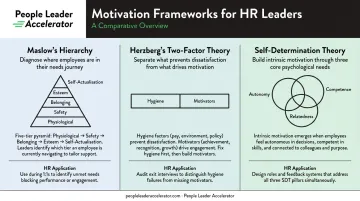
For HR leaders designing incentive structures or career development paths, SDT offers the most actionable foundation: people perform best when they have meaningful control, opportunities to grow, and genuine connection to their team.
Psychological Safety
Amy Edmondson's foundational research on 51 manufacturing teams found that psychological safety (the belief that speaking up, admitting mistakes, and taking risks won't result in punishment) enabled learning behavior, which in turn drove team performance. Google's Project Aristotle, studying 180 teams, ranked psychological safety first among five key team dynamics.
The mechanism matters here. Psychological safety isn't about comfort or eliminating accountability — it's about interpersonal risk-taking that enables teams to learn faster. HR leaders should treat it as a measurable organizational health metric, not a soft culture aspiration.
Reinforcement Theory and Performance Management
A meta-analysis of 19 organizational behavior-modification studies across 2,818 participants found an average performance improvement of approximately 17% from specific, contingent reinforcement. The mechanism is straightforward: the timing, consistency, and type of feedback shape future behavior.
This has direct implications for performance management design. Inconsistent feedback (praise that's delayed, generic, or disconnected from specific behavior) fails to reinforce the right actions. Well-intentioned performance systems undermine themselves when managers apply them inconsistently.
Understanding behavioral reinforcement is only part of the picture. How leaders read and respond to emotional dynamics shapes whether those systems land at all.
Emotional Intelligence
EQ is frequently cited in leadership development, but the evidence is more conditional than the hype suggests. A meta-analysis by Joseph and Newman found job-performance validity estimates ranging from .18 to .47 depending on how EQ was measured. The four relevant domains for HR leaders:
- Self-awareness
- Self-management
- Social awareness
- Relationship management
EQ is most predictive in roles with high emotional labor demands. How it's measured determines how useful it actually is, so treat it as a role-specific tool rather than a universal leadership requirement.
How HR Psychology Drives Talent Management Strategy
Structured Selection Reduces Noise
Schmidt and Hunter's classic synthesis reported validity estimates of .51 for structured interviews vs. .38 for unstructured. Even after Sackett et al.'s 2022 correction reduced the structured estimate to approximately .42, U.S. OPM guidance still confirms that greater structure improves validity, rater reliability, and consistency.
Structured selection is both an equity measure and a scientifically validated method for improving decision quality. The practical implication: standardize questions, use anchored scoring, and keep raters independent.
Person-Environment Fit and Early Attrition
Kristof-Brown et al.'s 2005 meta-analysis identified four distinct forms of fit that predict different outcomes:
| Fit Type | Key Outcomes |
|---|---|
| Person-Job | Task performance, job satisfaction |
| Person-Organization | Organizational commitment, lower quit intentions |
| Person-Group | Team cohesion, collaboration quality |
| Person-Supervisor | Relationship quality, engagement |
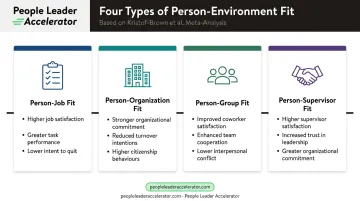
The practical takeaway: "culture fit" is too vague to be useful. Define fit against specific job demands, team composition, or organizational values — then assess it deliberately, not through informal impression.
Retention Is Rooted in Psychology
Gallup's estimate that 42% of voluntary turnover is preventable points directly to manager behavior and development dialogue as the primary intervention levers. Psychological research identifies four consistent drivers of whether an employee stays or leaves:
- Meaningful work — connection to purpose and impact
- Manager relationship quality — trust, fairness, and growth support
- Growth opportunities — perceived career trajectory
- Autonomy — control over how work gets done
Generic engagement surveys rarely surface which of these drivers is failing for a specific employee. HR leaders who understand the psychology behind each driver can target interventions precisely — adjusting role design, manager coaching, or recognition before an employee starts looking elsewhere.
Adult Learning Principles and L&D That Actually Works
Blume et al.'s meta-analysis of 89 training-transfer studies identifies the predictors that separate programs producing real behavior change from box-checking programs:
- Spaced practice across sessions (not one-time events)
- Variable examples and contextual application
- Coaching and developmental feedback
- Opportunity to apply learning immediately in role
- Supportive work environment that enables transfer
These aren't abstract findings — they're a design checklist. People Leader Accelerator's programs are built against them directly, combining spaced weekly engagement, peer cohort learning, and 1:1 mentoring from faculty with 25–30 years of practitioner experience. The measure of success is observable transfer to real organizational challenges, not course completion rates.
Applying Psychological Insights to Workplace Behavior
Diagnosing Underperformance
Before intervening, HR leaders need to distinguish between three different root causes — each requiring a different response:
- Ability gap — lacks the knowledge or skill; solution is development or role redesign
- Motivation gap — has the capability but not the willingness; solution involves understanding the psychological drivers (or barriers) to engagement
- Situational barrier — structural or managerial obstacles are in the way; solution is environmental, not individual
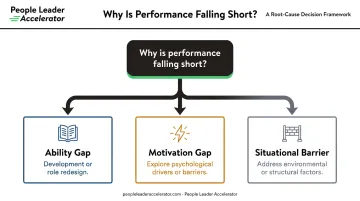
Most performance conversations skip this diagnostic step. The result is development interventions applied to motivation problems, or motivation conversations held with people facing structural barriers.
Conflict Resolution and Attribution Theory
When people explain their own behavior, they tend to cite situational factors — pressure, unclear expectations, limited resources. When they explain others' behavior, they default to dispositional explanations — they're difficult, unmotivated, or careless. This asymmetry is attribution bias, and it distorts conflict mediation.
HR leaders who understand this pattern can surface hidden assumptions more effectively, reframing disputes around shared situational factors rather than fixed character judgments.
The Psychology of Organizational Change
A 60-year review of quantitative research on change recipients by Oreg, Vakola, and Armenakis identifies three psychological factors that determine how people respond to organizational change:
- Loss aversion — the perceived threat of losing something familiar
- Status quo bias — the default preference for current conditions
- Individual readiness — shaped by perceived benefit and trust in leadership
Prosci's ADKAR model translates these insights into a practical sequence: Awareness → Desire → Knowledge → Ability → Reinforcement. HR leaders who treat change management as a communication project often skip the harder work: addressing loss aversion and rebuilding trust before the announcement lands.
Culture as Reinforced Behavior
Culture isn't values posted on a wall. Hartnell et al.'s meta-analysis confirms that different culture types relate differently to employee attitudes, innovation, quality, and financial outcomes — there's no single "strong culture" that optimizes everything.
More usefully: culture is the sum of reinforced behaviors — what gets rewarded, modeled, and tolerated. HR leaders can deliberately shape culture by identifying the specific behavioral norms that drive the outcomes they want, then building reinforcement systems around them. People Leader Accelerator's Designing Organizational Culture guide provides a structured framework for exactly this kind of design work.
Together, these four lenses — diagnosing performance gaps, resolving attribution distortions, navigating change psychology, and reinforcing cultural norms — give HR leaders a more precise toolkit for working with human behavior rather than around it.
How Cognitive Biases Affect HR Decision-Making
The Three Biases That Distort Talent Decisions Most
- Affinity bias: Favoring candidates who remind us of ourselves, this shows up in interview scoring, team building, and promotions. Research confirms a consistent relationship between rater liking and performance ratings.
- Confirmation bias: Early impressions shape how interviewers probe and interpret responses throughout a conversation — making this one of the most persistent distortions in hiring.
- Halo/horn effects: One strong or weak characteristic colors the entire evaluation, a well-documented distortion that reduces rating accuracy across every appraisal dimension.
Practical Debiasing Strategies
Knowing the biases is step one. The harder question is what actually works to correct them — and the research gives some pointed answers.
| Intervention | What It Addresses | Important Caveat |
|---|---|---|
| Structured scorecards | Reduces variance, improves validity | Requires job analysis and trained raters |
| Calibration meetings | Increases accountability, shared standards | Changed ratings don't automatically mean more accurate ratings |
| Diverse hiring panels | Surfaces different perspectives | No verified evidence that diversity alone improves predictive validity |
| Anonymous resumes | Removes name-based bias | A French randomized trial found unintended negative effects for minority candidates |
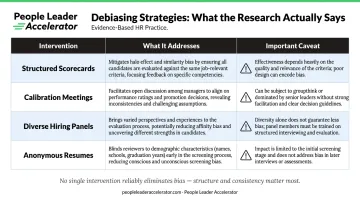
The consistent finding: no single intervention reliably eliminates bias. Structure and independent evidence collection outperform any one-off fix. That means building systematic checks into hiring, performance reviews, and succession planning — treating debiasing as an ongoing process, not a program rollout.
Building Your HR Psychology Skills as a People Leader
The skill areas where HR leaders gain the most from structured development:
- Behavioral interviewing and assessment literacy — understanding how to design and score structured interviews, interpret 360 data, and calibrate talent conversations
- Facilitation skills — creating conditions for psychologically safe dialogue in performance reviews, team diagnostics, and change conversations
- Coaching frameworks — applying adult development principles to grow people, not just evaluate them
- People analytics interpretation — reading engagement and performance data as behavioral signals, not just operational metrics
The SHRM BASK framework identifies analytical aptitude, consultation, and relationship management as core HR behavioral competencies — all of which are grounded in psychological science.
Recognizing those competencies is the starting point. Developing them reliably is harder. On-the-job experience builds familiarity, but it doesn't always produce accurate mental models. When the stakes are high — a mis-hire, a failed change initiative, a culture problem that's already embedded — trial and error is costly. Structured programs that combine evidence-based frameworks with real-world application close that gap faster.
People Leader Accelerator offers practitioner-led programs built around this combination. Faculty bring decades of hands-on HR leadership experience from high-growth organizations, paired with research-grounded instruction from Brad Harris, Ph.D., Associate Dean at HEC Paris. The curriculum applies directly to talent assessment, culture design, and organizational development challenges HR leaders face today.
Frequently Asked Questions
What is HR in psychology?
In psychology, HR refers to the application of psychological science — particularly industrial-organizational (I/O) psychology — to workplace settings. It focuses on understanding and improving human behavior, performance, motivation, and organizational effectiveness through evidence-based methods rather than clinical practice.
Can a psychologist become HR?
Yes. Psychologists with I/O backgrounds transition into HR roles effectively, as their training in human behavior, assessment, motivation, and organizational dynamics translates directly to talent management, culture design, and people strategy functions.
What psychological theories are most relevant to HR and talent management?
The most directly applicable frameworks are Self-Determination Theory (autonomy, competence, relatedness), psychological safety, behavioral reinforcement theory, and emotional intelligence. Each provides concrete mechanisms HR leaders can use to design systems, interventions, and development programs.
How does industrial-organizational psychology differ from general HR practice?
I/O psychology is the research-based science of human behavior at work; HR practice is the operational application of that knowledge. The most effective HR leaders draw on I/O psychology to ground their people decisions in evidence rather than intuition.
How can HR leaders use psychological principles to improve employee retention?
By identifying the psychological drivers of engagement — autonomy, growth, purpose, and manager relationship quality — HR leaders can design roles and management practices that address root causes of attrition rather than reacting after employees have already disengaged.
What skills from psychology make the most impactful HR leaders?
The highest-impact HR leaders tend to combine emotional intelligence, behavioral assessment literacy, and conflict resolution grounded in attribution theory. Knowing how to apply adult learning principles to leadership development rounds out that skill set.