Introduction
HR leaders at scaling organizations face a familiar bind: they're expected to operate strategically while buried in manual work that disconnected tools create. An ATS that doesn't talk to onboarding software. A time-tracking system that payroll can't read. Compensation data living in three separate spreadsheets. Every gap means someone on the HR team is reconciling records by hand instead of doing work that matters.
The decisions you make about your HR tech stack at 50 employees will shape — and sometimes constrain — what's possible at 500. This guide covers:
- What an HR tech stack actually is and why the definition matters
- Which components belong in a mature, integrated stack
- How to build or evaluate one that scales with your organization
Key Takeaways
- An HR tech stack functions as an integrated ecosystem where each layer depends on the one beneath it
- Core HR and payroll form the foundation — get this layer right before building upward
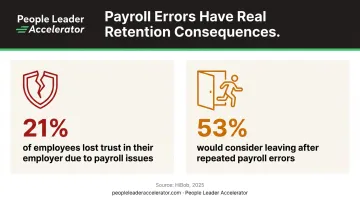
- 53% of employees say repeated payroll errors would make them consider leaving (HiBob, 2025)
- Platform vs. best-of-breed is a strategic judgment call — not a features conversation
- Integration depth matters more than feature lists when evaluating vendors
What Is an HR Tech Stack?
An HR tech stack is the integrated suite of software tools an organization uses to manage the full employee lifecycle — from recruiting and onboarding through performance, compensation, and offboarding. "Stack" is the right word: these tools are meant to work together, not operate in isolation.
HRIS, HRMS, and HCM: What's the Difference?
Practitioners use these terms interchangeably, but the distinction matters when you're evaluating or building a stack:
| Term | What It Does |
|---|---|
| HRIS | Stores and manages core employee data: records, policies, org structure, employment history |
| HRMS | Adds process management capabilities on top of that data layer |
| HCM | The broadest category — encompasses everything from core HR through workforce planning, talent development, and analytics |
Paychex's 2024 guidance frames these as useful scope distinctions rather than formal industry standards. Most vendors blur the lines anyway. Focus on the layer of functionality you actually need, not the acronym on the vendor's homepage.
Why Stack Decisions Matter Early
A misaligned stack is far harder to unwind than to avoid. The tools you select at 50 employees set defaults (data structures, integrations, pricing commitments) that become increasingly expensive to change.
Three compounding costs make early decisions especially consequential:
- Migration complexity: moving historical data between platforms rarely goes cleanly
- Integration debt: point-to-point connections built around one system break when you swap it out
- Pricing lock-in: multi-year contracts and per-seat pricing scale against you as headcount grows
Treat stack selection as an infrastructure decision, not a software purchase.
Core Components of an HR Tech Stack
A mature stack typically spans six functional layers. Use these as categories, not vendor recommendations — map your current tools against each layer to identify what's covered, what's duplicated, and what's missing.
- Core HR / HRIS
- Talent Acquisition
- Talent Management
- Workforce Management
- Benefits and Compliance
- HR Analytics
Core HR and Payroll
Employee records, org structure, policy documentation, employment history, and payroll form the foundation. Everything else is built on top of it.
Payroll deserves specific attention. HiBob's 2025 survey of 2,000 US employees found that 21% had lost trust in their employer due to payroll issues, and 53% said repeated mistakes would make them consider leaving. Before evaluating any other layer of your stack, make sure the payroll and core HR foundation is solid.
Talent Acquisition Tools
Many organizations treat the following as one function — they aren't:
- Applicant Tracking System (ATS): Manages the candidate pipeline from job posting through offer acceptance
- Onboarding software: Bridges offer acceptance to productive employment
Organizations at higher levels of onboarding maturity are 103% more likely to report improvements in new-hire retention than less mature peers, according to Brandon Hall Group research. Despite this, onboarding remains one of the most under-resourced capabilities in growing companies. PLA's New Hire Onboarding Guide is designed specifically to help HR leaders build structured, scalable onboarding programs — even before dedicated software is in place.
Talent Management Tools
This layer covers performance management, learning management (LMS), career development, and succession planning. The best talent management stacks do one thing well: they make internal mobility visible and actionable rather than aspirational.
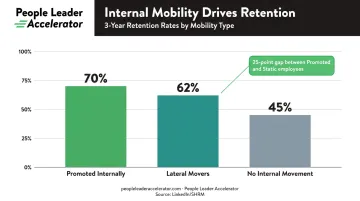
The data on this is clear. A LinkedIn analysis of 32 million active profiles found three-year retention rates of 70% among employees promoted within three years, 62% for lateral movers, and just 45% for employees with no internal movement, as reported by SHRM. A 25-point retention gap warrants dedicated investment, not a footnote in your talent strategy.
Workforce Management and Benefits
The operational and compliance layer:
- Time and attendance: Tracks hours worked; must connect directly to payroll
- Scheduling: Manages shift planning; gaps between scheduling and time-tracking create miscounted hours and underestimated labor costs — critical for hourly-heavy workforces
- Benefits administration: Reduces the manual burden of open enrollment for lean HR teams
Scheduling tools that don't integrate with time-tracking are among the most common and costly operational gaps in mid-market HR stacks.
HR Analytics
A properly embedded analytics layer does more than generate reports. It surfaces:
- Turnover trends by department and manager
- Time-to-fill by role and team
- Overtime exposure and labor cost forecasting
- Engagement patterns that predict attrition before it happens
Gartner found that 48% of HR leaders planned to increase their 2024 HR technology budget, reflecting growing recognition that workforce decisions made without data are a competitive disadvantage. Treat analytics as a stack requirement from the start, not something to layer in later.
How to Build Your HR Tech Stack
This is a sequenced process, not a shopping exercise. Define requirements before opening a single vendor deck.
Step 1: Audit Your Current State
Document every HR tool currently in use — including spreadsheets that exist because the official system didn't meet the need. For each tool, map:
- Which function it serves
- Who uses it and how often
- Where it duplicates another tool
- Where it leaves a function entirely unmet
This audit almost always surfaces more shadow IT than expected. Those spreadsheets are symptoms, not solutions.
Step 2: Define Requirements by Function and Stage
Requirements should come from the people doing the work, not just HR leadership. A 150-person manufacturing company and a 150-person SaaS company have materially different needs around scheduling, compliance, and development.
Before opening any vendor pitch deck, document what "good" looks like for each functional layer. Workforce type, industry, and growth stage all shape requirements.
Step 3: Decide on Platform vs. Best-of-Breed
This is one of the most consequential decisions in stack design:
| Approach | Strengths | Tradeoffs |
|---|---|---|
| Unified HCM Platform | Cohesion, simpler admin, native integration | May sacrifice depth in specific areas |
| Best-of-Breed | Stronger point solutions | More integration work, higher admin overhead |
For most scaling organizations under 500 employees, platform consolidation is worth the tradeoff. The integration maintenance cost of a best-of-breed stack compounds quickly as headcount grows.
Step 4: Evaluate Vendors on Real Workflows
Build a scoring rubric before engaging any vendor. Weight it by what actually matters for your organization:
- Integration capability with your existing systems
- Mobile experience for managers and employees
- Compliance coverage for your industry and geography
- Implementation support and post-launch service model
- Scalability at your anticipated future headcount
Test with actual end users — managers and employees, not just HR admins. Always run reference checks with organizations of similar size and industry. Ask specifically about implementation experience, not just the product in steady state.
Step 5: Sequence Implementation and Measure Adoption
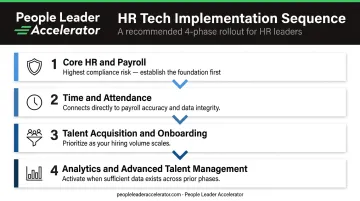
Most organizations can't switch all systems simultaneously. Follow this sequencing:
- Core HR and payroll — highest compliance and trust risk
- Time and attendance — connects directly to payroll accuracy
- Talent acquisition and onboarding — prioritize as hiring accelerates
- Analytics and advanced talent management — when sufficient data exists to act on
Define data migration responsibilities before starting. Establish clearly who cleans the data, who validates it, and who owns the record of truth when systems conflict. Measure adoption at 60 and 90 days post-launch by feature utilization, not just login rates.
Key Considerations When Evaluating HR Tech
Even tools that look strong in demos can fail in practice. These criteria serve as the filter layer.
Integration and Data Flow
HR tools that don't share data aren't a stack — they're separate systems held together by manual effort. Evaluate integration depth before evaluating features:
- Native connections: Built directly into the platform
- Open APIs: Allow custom integrations
- Middleware: Third-party connectors (adds cost and failure points)
The two most common failure points: payroll pulling hours from time-tracking, and ATS offer data feeding into onboarding records. Ask vendors specifically how these handoffs work — not just whether they exist.
Scalability and Pricing Model
Per-employee-per-month pricing that looks reasonable at 100 people can become prohibitive at 400. Understand the cost curve before signing, not after.
Ask vendors to demonstrate the platform in use at both your current headcount and your anticipated size in 18–24 months. If they can't provide reference customers at that scale, treat it as a red flag about their experience there.
Security and Data Privacy
HR systems hold some of the most sensitive data in any organization — including Social Security numbers, bank account details, medical leave records, compensation history, and performance documentation. Involve IT and legal in any evaluation that touches employee PII.
Key due-diligence questions:
- Does the vendor have a SOC 2 Type II report? (This is an examination report, not a certification — ask to see it)
- What encryption standards apply to data at rest and in transit?
- How are role-based access controls configured?
- What are the breach notification timelines?
AI and Automation Readiness
AI capabilities are expanding across resume screening, attrition prediction, compensation benchmarking, and scheduling optimization. Gartner found that 38% of HR leaders were piloting, planning, or had implemented GenAI as of early 2024 — up from 19% in mid-2023.
AI requires clean, consistent underlying data. Organizations with fragmented HR records will get unreliable outputs regardless of how sophisticated the AI layer is — data hygiene has to come before any AI investment.
Common HR Tech Stack Mistakes to Avoid
These patterns cause stacks to fail. They're rarely vendor problems; they're decision-making problems.
Buying for Features Instead of Fit
The most capable platform available is not necessarily the right one. Buying on feature depth rather than fit results in shelfware — tools that are paid for but not actually used. Employee and manager adoption rates determine ROI, not feature counts.
Before selecting any tool, answer: will the people who need to use this actually use it? If the answer is uncertain, the tool is the wrong choice.
Underestimating Change Management
Implementation failure is rarely a technology problem. It's a change management problem. HR leaders who launch new systems without investing in training, communication, and manager buy-in routinely see adoption collapse within 90 days.
Budget time and resources for change management at the same level you budget for the software itself. A well-implemented average tool will consistently outperform a poorly-adopted excellent one — the gap between the two is almost always execution, not technology.
Building in Silos
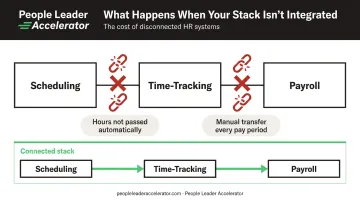
Disconnected stacks — where each HR function owns its own tool with no data flow between systems — create reconciliation work that lands back on HR. The cost of manually reconciling data between siloed systems often exceeds the cost of integration.
The payroll-time-tracking gap is the most common version of this problem. When the data chain breaks:
- Scheduling data doesn't flow into time-tracking
- Time-tracking doesn't feed payroll cleanly
- Someone manually transfers hours every pay period
The root cause isn't the process — it's how the stack was designed in the first place.
Frequently Asked Questions
What comes under HR tech?
HR tech covers tools across the full employee lifecycle: core HR and payroll, talent acquisition (ATS, onboarding), talent management (performance, LMS, career development), workforce management (scheduling, time and attendance), benefits administration, and HR analytics.
What is the difference between an HRIS, HRMS, and HCM?
An HRIS stores and manages employee data. An HRMS adds process management capabilities on top of that data. An HCM is the broadest category — encompassing everything from core HR through workforce planning, talent development, and analytics. In practice, vendors use these terms interchangeably; the main difference is scope.
What HR tools should a startup or scaling company build first?
Start with core HR and payroll — this carries the highest compliance and trust risk. Then add time and attendance, followed by talent acquisition and onboarding tools as hiring accelerates. Analytics and advanced talent management come later, when there's enough data to act on meaningfully.
How do I know when to consolidate my HR tech stack?
The clearest signals: HR teams spending significant time on manual data reconciliation, payroll errors stemming from disconnected systems, or employees needing multiple logins for basic self-service tasks. These are integration failures — and consolidation typically solves them.
How much does an HR tech stack cost?
Most platforms use per-employee-per-month (PEPM) pricing. General HR software runs roughly $15–$30 PEPM; mid-market HRIS typically falls between $18–$35 PEPM. Use these as rough starting points — actual costs depend on contract terms, modules, and headcount.
What is the role of AI in an HR tech stack?
AI is increasingly embedded across resume screening, attrition prediction, scheduling optimization, and compensation benchmarking. Its value hinges on the quality of the underlying HR data. Organizations should address data hygiene and integration gaps before expecting reliable AI outputs — the technology amplifies what's already in your data, clean or not.