
But that same hands-on approach eventually becomes a liability. Hold on too long, and the organization accumulates compliance gaps, retention problems, and strategic drift. Step back too early, and you hand off culture before it has roots.
This article covers the practical triggers, warning signs, and handoff mechanics that help CEOs get the timing right.
Key Takeaways
- CEO-led HR works in early stages but breaks down as headcount and complexity grow.
- The 15–50 employee range is typically when dedicated HR leadership becomes necessary.
- Warning signs include rising turnover, inconsistent employee treatment, and HR tasks displacing strategic priorities.
- Stepping back from HR operations means shifting from day-to-day operator to culture architect — not disengaging from people strategy.
- A structured handoff protects culture continuity while reducing legal exposure and talent risk.
Why CEO-Led HR Makes Sense Early — And Where It Breaks Down
Under 15 employees, informal HR isn't just acceptable — it works. The CEO knows everyone, makes fast people decisions, and embeds values directly through behavior. There are no bureaucratic layers between culture and execution.
What CEOs do well in this phase:
- Hire for cultural fit because they personally know what "cultural fit" means
- Resolve conflicts quickly with full context of the team dynamics
- Communicate expectations directly, without policy documents as intermediaries
- Make compensation decisions based on their own read of the business
The problem is that none of this scales.
Where the Model Starts to Break Down
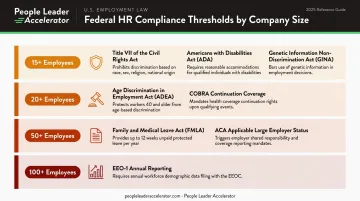
As headcount grows past 15–25 employees, compliance obligations start stacking up fast. Federal law layered in at each threshold:
- 15+ employees: Title VII, ADA, and GINA protections apply
- 20+ employees: ADEA (age discrimination) and COBRA coverage obligations begin
- 50+ employees: FMLA employer coverage and ACA applicable large employer status kick in
- 100+ employees: Annual EEO-1 reporting required
A CEO without HR expertise navigating these thresholds faces real legal and financial exposure. The DOL's Wage and Hour Division recovered more than $259 million in back wages for nearly 177,000 workers in FY2025. Compliance failures at this scale show up directly on the balance sheet.
There's also a deeper issue: CEOs often believe that delegating HR means losing control of culture. It doesn't. Stepping back from HR operations — benefits administration, policy enforcement, employee relations — is not the same as stepping away from people strategy.
The CEO's role shifts from operator to architect. In practice, that means setting the hiring bar, defining what "good culture" looks like, and holding the people function accountable — without personally running every process that supports it.
Key Triggers: When It's Time to Step Back
There's no single right moment — it's usually a combination of factors arriving at once. Four in particular tend to signal that informal HR management has run its course.
Headcount and Growth Rate
Most practitioners point to the 15–50 employee range as the window when informal HR breaks down. Hawkwood's analysis of 30 European Series A AI startups, reported by Forbes, found a median headcount of 69 at first HR hire — notably higher than the sub-50 threshold that investors previously encouraged. The gap between those two numbers is where compliance and retention risk accumulates.
Rapid growth compresses this timeline. Doubling headcount in 12 months creates the same structural pressure as being twice the size — onboarding, documentation, and people management demands surge regardless of your absolute headcount. McKinsey found that investors attribute 65% of portfolio company failures to people and organizational issues — a stark reminder that people infrastructure isn't a back-office concern.
Compliance and Legal Complexity
Every new hire adds a compliance surface area that compounds. These obligations don't stay static — they grow with the team:
- Benefits administration and open enrollment management
- Leave tracking (FMLA, state-specific leave laws, accommodations)
- Anti-harassment policy enforcement and training
- Documentation requirements for performance and terminations
A formal HR complaint or investigation is often the moment that makes the case for dedicated HR leadership. But waiting for that moment is reactive. By the time a complaint lands, the gaps that created the exposure have usually been building for months.
Cultural Scale
When the CEO can no longer personally know every employee, informal people management stops working. Cultural values that were once communicated through direct contact now need to live in systems, processes, and people leaders who can carry them forward. That's a natural transition point. The CEO's job shifts from modeling the culture to designing the infrastructure that sustains it.
CEO Time and Opportunity Cost
This is ultimately a resource allocation question. When HR tasks — employee complaints, performance conversations, benefits questions — are consuming a meaningful share of the CEO's weekly calendar, the organization is paying a real opportunity cost. Every hour spent on operational HR is an hour not spent on fundraising, customer relationships, or product decisions. At a scaling company, those tradeoffs add up fast.
Signs the CEO Is Holding On Too Long
Even when CEOs recognize the need to transition, they often delay. These are the signals that delay has gone too far.
Operational Displacement
A concrete example: a CEO in a 35-person company spends Monday morning handling a benefits enrollment question, Tuesday afternoon in an uncomfortable conversation about a manager's performance, and Wednesday resolving a compensation dispute that should have had a documented framework. By Thursday, the board deck for next week's fundraise hasn't been touched.
That's not an edge case. That's what it looks like when HR tasks have crowded out the CEO's strategic function.
Inconsistent Employee Treatment
Different managers apply rules differently. Feedback is verbal and undocumented. Compensation decisions get made ad hoc, without a clear framework. This inconsistency isn't just an HR problem — it's a legal risk and a trust problem.
Retention Signals Without Data
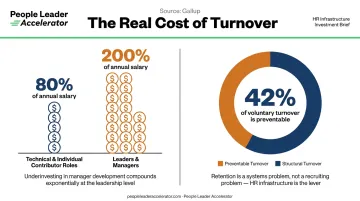
Gallup estimates that replacement costs run approximately 80% of salary for technical roles and up to 200% for leaders and managers. More striking: Gallup also found that 42% of voluntary turnover is preventable — but prevention requires the data infrastructure to recognize problems before they become departures.
Without exit interviews, engagement tracking, or structured feedback mechanisms, a CEO won't know why people are leaving until too many already have.
Compliance Gaps Operating in Silence
Undocumented HR policies, uninvestigated complaints, and ad hoc benefits handling don't generate immediate alarms. They accumulate in the background until exposure surfaces as a formal complaint, an audit, or a lawsuit — at which point remediation costs far exceed what proactive HR infrastructure would have required.
How to Hand Off HR Responsibilities the Right Way
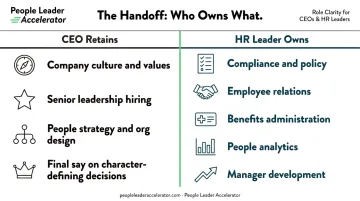
The handoff is not a clean break. There are things the CEO should always retain, and things that should transfer to a dedicated HR leader.
The CEO retains:
- Company culture and values ownership
- Senior leadership hiring
- Overall people strategy and organizational design philosophy
- Final say on anything that shapes the company's character
The HR leader owns:
- Compliance, documentation, and policy infrastructure
- Employee relations and complaint investigations
- Benefits administration and operational HR
- People analytics and HR data infrastructure
- Manager development and HR program execution
Before the Transition Happens
Before stepping back, the CEO should document the company's values, hiring principles, and people management philosophy. An incoming HR leader needs a cultural foundation to build from — not just an empty role to fill with whatever they bring from their previous employer.
This documentation doesn't have to be elaborate. A clear articulation of what the company values, how it makes hiring decisions, and what behaviors it expects from managers gives the first HR leader guardrails that preserve cultural continuity.
What Makes a Handoff Succeed
The most common failure mode is hiring an HR leader and positioning them as purely administrative — processing paperwork and managing compliance while the CEO continues to handle anything people-strategic. That setup underutilizes the HR leader and perpetuates the CEO's operational burden.
A successful transition means equipping the first HR leader to operate strategically, not just administratively. Give them access to the executive team, involve them in organizational planning, and treat them as a partner in people strategy rather than a function to be managed.
For first-time HR leaders stepping into a scaling environment, the learning curve is steep. Andrew Bartlow, co-author of Scaling for Success: People Priorities for High Growth Organizations and Core Faculty at People Leader Accelerator, works directly with HR leaders navigating exactly this transition, drawing on 25 years of practitioner experience and a framework built specifically for high-growth organizations.
PLA's HR leader mentoring and organizational assessment services help incoming people leaders build strategic HR infrastructure — not just absorb the CEO's administrative backlog.
Frequently Asked Questions
What is the relationship between HR and CEO?
The CEO is ultimately responsible for people strategy and culture. HR translates that vision into systems, policies, and programs. The relationship works best when both operate as strategic partners — HR informs executive decisions, the CEO sets the cultural direction HR executes against.
At what company size should a CEO hire a dedicated HR leader?
The first dedicated HR hire typically makes sense between 15 and 50 employees. The exact trigger depends on growth rate, compliance complexity, and how much of the CEO's time is being consumed by people management tasks.
What HR responsibilities should a CEO always retain?
CEOs should always own culture, company values, senior leadership hiring, and overall people strategy. These areas can't be fully delegated without losing the organizational alignment that makes everything else work.
What are the biggest risks of a CEO managing HR too long?
The primary risks are compliance exposure, inconsistent employee treatment, talent attrition from weak HR infrastructure, and strategic distraction — the CEO's attention shifts to operational HR tasks rather than growth-driving priorities.
How do you know if a CEO stepped back from HR too early?
Watch for cultural inconsistency — the HR leader making decisions that should belong to the CEO, or the organization lacking clear people management principles. An HR hire operating purely in administration, with no strategic partnership with leadership, is another warning sign.
What should a CEO look for when hiring their first HR leader?
Prioritize candidates with experience scaling HR in high-growth or startup environments who can operate both strategically and operationally. The right hire builds infrastructure from scratch while partnering closely with the executive team — not just administering what already exists.