

Introduction
Picture this: it's Tuesday morning, and you're knee-deep in resume screening for three open roles. By Thursday, you're mediating a performance conversation between a manager and their direct report. Friday brings a compensation benchmarking request and an engagement survey that's three weeks overdue.
Sound familiar? For HR leaders at fast-growing companies, this is the week, every week. That's exactly why the line between "recruitment" and "HR" gets blurry fast.
The confusion is real, but it matters more than semantics. How you define that boundary shapes how you structure your team, allocate resources, and decide what gets prioritized when everything feels urgent.
According to SHRM's 2022 Body of Applied Skills and Knowledge, Talent Acquisition is one functional area within a larger HR knowledge domain — not the whole picture.
This article gives HR and people leaders a working framework for where recruitment ends and where HR begins — so you can structure your team, set priorities, and lead with clarity.
Key Takeaways
- Recruitment is a specialized subset of HR, not a synonym for it
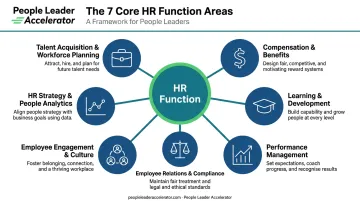
- HR spans seven core areas covering the full employee lifecycle
- The recruitment-to-HR handoff is most vulnerable — and most often mishandled — during onboarding
- Misaligned hires create downstream HR problems that consume far more time than good hiring saves
- High-growth companies that treat recruitment as their only HR priority accumulate people debt they'll have to repay later
Is Recruitment Part of HR? The Short Answer
Yes — recruitment is part of HR. But it's a specialized subset, not a stand-in for the whole function.
HR is the broader discipline responsible for the complete employee lifecycle, from first contact with a candidate to the day they leave the organization. Recruitment is simply the entry point to that lifecycle.
The confusion is understandable, because organizational structures vary widely:
- In small businesses and early-stage startups, one HR generalist typically handles both recruitment and every other HR function
- In mid-size companies, a dedicated recruiter or TA lead often sits within an HR team
- In large enterprises, an independent Talent Acquisition department may have its own budget, headcount, and technology stack — while still reporting to the CHRO or CPO
Regardless of how it's structured, recruitment sits inside the people function — the reporting line and budget may shift, but the relationship to HR doesn't.
The distinction matters most under pressure. In high-growth companies, where hiring velocity is high, organizations that treat recruitment as the primary HR priority tend to underinvest in the functions that keep employees performing, engaged, and staying — compensation, onboarding, performance management, culture, and more.
What Does HR Actually Cover? The 7 Core Areas
HR is an umbrella function responsible for the full employee lifecycle. Here's how the major areas break down:
Talent Acquisition and Workforce Planning
This is where recruitment lives. It covers identifying hiring needs, building talent pipelines, sourcing candidates, and ensuring headcount aligns with business growth. Recruitment is one piece of this work — not the whole function.
Compensation and Benefits
HR designs and manages pay structures, benefits packages, and total rewards programs. This work keeps the organization competitive in the market and directly affects whether new hires accept offers and whether existing employees stay.
Learning and Development
Training programs, upskilling initiatives, mentoring structures, and leadership development all fall here. The goal is ensuring employees can contribute at a higher level over time — not just perform adequately at hire.
Performance Management
HR establishes review cycles, sets expectations, and coaches managers through difficult conversations. Key responsibilities include:
- Designing evaluation frameworks tied to role expectations
- Supporting managers through performance improvement processes
- Managing adverse actions when necessary
This is also where many recruitment failures eventually surface — misaligned hires, unclear role definitions, and gaps in onboarding all show up here first.
Employee Relations and Compliance
Workplace conflict resolution, fair treatment practices, and compliance with employment law all live here. When this area is working, most employees never notice it. When it breaks down — a harassment complaint, a wage dispute, a termination gone sideways — it can consume the entire HR team for weeks.
Employee Engagement and Culture
HR builds the conditions for people to do their best work. That includes engagement surveys, DEI initiatives, employee resource groups, and culture programs.
Gallup's Q12 meta-analysis, based on over 183,000 business units across 90 countries, found that top-quartile engagement units had 23% higher profitability and 18% higher sales productivity compared to bottom-quartile units. Culture is a financial lever, not a soft-skills footnote.
HR Strategy and People Analytics
Modern HR functions use workforce data to make decisions: turnover analysis, headcount forecasting, compensation benchmarking, and aligning people priorities with business strategy. When this work is done well, HR isn't reacting to what already happened — it's shaping what comes next.
What Is Recruitment's Role Within HR?
Recruitment is the process of identifying, attracting, screening, interviewing, selecting, and onboarding candidates into the organization. The impression a company makes during hiring doesn't disappear once someone accepts an offer.
The Core Activities Recruiters Own
- Writing and posting job descriptions
- Sourcing candidates through job boards, LinkedIn, and direct outreach
- Screening resumes and conducting initial interviews
- Coordinating the hiring process with hiring managers
- Managing offer negotiations and pre-boarding through Day 1
How Recruitment Feeds HR Outcomes
The quality of recruiting directly shapes downstream HR results. A misaligned hire doesn't just create a performance problem — it creates a manager relations problem, a team dynamics problem, and eventually a turnover problem. All of which HR then has to manage.
The quality of each hire determines how much reactive work lands on HR's plate afterward.
Recruitment as Talent Acquisition: A Strategic Elevation
There's an important distinction between transactional recruitment and strategic talent acquisition. Transactional recruitment fills a vacancy. Strategic talent acquisition builds pipelines, informs workforce planning, and shapes employer brand.
SHRM describes this evolution as recruiters becoming "strategic talent advisors" who understand the reason behind each hire, advise business leaders, and help create workforce plans for both short- and long-term talent gaps. The function doesn't change its nature — it expands its scope.
Key metrics that mature TA functions track:
| Metric | SHRM Benchmark (2026) |
|---|---|
| Median time-to-fill (nonexecutive) | 39 calendar days |
| Median cost-per-hire (nonexecutive) | $1,300 |
| Median time-to-fill (executive) | 45 calendar days |
| Median cost-per-hire (executive) | $15,000 |
How Recruitment Structure Varies by Organization Size
- Startups and small businesses: HR generalist handles recruitment alongside all other HR functions
- Mid-size companies: Dedicated recruiter or TA lead sits within the HR team
- Large enterprises: Independent Talent Acquisition department with its own budget and team, reporting to the CHRO
The right structure follows organizational complexity and hiring volume, not industry convention.
Recruitment vs. HR: Key Differences at a Glance
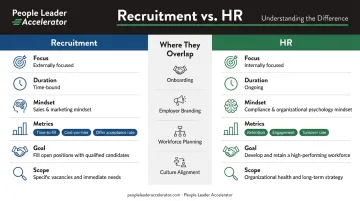
Both functions are people-focused — but they differ substantially in scope, mindset, and how success gets measured.
Scope and Time Horizon
Recruitment is externally focused and time-bound. It ends when the new hire starts. HR is internally focused and ongoing — it spans the full employment relationship and shapes the organization's long-term people capability.
Mindset and Skills
Recruiters operate with a sales and marketing orientation: sourcing, negotiation, candidate relationship management, speed. HR professionals operate with a different orientation: compliance, organizational psychology, policy development, and long-term workforce stability. Both require real expertise — the skill sets simply don't overlap as much as people assume.
Key Metrics
| Function | Primary Metrics |
|---|---|
| Recruitment | Time-to-fill, cost-per-hire, offer acceptance rate, quality of hire |
| HR | Employee retention, engagement scores, turnover rate, compliance outcomes |
Where They Overlap
Four areas create genuine overlap — and genuine friction when the two functions aren't aligned:
- Onboarding: The critical handoff point between recruitment and HR
- Employer branding: Both functions influence how the company is perceived externally and internally
- Workforce planning: Both inform headcount decisions and future hiring needs
- Culture alignment: Both must reinforce the same values and expectations
When these four areas aren't coordinated, the cost shows up in turnover, poor new hire performance, and a fractured employee experience.
Where Recruitment Ends and HR Begins
Recruitment's responsibility ends when the offer is accepted and the employee shows up on Day 1. HR takes over from there — managing orientation, onboarding integration, development, and the ongoing employment relationship.
The Onboarding Bridge
Onboarding is where the handoff between recruitment and HR most often breaks down. Brandon Hall Group research found that organizations with mature onboarding practices were 103% more likely to report improvements in new-hire retention and employee engagement. More than half of voluntary attrition for new hires occurs during the first six months.
Two things need to happen for onboarding to work:
- Recruiters must ensure candidate expectations are accurately set before Day 1 — on role scope, culture, compensation, and growth trajectory
- HR must have full context on what was communicated during the hiring process — so the onboarding experience doesn't contradict what was sold
When those two things don't happen in sequence, new hires experience a disjointed start. Replacing a new hire who leaves within six months typically costs 50–75% of their annual salary — a direct consequence of a broken handoff.
Preventing Silo Failures
When recruitment and HR operate in isolation, roles get filled for speed rather than fit. Early attrition rises. HR spends time managing the fallout of hires that never should have passed the offer stage.
A healthy handoff looks like this:
- Candidate information is shared, not siloed
- Expectations set during recruiting are documented and transferred
- Onboarding is coordinated — not owned by one function and ignored by the other
Why This Distinction Matters for HR Leaders in Growing Organizations
In high-growth companies — startups scaling quickly, PE-backed organizations expanding headcount, tech companies entering new markets — the temptation is to treat recruitment as the primary HR priority. The urgency is real. Open roles create visible pain. Every other area of HR creates invisible pain — until it doesn't.
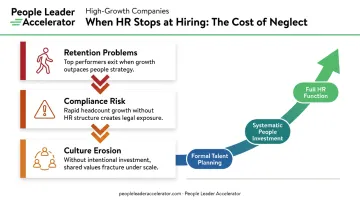
When all HR energy goes into filling roles, the other areas get neglected. The downstream consequences compound quietly:
- Retention problems emerge as new hires hit a culture with no infrastructure
- Compliance risk accumulates until it surfaces as a legal or operational crisis
- Culture erodes in ways that take years — and significant cost — to reverse
By the time these issues surface, they're harder to fix than the open roles that caused the original panic.
McKinsey's research on hypergrowth companies documents a consistent pattern: organizations that scale successfully move from network-based, reactive hiring to formal talent planning and systematic people investment across the full function. The recruitment infrastructure doesn't shrink — it gets supported by the rest of HR, rather than substituting for it.
HR leaders in growth environments need to clearly define what belongs to talent acquisition versus what belongs to the broader HR function — so both can be resourced appropriately. This is a core strategic skill: knowing when to separate the two functions, when to integrate them, and how to ensure neither operates as if the other doesn't exist.
Faculty at People Leader Accelerator work directly on these questions with HR leaders navigating exactly these environments. Andrew Bartlow, co-author of Scaling for Success: People Priorities for High Growth Organizations, and Carmela Krantz, who has served as the first VP of HR at nine companies — including six start-ups — bring direct experience building HR functions from the ground up in high-growth settings. The program is built around real organizations, not hypothetical scenarios, and explicitly addresses how to prioritize across a full HR agenda under growth pressure.
Recruitment is the first chapter of the employee experience. It only holds up if the culture, development, and performance systems HR owns are there to back it up.
Frequently Asked Questions
Is recruitment a part of human resources?
Yes. Recruitment is a subset of HR — specifically the talent acquisition function. While it may operate as a separate team in larger organizations, it sits within the broader people function that the CHRO or CPO oversees.
What are the 7 core HR areas?
The seven core areas are: Talent Acquisition and Workforce Planning, Compensation and Benefits, Learning and Development, Performance Management, Employee Relations and Compliance, Employee Engagement and Culture, and HR Strategy and People Analytics.
What is the difference between a recruiter and an HR professional?
Recruiters focus on sourcing, screening, and hiring external talent. HR professionals manage the full range of people practices after hire — covering compensation, development, employee relations, compliance, and culture. The two roles share a people mandate but operate on fundamentally different timelines and success metrics.
Can a company have HR without a dedicated recruitment team?
Yes. In small or early-stage organizations, HR generalists commonly handle recruitment alongside all other HR functions. Some companies also outsource recruitment entirely while maintaining an internal HR team for everything post-hire.
Should recruitment report to HR?
In most organizations it does, typically under the CHRO or CPO. In large enterprises, Talent Acquisition may carry its own budget and near-standalone structure while remaining strategically aligned with the broader HR agenda.