Introduction
Many HR professionals know what an HR Manager does. They've seen the job posting, maybe held the role. The HR Generalist is just as familiar — the person who does a bit of everything across the employee lifecycle.
But the HR Business Partner? That title gets misused constantly. Some organizations slap "HRBP" on what is essentially a senior generalist role. Others treat it as a vague upgrade to an HR Manager job description. Neither gets it right.
The HRBP role is genuinely distinct. In organizations serious about connecting people strategy to business performance, it's one of the most consequential roles in the entire HR function. According to Gartner, only 51% of stakeholders currently view their HRBPs as strategic — which means the gap between what the role promises and what it delivers is very real.
This guide breaks down the HRBP role in full: what it actually is, what HRBPs do day-to-day, how it differs from other HR roles, what skills it demands, and how to move into one.
Key Takeaways
- HRBPs are strategic advisors embedded within business units, not HR administrators
- The role demands business acumen just as much as HR expertise
- HRBPs differ from HR Managers and Generalists in scope and orientation, not just seniority
- Impact is greatest in mid-to-large companies and fast-scaling organizations
- Moving into HRBP requires a deliberate mindset shift — experience alone won't get you there
What Is an HR Business Partner (HRBP)?
The Core Definition
SHRM defines the HRBP as an HR professional who aligns business objectives with employees and management in designated business units. CIPD frames it similarly: HRBPs work directly with business leaders and line managers to diagnose people priorities, build people plans, and implement organization-wide approaches.
What both definitions share is the word align. The HRBP's job is to connect what the business needs to what the workforce can deliver — strategy and people, working in the same direction.
The "Partner" Distinction
Traditional HR roles often sit behind the scenes, responding to requests from managers and employees. The HRBP model flips that dynamic. An effective HRBP sits alongside business leaders — attending leadership meetings, contributing to strategic planning conversations, and pushing back when a business decision carries real people-side risk.
That proximity to leadership is what separates the role from operational HR. The HRBP functions as a trusted advisor with a seat at the table, not someone waiting to be asked.
How the Role Evolved
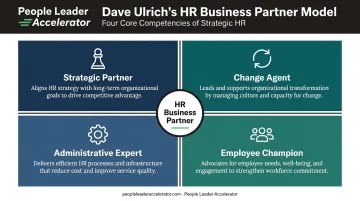
The HRBP model traces back to Dave Ulrich's four-role HR framework, introduced in Human Resource Champions (Harvard Business Review Press, 1996). Ulrich argued that HR needed to operate across four dimensions — not just as a compliance and administrative function:
- Strategic partner — aligning HR priorities with business goals
- Administrative expert — running efficient, reliable HR operations
- Employee champion — advocating for workforce needs and engagement
- Change agent — driving organizational transformation
That framework took hold. Over the following decades, organizations began carving out a dedicated role to own the strategic partner and change agent dimensions. McKinsey's 2022 research on HR operating models identified five archetypes — from the classic "Ulrich+" model to agile and leader-led approaches — all of which position the HRBP as a critical bridge between people priorities and business outcomes.
Where HRBPs Sit in the Organization
HRBPs operate at the intersection of business strategy and workforce management. They translate organizational goals into talent initiatives — and bring feedback from managers and employees back to senior leadership. In a well-functioning HRBP model, that bidirectional flow is where real organizational value gets created.
Key Roles and Responsibilities of an HR Business Partner
Workforce Planning and Talent Strategy
HRBPs partner with business leaders to anticipate talent needs before they become urgent gaps. This means analyzing where the business is headed, identifying the capabilities required to get there, and building hiring and development strategies that support future objectives — not just filling open requisitions.
CIPD notes that HRBPs use workforce data to identify future needs, guide organizational restructures, and advise on succession planning. In practice, that means the HRBP is in the room when business strategy is set — not called in after decisions are made.
Performance Management and Leadership Coaching
HRBPs support managers in running effective performance processes — not by doing performance management for them, but by coaching them to do it well. This includes:
- Advising on consistent evaluation criteria
- Helping managers prepare for difficult performance conversations
- Identifying development opportunities that retain and grow top talent
- Providing guidance on disciplinary and capability issues when they arise
Strategic vs. Operational Responsibilities
HRBPs operate across both domains, but the emphasis matters:
Strategic work (where HRBPs add the most unique value):
- Organizational design and restructuring
- Leadership coaching and executive team effectiveness
- Succession planning and talent pipeline development
- Change management during periods of growth or transformation
Operational work (handled as needed, not as the primary focus):
- Complex employee relations issues
- Supporting recruitment for critical or senior roles
- Advising managers on policy application
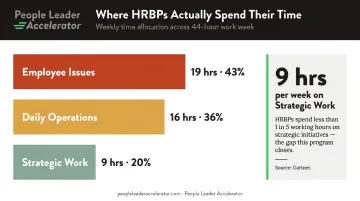
In practice, Gartner's research reveals a time allocation problem worth noting: HRBPs spend nearly 19 hours per week on employee issues and more than 16 hours on daily operations — leaving only about 9 hours per week on strategic work. For organizations that want their HRBPs functioning as true business partners, clearing operational drag from the role is a prerequisite.
Change Management
When organizations restructure, expand, or shift direction, HRBPs own the people side of that transition — not just the communication plan. Effective change management at this level requires:
- Translating leadership decisions into clear, consistent messaging for teams
- Identifying employees at highest risk of disengagement or attrition during uncertainty
- Coaching managers on how to lead their teams through ambiguity
- Tracking workforce sentiment and flagging issues before they compound
The difference between a reactive HR function and a strategic one often shows up here — in whether the HRBP was shaping the change plan or scrambling to respond to it.
Data and Analytics
HRBPs use workforce data to make evidence-based recommendations. Common applications include:
- Analyzing turnover patterns to surface retention risks
- Reviewing engagement survey trends to identify culture issues
- Tracking performance metrics to connect talent interventions to outcomes
- Using headcount data to inform workforce planning conversations
When HRBPs bring data into leadership conversations, they shift the dynamic — from HR presenting requests to HR presenting evidence. That's what earns a seat at the strategy table.
HR Business Partner vs. HR Manager vs. HR Generalist
These three roles get confused — and the confusion is understandable, because title conventions vary widely across organizations. Here's a clean comparison:
| Role | Primary Focus | Scope |
|---|---|---|
| HR Business Partner | Strategic advisory to business unit leaders | Embedded with specific business areas; focused on workforce strategy, org design, and change |
| HR Manager | Overseeing HR operations and function delivery | Plans, coordinates, and directs administrative HR functions; may supervise specialists |
| HR Generalist | Broad employee lifecycle support | Recruitment, onboarding, benefits, policy administration, employee relations across the full lifecycle |
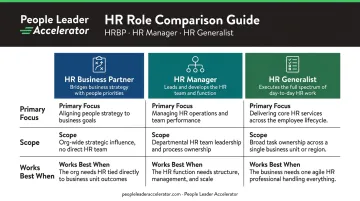
How These Roles Actually Work Together
A few clarifications worth keeping in mind:
- HRBPs and HR Managers are often complementary, not competing. The HR Manager keeps the HR function running; the HRBP keeps HR connected to the business. Many organizations run both roles in parallel.
- HRBPs are more specialized than Generalists — not necessarily more senior. A Generalist covers a wide range of HR tasks from a central position. An HRBP is typically embedded within a specific business unit, focused on advisory work rather than transaction execution.
- Scope matters more than title. Some organizations label a role "HRBP" when it's really a senior generalist. Others assign HR Managers responsibilities that look more like business partnering. When evaluating any role, look at what the person actually does — who they advise, what decisions they influence, and where they spend their time.
Essential Skills and Qualifications of an Effective HRBP
Business Acumen
Business acumen is the clearest differentiator between operational HR professionals and effective HRBPs. It means understanding how the organization generates revenue, where costs are concentrated, what competitive pressures exist, and how people decisions affect financial performance.
SHRM's Body of Applied Skills and Knowledge (BASK) includes Business Acumen and Consultation as core competencies — and SHRM's own HRBP role template applies both directly to the position. Without it, HRBPs struggle to earn credibility with business leaders who are making decisions in financial and operational terms.
Data Fluency
HRBPs don't need to be data scientists. They do need to pull meaning from workforce data and translate it into recommendations leaders can use. For example:
- Exit interview analysis that surfaces the actual drivers of turnover
- Engagement survey trends that point to specific team or manager issues
- Headcount and productivity data that informs hiring and restructuring decisions
Coaching and Influence
HRBPs rarely have direct authority over the leaders they advise. Their effectiveness depends on influence — building credibility through insight, asking the right questions, and constructively challenging decisions that carry workforce risk. This requires genuine coaching skill, not just good communication.
Education and Certifications
Most HRBP roles require:
- Bachelor's degree in HR, Business Administration, or a related field
- 8–10 years of HR experience (per SHRM's HRBP role template)
- SHRM-CP or SHRM-SCP strongly preferred — these signal strategic HR competence
- SPHR (from HRCI) is also relevant — designed for HR leaders who shape strategy, with a minimum of four years' experience required for eligibility
For senior HRBP positions, an MBA or master's degree is increasingly common.
The HRBP Model in High-Growth and Scaling Organizations
Why HRBPs Matter More at Scale
Fast-growing organizations face a particular version of the people challenge. Headcount doubles, structures shift, culture comes under pressure, and managers are often promoted faster than they're prepared. Without someone whose job is to think strategically about the workforce — not just process HR transactions — the people function becomes purely reactive.
McKinsey's research on scaling startups found that 65% of startup failures are attributable to people and organizational issues — not product, market, or funding. That statistic underscores exactly why having a capable, strategic HR presence is non-negotiable in high-growth environments.
Specific Challenges HRBPs Navigate in Scaling Companies
- Rapid hiring cycles that sacrifice quality for speed if left unguided
- Culture dilution as new hires outnumber original employees
- Manager readiness gaps when individual contributors are promoted too quickly
- Compensation equity issues that accumulate when hiring is done reactively
- Evolving org structures that require frequent redesign to match business needs
Each of these requires someone who can think across the whole workforce picture, not just process individual requests.
How People Leader Accelerator Addresses This
People Leader Accelerator was built specifically for this context. The faculty brings direct experience navigating the exact scaling challenges described above — not theoretical knowledge, but firsthand work inside high-growth organizations:
People Leader Accelerator was built specifically for this context. The faculty brings direct experience navigating the exact scaling challenges described above — not theoretical knowledge, but firsthand work inside high-growth organizations:
- Marie Szuts led the people function at Figma during its period of rapid growth, developing scalable HR strategies as headcount and complexity increased simultaneously
- Carmela Krantz has served as the first VP of HR at nine companies, including six startups — building people functions from scratch across a range of industries and growth stages
- Andrew Bartlow co-authored Scaling for Success: People Priorities for High Growth Organizations and brings 25 years of HR and talent experience across high-growth and private equity-backed companies
The curriculum gives HR professionals the strategic frameworks and peer network to operate confidently at the HRBP level — in environments where getting people decisions right has an outsized impact on the business.
How to Move Into an HR Business Partner Role
The Typical Career Path
Most HRBPs start in operational HR — HR Coordinator, HR Generalist, or HR Manager roles — and build broad foundational knowledge before transitioning to a more strategic function. Gaining experience across multiple HR domains is valuable preparation:
- Talent acquisition builds familiarity with workforce supply and demand
- Employee relations develops judgment on complex people issues
- Learning and development builds coaching and capability-building skills
- Compensation exposure develops the business-side fluency HRBPs need
SHRM's HRBP role template specifies 8–10 years of HR management experience as a baseline — which suggests the path is a long one, but the breadth of that experience matters as much as the length.
What the Transition Actually Requires
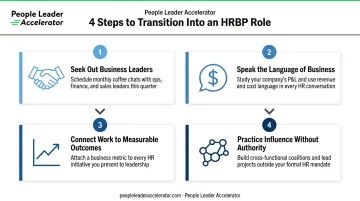
The shift to HRBP isn't primarily about acquiring new HR knowledge — it's about changing how you engage with the business. That means:
- Seek out business leaders proactively. Don't wait for them to come to you — initiate conversations about where the business is headed and what talent challenges stand in the way.
- Speak the language of the business. Finance, operations, strategy — HRBPs who engage these conversations on equal terms earn far more credibility.
- Connect your work to measurable outcomes. Every HR initiative should be tied to a business result. If you can't articulate the connection, the work won't be seen as strategic.
- Practice influence without authority. Build relationships with leaders before you need to challenge them.
Structured Development as a Path Forward
Most HR professionals navigate this transition through trial and error — picking up strategic instincts gradually, often without feedback. Programs designed to accelerate that development can shorten the timeline considerably.
People Leader Accelerator's cohort-based program places HR professionals in small groups of 8–12 peers with comparable scope and organizational complexity. Participants work on their actual organizations each week — not hypothetical case studies — so the development is immediately applicable.
The PLA Mastermind membership extends that peer support beyond the program, providing a structured forum for ongoing high-stakes decisions.
For HR professionals serious about moving into or elevating their performance as an HRBP — particularly in high-growth or investor-backed environments — this kind of structured peer development is one of the fastest ways to build the strategic credibility the role demands.
Frequently Asked Questions
What is HR business?
"HR business" refers to the overall function of human resources management, encompassing hiring, development, compensation, compliance, and employee relations. The term speaks to HR's purpose within an organization and how it contributes to business performance.
What are the four roles of HR?
Dave Ulrich's foundational framework identifies four roles: strategic player, administrative expert, employee champion, and change agent. The HRBP role most closely embodies the strategic player and change agent functions — focused on aligning HR with business goals and driving organizational transformation.
What is the difference between an HR Business Partner and an HR Manager?
HR Managers oversee HR operations and day-to-day administration: managing compliance, running HR processes, and supervising HR staff. HRBPs work directly with business unit leaders to align workforce strategy with business objectives. The roles are often complementary rather than hierarchical.
What skills does an HR Business Partner need?
The most critical skills are business acumen, data analysis, coaching and influencing senior leaders, change management, and strong communication. Strategic thinking is what distinguishes HRBPs from general HR practitioners, not just additional HR knowledge.
Is an HR Business Partner a senior role?
Yes. The HRBP role is considered mid-to-senior level, requiring significant HR experience and the ability to advise executive leadership. While junior HRBP titles exist in some organizations, the role is inherently strategic and carries more influence than typical operational HR positions.
When does a company need an HR Business Partner?
Organizations benefit most from an HRBP when they are scaling rapidly, facing persistent talent challenges, or need HR strategy more tightly connected to business performance. The model is especially valuable when business leaders need a trusted people advisor embedded within their teams rather than a separate HR department to escalate issues to.