

There's a real paradox here. HR builds recognition programs for everyone else — and then gets systematically left out of them.
This guide covers everything you need to change that: when HR Professionals Day falls and what it actually means, what meaningful appreciation looks like beyond surface gestures, and how leaders at every level can make recognition count year-round.
Key Takeaways
- HR Professionals Day is observed on September 26 each year in the U.S. — treat it as a catalyst, not a one-time checkbox
- The most impactful appreciation is specific, public, and comes from senior leadership
- Consistent, frequent recognition drives stronger engagement and retention than any single annual gesture
- Investing in professional development — coaching, leadership programs, or skills-building — delivers the highest-value appreciation for career-driven HR professionals
- Organizations that treat HR as a strategic partner consistently retain their best HR talent
Why HR Professionals Deserve More Recognition Than They Get
The Invisible Work Problem
Most employees interact with HR during a handful of moments — onboarding, a benefits question, a promotion. What they don't see is everything happening in between: the compliance audit, the harassment investigation, the workforce reduction that took weeks of preparation, the performance framework that shaped their manager's behavior.
According to SHRM's 2025 State of the Workplace report, 62% of HR departments reported operating beyond normal capacity in 2024. That's not a staffing problem — it's a structural one. HR teams are absorbing more work than their headcount can realistically support, and most of that work is invisible to the people it serves.
When that invisibility persists without acknowledgment, engagement suffers. Gallup and Workhuman's longitudinal research found that employees who received high-quality recognition were 45% less likely to have left their employer over a two-year period. There's no reason to believe HR professionals are immune to the same dynamic — and every reason to think the gap hits harder for a group that rarely sees their own contributions named publicly.
The High-Stakes Work Nobody Talks About
HR professionals are often the first people in the room when things go wrong. Consider what that actually includes:
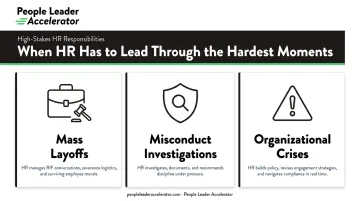
- Mass layoffs: HR plans and delivers reduction-in-force conversations, often managing legal risk, severance logistics, and surviving-employee morale simultaneously
- Harassment and misconduct investigations: HR investigates, documents, and recommends discipline — sometimes against senior leaders who push back on findings
- Organizational crises: During the pandemic, HR teams built remote work policies, revised engagement strategies, and navigated compliance in real time without established precedent
This work doesn't appear in year-end reviews or company newsletters. The people absorbing the organization's hardest moments do so quietly — and typically without any formal acknowledgment that it happened.
The Cobbler's Children Problem
HR designs peer recognition programs, employee appreciation weeks, and manager training on how to give feedback. They build the recognition infrastructure for everyone else — then return to a function that rarely has that same apparatus pointed back at it.
This isn't malicious. It's a blind spot — one that persists because no one has formally owned it. The sections that follow outline what closing that gap actually looks like, from specific recognition practices to leadership behaviors that make a measurable difference.
HR Professionals Day: When It Is and Why It Matters
HR Professionals Day is observed on September 26 each year in the United States. The observance recognizes the strategic and operational contributions HR professionals make to organizational health, culture, and employee well-being.
Separately, International HR Day is observed on May 20 — a global initiative launched in 2019 by the European Association for People Management (EAPM) to celebrate the HR profession's impact worldwide. Organizations operating across multiple regions have two natural anchor points to build recognition around.
Both dates are useful starting points — but neither substitutes for the ongoing recognition that actually shapes how HR professionals feel about their work. A single well-executed event can create goodwill; it can't create a culture of appreciation on its own. Use September 26 as a catalyst to examine how your organization recognizes its HR team throughout the rest of the year.
Meaningful Ways to Show Appreciation on HR Professionals Day
Verbal and Written Recognition
The difference between recognition that lands and recognition that doesn't comes down to specificity. Compare these two approaches:
- Vague: "Thanks to our amazing HR team for everything you do!"
- Specific: "This year, our HR team rebuilt our onboarding process from scratch. New hire ramp time dropped by three weeks, and first-year retention improved. That outcome belongs to them."
The second version names the contribution, connects it to a result, and treats HR as a strategic function — not just a support service.
A few ways to execute this well:
- A CEO message that names 2–3 specific HR initiatives and their outcomes, sent company-wide
- A Slack or Teams post that highlights individual HR team members by name
- A short video from senior leadership acknowledging what the HR team absorbed this year, including the hard moments
Public recognition matters especially for a team that typically works behind the scenes. Most of what HR does never gets announced — making it visible is itself the gesture.
Events and Peer Appreciation
Events work best when they feel proportionate to the work being recognized. A catered lunch from leadership with genuine, prepared remarks lands differently than a generic pizza party.
Peer recognition is equally powerful. Employees across the organization often have specific, meaningful stories about times HR made a real difference: a job offer conversation that went smoothly, support through a difficult manager situation, help navigating a leave of absence. Those stories are worth collecting.
One approach: ask employees to submit short appreciation notes or 60-second video messages about a time HR helped them. Compile them and present the collection to the HR team. It's more meaningful than any trophy because it shows the team the direct human impact of their work.
Thoughtful Gifts and Tangible Gestures
When giving gifts, the principle is straightforward: personalization over generic swag, quality over quantity.
Gift categories that resonate:
- Wellness experiences (spa credits, fitness memberships, meal delivery)
- Professional resources: books, subscriptions to HR publications, or access to research platforms
- Experience-based rewards tied to the recipient's interests
One critical note: a gift without words risks feeling transactional. Pairing any tangible gesture with a specific, written message transforms it from a box to a statement of appreciation.
A gift from a CEO or executive should carry a personal note naming something specific. A peer gift can be more informal, but still benefits from a few genuine sentences.
How to Recognize HR Professionals Year-Round
One-day recognition is better than none. But research is clear that frequency matters far more than grand gestures.
Gallup's 2024 research found that 61% of employees receiving both feedback and recognition at least weekly were engaged — compared to just 38% among those who received feedback frequently but recognition less often. The engagement gap between recognized and under-recognized employees is not small, and it doesn't close with an annual event.
Build Recognition Into Systems
Structural inclusion is what separates sustainable recognition from performative gestures. Practical ways to institutionalize it:
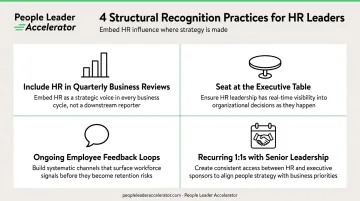
- Include HR contributions in quarterly business reviews — not just headcount metrics, but strategic outcomes HR drove
- Ensure HR leaders have a seat at the executive table before decisions are made, not after implementation is needed
- Create ongoing feedback loops where employees can submit appreciation for HR through existing channels (engagement surveys, internal tools, 1:1 templates)
- Schedule recurring one-on-ones between senior leadership and HR leaders that include explicit appreciation for recent contributions — separate from performance conversations
The distinction between informal recognition and structural inclusion matters. Informal recognition feels good. Structural inclusion signals that HR is treated as a genuine business partner.
Invest in HR Professionals' Development
Professional development is year-round recognition in the most durable form. It communicates two things simultaneously: we see the work you're doing, and we're investing in where you're going.
Specific investments that resonate:
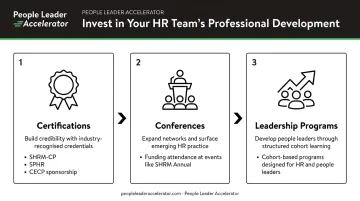
- Sponsoring certifications like SHRM-CP, SPHR, or CECP
- Funding attendance at HR conferences (SHRM Annual, for example)
- Enrolling HR leaders in leadership development programs designed specifically for the function
People Leader Accelerator runs cohort-based programs built specifically for HR and people leaders, with faculty averaging 25–30 years of practitioner experience from high-growth organizations. Groups are kept small so participants work through decisions they're actually facing — not hypothetical case studies. For an executive looking to invest meaningfully in an HR leader's trajectory, that kind of sponsorship sends a clear signal.
Sample Appreciation Messages for HR Professionals
Effective appreciation messages share three qualities: they name a specific contribution, they address the person rather than the function, and they come at a meaningful moment. Tone and detail will vary depending on who's writing.
The four examples below cover common scenarios — adjust names, specifics, and timing to fit your context.
From a CEO (HR Professionals Day)
"On HR Professionals Day, I want to recognize [Name] and the entire HR team — not for 'everything they do,' but for what I watched them specifically accomplish this year. [Name] redesigned our performance review process after hearing manager frustration firsthand. The result was a system our managers actually use. That kind of work — listening, designing, iterating — is what makes this organization function well. Thank you."
From a Manager (After a Specific Project)
"[Name], I wanted to take a moment to thank you directly. The work you did to rebuild our onboarding program this quarter made an immediate difference for the three new hires on my team. They felt prepared on day one in a way previous hires hadn't. I know that project required a lot of behind-the-scenes work I didn't fully see — I appreciate it."
From an Employee (to an HR Business Partner)
"I want to thank [Name] for how they handled my situation earlier this year. I came to HR not sure what to expect, and I left the conversation feeling heard and with a clear path forward. That kind of support isn't a small thing — it genuinely changed how I felt about being at this company."
From a Peer HR Team Member
"[Name], I've watched you handle three separate investigations this quarter while keeping your composure and protecting everyone involved with real care. That work is hard and it's often thankless. I see it, and I want to make sure you know it doesn't go unnoticed — at least not by me."
Frequently Asked Questions
When is HR Professionals Day?
HR Professionals Day is observed annually on September 26 in the United States. Separately, International HR Day is observed on May 20 globally, giving organizations two natural moments to formally recognize their HR teams each year.
What is the theme of HR Professionals Day?
There is no fixed annual theme. The observance centers on recognizing the strategic, often-invisible contributions HR professionals make to organizational health, culture, and employee well-being.
What is International HR Day?
International HR Day is observed on May 20 and was launched in 2019 by the European Association for People Management (EAPM). It's a global initiative recognizing the HR profession's impact on organizations and societies worldwide — complementing the U.S.-focused September 26 observance.
How do you write an appreciation message for an HR professional?
Name a specific contribution they made, and address the individual — not just the role. A public message (company-wide email, team meeting shoutout, or internal post) carries more weight than a private one.
What is the best gift for an HR professional?
Personalized, high-quality gifts are appreciated, but the research points toward development investments and specific verbal acknowledgment as more meaningful and lasting. Sponsoring a certification, a leadership program, or a professional conference tends to resonate more deeply than any physical item.
Why is it important to recognize HR professionals?
Recognizing HR professionals reinforces a culture of mutual appreciation and supports retention of high-performing HR talent. It also acknowledges the strategic role HR plays across hiring, compliance, culture, and employee well-being — areas that touch every part of the organization.