
Keeping pace with that rate of change takes more than day-to-day experience. HR associations offer something on-the-job work can't: structured access to certifications, compliance updates, salary benchmarking data, and peer networks that connect you with professionals facing the same challenges.
This guide covers 18 associations organized by focus area — generalist, role-specific, industry-specific, and executive — so you can quickly identify which ones align with where you are now and where you want to go.
Key Takeaways
- SHRM is the largest and most broadly recognized HR association, with nearly 340,000 members across 180 countries.
- HR associations fall into four categories: generalist, role-specific, industry-specific, and special interest/executive.
- Membership costs range from free (HCI community tier) to $9,750/year (SHRM Executive Network) — know what you'll use before you commit.
- Industry-specific associations offer compliance guidance and benchmarking unavailable in general HR resources.
- Associations work best alongside peer learning and structured programs, not as a standalone development strategy.
What Is an HR Association and Why Join One?
An HR association is a professional membership organization that supports HR practitioners through education, certifications, research, networking events, and compliance guidance. They're distinct from general business groups — every resource is built specifically for people professionals.
The Four Main Types
| Type | What It Covers | Best For |
|---|---|---|
| Generalist | Broad HR topics, compliance, general credentials | All career stages |
| Role-Specific | Deep expertise in compensation, L&D, payroll, HR tech | Specialists |
| Industry-Specific | Sector rules, labor markets, workforce benchmarks | Healthcare, education, government, construction |
| Special Interest/Executive | Senior peer networks, identity-centered development | CHROs, VPs, senior leaders |
The type you choose depends on where you are in your career — but the case for joining at least one is consistent across all of them.
Core Career Benefits
Membership delivers value in four concrete ways:
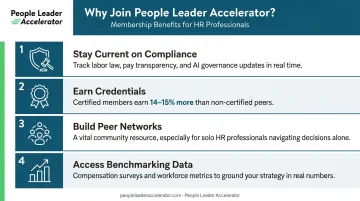
- Stay current on compliance — labor law changes, pay transparency requirements, and AI governance updates land in your inbox first
- Earn credentials — certifications signal credibility to employers and boost earning potential. SHRM reports certified members earn 14–15% more than non-certified peers, based on member surveys
- Build peer networks — especially critical for solo HR professionals who lack internal colleagues to pressure-test decisions
- Access benchmarking data — compensation surveys, workforce metrics, and staffing ratios that inform strategic recommendations
18 HR Associations Every Professional Should Know
These 18 associations are organized by focus area to help you quickly identify which ones align with your role, industry, and career goals.
Generalist HR Associations
1. Society for Human Resource Management (SHRM) The world's largest HR professional society — nearly 340,000 members in 180 countries. SHRM offers the SHRM-CP (for operational HR) and SHRM-SCP (requires at least three years of strategic HR experience), plus compliance resources, local chapters, HR Magazine, and an extensive policy toolkit.
Membership pricing: $299/year (professional), $49/year (student), $118/year (global).
2. HR Certification Institute (HRCI) A standalone credentialing body with a 50-year history. HRCI administers the PHR, SPHR, and GPHR certifications — distinct credentials from SHRM's offerings, not interchangeable. The 2025 pass rates were 72% for the PHR and 76% for the SPHR. Best for professionals seeking internationally recognized credentials based on verified HR knowledge and experience.
3. Human Capital Institute (HCI) Focuses on strategic talent management and workforce planning. The free Community Membership tier makes it accessible at any career stage. Premium certifications — Strategic Workforce Planning (SWP) at $1,995 and Strategic HR Business Partner (SHRBP) at $2,795 — each require coursework, an 80%+ exam score, and renewal every three years.
4. National Human Resources Association (NHRA) Established in 1951, NHRA operates through national and regional affiliates. National dues are $160/year for individuals. The volunteer-based, regionally organized structure creates more intimate networking than large national conferences — worth considering if local connection matters to you.
Role-Specific HR Associations
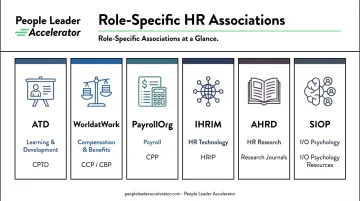
5. Association for Talent Development (ATD) The go-to organization for learning and development professionals. ATD offers the Certified Professional in Talent Development (CPTD), which requires at least five years of experience, along with TD Magazine and extensive instructional design and workforce engagement content.
Membership pricing: $299/year (professional), $479/year (Professional Plus), $129/year (student).
6. WorldatWork WorldatWork serves total rewards, compensation, and benefits professionals worldwide. Offers salary surveys covering 800+ jobs, a Salary Data Center, and credentials including the Certified Compensation Professional (CCP) and Certified Benefits Professional (CBP).
Membership pricing: $360/year (one-year individual membership).
7. PayrollOrg (formerly American Payroll Association) Formed on May 2, 2023, when the American Payroll Association and Global Payroll Management Institute merged. Offers the Fundamental Payroll Certification (FPC) for those building baseline competency and the Certified Payroll Professional (CPP) for experienced practitioners. The CPP is the only nationally recognized credential for payroll professionals in the U.S.
8. International Association for Human Resource Information Management (IHRIM) Serving the HR technology community since 1980, IHRIM offers the Human Resource Information Professional (HRIP) designation, which covers HCM, HRIS, and HR technology management. The HRIP is one of the few credentials focused specifically on HR systems rather than generalist HR practice.
9. Academy of Human Resource Development (AHRD) A global academic-practitioner organization dedicated to HR development research. Members access four research journals — including Human Resource Development Quarterly and Human Resource Development Review — plus annual conferences with both scholars and practitioners. Useful if you want peer-reviewed research to ground your people strategies in evidence.
10. Society for Industrial and Organizational Psychology (SIOP) SIOP serves I/O psychology practitioners and academics. SIOP's Work Smart Series educational activities qualify for SHRM recertification credits (membership alone does not earn credit — attendance at qualifying activities does). Annual dues: $199 for professional members, $80 for affiliates, $59 for students.
Industry-Specific HR Associations
11. American Society for Healthcare Human Resources Administration (ASHHRA) The only national membership organization exclusively for HR professionals in healthcare settings. Resources cover workforce strategy, compliance, credentialing, risk management, and compensation — all tailored to clinical environments.
12. College and University Professional Association for Human Resources (CUPA-HR) The association for HR teams in higher education. Its annual compensation surveys cover faculty, administrators, professionals, and nonexempt staff. The 2025–26 faculty survey covered 795 U.S. institutions and over 280,000 full-time faculty — benchmarking data you simply won't find anywhere else for academic HR.
13. American Association of School Personnel Administrators (AASPA) Serving a network of 3,500+ PK–12 HR professionals, AASPA offers HR boot camps, legal and human-capital summits, legislative advocacy resources, and annual conferences specific to school district employment structures. No other association addresses the staffing and compliance structures unique to school districts at this depth.
14. Public Sector HR Association (PSHRA) Formerly IPMA-HR, rebranded January 3, 2023. PSHRA serves government HR teams with the PSHRA-CP certification — covering compliance, documentation, recruitment, classification, and compensation — plus a 10-week Public Sector HR Essentials online course built around civil service requirements.
15. Human Resources Construction Council (HRCC) A consortium of HR and workforce development professionals at U.S.-based merit-shop contractors. HRCC addresses construction-specific workforce challenges through peer exchange, an industry conference, and endorsed resources focused on craft training, hiring, retention, and legal topics.
16. Hospitality Human Resources Association (HHRA) Founded in 1982 by Central Florida hotel-industry HR professionals, HHRA now spans hospitality HR, consultants, educators, and labor-law attorneys. Offerings include monthly seminars and professional networking — valuable for HR professionals managing the complex workforce dynamics of hotels and restaurants.
Special Interest and Executive-Level Groups
17. SHRM Executive Network SHRM's senior-leader community for practicing CHROs and VP-equivalents at companies with 250+ employees. The quarterly journal People + Strategy is its flagship publication. Annual dues range from $3,995 to $9,750 depending on position and company size.
18. National Association of African Americans in Human Resources (NAAAHR) A career development and networking organization focused on advancing Black and African American HR professionals. Offerings include educational and professional development, mentorship and coaching tools, professional cohorts, certification training, and leadership development programming.
How to Choose the Right HR Association for Your Career
With 18 options across four categories, the decision comes down to three questions.
Start With Your Primary Goal
| Goal | Best Association Type | Example |
|---|---|---|
| Broad credential recognition | Generalist | SHRM, HRCI |
| Deep functional expertise | Role-specific | ATD, WorldatWork, PayrollOrg |
| Sector compliance & benchmarking | Industry-specific | CUPA-HR, ASHHRA, PSHRA |
| Senior peer access | Executive/special interest | SHRM Executive Network, NAAAHR |
Then Run the Numbers
Membership costs span a wide range. Before committing, calculate your actual ROI:
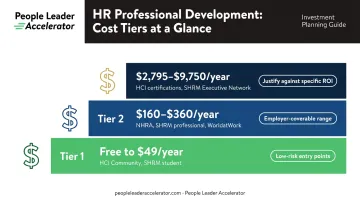
- Free to $49: HCI Community Membership, SHRM student tier — low-risk starting points
- $160–$360/year: NHRA, SHRM professional, WorldatWork — the mainstream range; most employers will cover this as a development expense
- $2,795–$9,750: HCI certification programs, SHRM Executive Network — justify these against specific certifications, salary surveys, or network access you'll actively use
Ask your employer to cover membership as part of your professional development budget. The ask lands better when you tie it to specific business outcomes — a compensation benchmarking survey, a compliance certification, or peer access to solve a specific workforce challenge.
Pair Associations With Structured Learning
Associations give you content and community. What they rarely provide is structured accountability for applying that content to your actual role. For HR professionals in high-growth organizations who need to shift from operational to strategic quickly, that gap matters.
People Leader Accelerator's programs and PLA Mastermind (small cohorts of 8–12 senior HR leaders meeting monthly to work through active workforce challenges) complement association memberships with applied frameworks and peer accountability. PLA is also a recognized SHRM Recertification Provider, so participation counts toward SHRM-CP and SHRM-SCP renewal credits.
Conclusion
There's a right home for every HR professional across these 18 associations — the key is matching the association to where you want to grow, not just joining the most familiar name. A solo HR generalist in healthcare needs something different than a compensation specialist at a scaling tech company or a new CHRO at a mid-market firm.
Association membership builds a strong foundation. Staying current on compliance and earning credentials matters. What accelerates careers beyond that foundation is pairing those credentials with applied frameworks, peer accountability, and the experience of making real strategic decisions under pressure.
People Leader Accelerator's programs and alumni network are designed for HR and people leaders ready to move from operational execution into strategic leadership — developing the skills and judgment that credentials alone don't cover. Explore what's available and see where it fits your next step.
Frequently Asked Questions
What is the Human Resources Association?
An HR association is a professional membership organization that supports HR practitioners through education, certifications, compliance resources, and networking. They range from broad generalist bodies like SHRM to niche groups focused on specific industries (healthcare, K–12 education) or HR disciplines (payroll, compensation, HR technology).
What is the largest HR association?
SHRM (Society for Human Resource Management) is the world's largest HR professional society, with nearly 340,000 members in 180 countries. It offers certifications (SHRM-CP and SHRM-SCP), local chapters, compliance tools, and HR Magazine — the most broadly applicable association for HR professionals at any career stage.
What are the main areas of human resources?
The core HR disciplines include talent acquisition, learning and development, compensation and benefits, employee relations, HR technology, and organizational development. Several associations on this list specialize in one of these areas — WorldatWork for compensation, ATD for learning and development, for example.
How much does it cost to join an HR association?
Costs range from free (HCI Community Membership) to $299–$360/year for SHRM or WorldatWork, up to $3,995–$9,750/year for the SHRM Executive Network. Factor in what's included — certifications, salary surveys, conference access — and check whether your employer will cover it as a professional development expense.
Is SHRM membership worth it?
Yes, for the majority of HR professionals. SHRM's certification programs (SHRM-CP, SHRM-SCP), compliance resource library, and local chapter access make the $299/year membership a strong value — especially early in your career or when pursuing an industry-recognized credential.
Can I join multiple HR associations?
Many HR professionals hold memberships in multiple associations at once — SHRM for general knowledge alongside ATD for L&D specialization, or WorldatWork for compensation benchmarking. Start with one core association aligned to your primary goal, then add specialty memberships as your focus areas develop.