
This guide covers everything HR leaders need: a clear definition of diversity in HR, the business case, types of workplace diversity, the HR leader's strategic role, common challenges, and how to measure progress effectively.
Key Takeaways
- Diversity in HR means actively valuing differences across gender, race, age, background, and more — not just clearing legal minimums
- Research consistently links diverse workforces to stronger financial performance, higher innovation, and better retention
- HR leaders drive diversity strategy across every stage of the employee lifecycle — from hiring to leadership development
- Sustainable diversity efforts require clear goals, measurable KPIs, leadership accountability, and a culture of genuine inclusion
- Real diversity impact comes from structured frameworks and accountability — not symbolic programs
What Is Diversity in HR?
Diversity in human resource management is the conscious practice of recognizing, accepting, and leveraging differences among people within an organization. This includes race, gender, age, ethnicity, sexual orientation, physical ability, cognitive style, cultural background, and professional experience — among many others.
Three terms get used together constantly, but they mean different things:
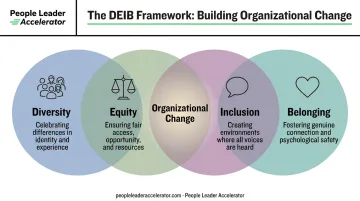
- Diversity — the mix of people present in the workforce
- Equity — recognizing unequal starting points and designing systems that account for them
- Inclusion — a culture where everyone belongs, has a voice, and can actually influence decisions
These concepts are often grouped as DEI, and increasingly as DEIB when belonging is added as a fourth dimension. They are interdependent. Without inclusion, diversity is just a headcount exercise. Without equity, inclusion stays performative. All three have to work in concert to drive real organizational change.
What Diversity Is Not
True diversity in HR is not tokenism. It's not filling demographic quotas and calling it done. It's not a one-time training session or a hiring push that gets abandoned after onboarding.
Lasting diversity requires representation at every level — including leadership — paired with equitable systems and a culture where different perspectives actually shape decisions.
Surface-Level vs. Deep-Level Diversity
Harrison, Price, and Bell's foundational 1998 research established a useful distinction:
- Surface-level diversity — observable characteristics like race, gender, and age
- Deep-level diversity — values, beliefs, communication styles, and cognitive approaches
Their longitudinal finding showed that surface-level effects weaken over time as colleagues get to know each other, while deep-level differences grow in importance. HR leaders who focus only on visible representation miss the deeper layer that drives how teams actually collaborate and perform.
Why Diversity Matters: The Business Case for HR Leaders
Ethical reasons are the right starting point. But securing executive investment in DEI typically requires quantifiable business outcomes. The data is there — and it's compelling.
Financial Performance
McKinsey's 2023 research found that top-quartile executive teams for both gender and ethnic diversity were 39% more likely to financially outperform bottom-quartile peers. This is a correlational finding, not a guarantee — but it's consistent evidence across multiple years of research and should be used as strategic context when building the case for DEI investment.
Innovation and Decision-Making
Deloitte Australia's research found that high-diversity, high-inclusion teams reported an 83% greater ability to innovate and 80% better perceived business performance compared to low-diversity, low-inclusion teams. One critical insight: diversity without inclusion showed weaker results. Demographic variety combined with genuine inclusion is what moves the needle on creative problem-solving.
Talent Attraction and Retention
Glassdoor's survey data found 76% of job seekers considered workforce diversity important when evaluating employers — a figure that shapes recruiting strategy, particularly for companies competing for talent.
Retention is where the financial stakes get sharper. Gallup's estimates put replacement costs at roughly:
- 200% of salary for leaders and managers
- 80% of salary for technical professionals
- 40% of salary for frontline staff
Losing diverse employees at higher rates than the general workforce carries both a culture cost and a measurable financial one.
Engagement, Belonging, and Employer Brand
A BetterUp study reported that high belonging correlated with 56% higher job performance and 50% lower turnover risk — "linked" being the operative word, not "caused." That pattern holds across industries: belonging influences both retention and output in ways that matter to the bottom line.
The employer brand case is equally practical. Inclusive organizations tend to see compounding advantages:
- Diverse teams better understand and serve diverse customer bases
- An inclusive reputation attracts candidates who have other options
- Younger workers increasingly factor company values into job decisions — not just salary
Types of Diversity in the Workplace
HR professionals commonly work across several distinct categories of diversity. Understanding the full range prevents programs from focusing too narrowly on a single dimension.
Four Broad Categories
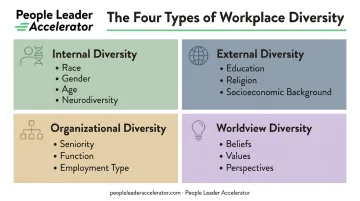
A useful practitioner taxonomy organizes diversity into four areas:
- Internal diversity — traits people are born with or cannot change: race, gender identity, ethnicity, age, sexual orientation, neurodiversity
- External diversity — characteristics that evolve over time: education, religion, socioeconomic background, life experience
- Organizational diversity — role-related differences: seniority, function, employment type, department
- Worldview diversity — differences in perspectives, beliefs, and values shaped by the combination of the above
Legally and Socially Significant Categories
Beyond the framework, several specific categories demand direct attention from HR professionals:
- Racial and ethnic diversity — still the site of measurable hiring disparities, as a study of ~83,000 applications to 108 large employers found distinctively Black names received roughly 9% fewer employer contacts
- Gender diversity — representation gaps persist most sharply at senior leadership levels
- Age and generational diversity — workforces spanning Gen Z through Baby Boomers require communication and management approaches that work across different expectations and work styles
- Disability diversity — physical, intellectual, and psychiatric; research suggests neurodivergent professionals in certain roles can be 30% more productive than teams without them, in well-matched roles, not universally
- Religious and cultural diversity — accommodation policies and inclusive scheduling matter here
Title VII of the Civil Rights Act and the ADA set the legal compliance floor. Best-practice organizations go considerably further.
Why Intersectionality Matters
Employees hold multiple identities simultaneously, and intersectionality shapes how those identities compound. A Black woman in a senior role faces a distinct set of dynamics — not the sum of race-related barriers plus gender-related barriers, but something shaped by both at once. Effective diversity programs account for this: data collection, policy design, and support structures should be built around how people actually experience the workplace, not around isolated demographic categories.
The HR Leader's Strategic Role in Building a Diversity Strategy
Start With Data, Not Assumptions
Building a sustainable diversity strategy begins with listening. Before designing programs, HR leaders should:
- Audit workforce composition — representation across levels, functions, teams, and leadership layers
- Survey employee experience — pulse surveys, focus groups, and exit interviews surface gaps that demographic data alone won't show
- Benchmark against industry norms — representation data without context is difficult to act on
Structured listening — particularly exit interviews and belonging surveys segmented by demographic group — often reveals which specific gaps matter most to employees.
Embed Diversity Across the Employee Lifecycle
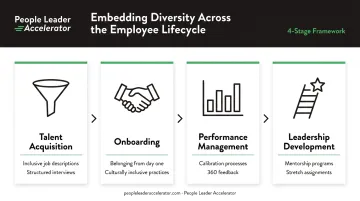
Diversity strategy isn't a standalone program. It belongs inside every HR process:
- Talent acquisition — inclusive job descriptions, structured interviews to reduce evaluator discretion, proactive sourcing from diverse candidate pipelines
- Onboarding — experiences that help diverse new hires feel connection and belonging from day one, not just process compliance
- Performance management — calibration processes and 360-degree feedback to reduce the bias that shows up in informal evaluation
- Leadership development — ensuring underrepresented employees have equitable access to stretch assignments, sponsorship, and mentorship — not just formal programs
Secure Leadership Accountability
DEI efforts without executive sponsorship rarely survive the first budget cycle or organizational shift. HR leaders need to connect diversity goals to business outcomes leadership already cares about: talent competitiveness, innovation, financial performance, and risk reduction.
Tying DEI-related goals to leadership KPIs and incentive structures creates structural accountability rather than relying on goodwill.When DEI progress appears in performance reviews and compensation decisions, it gets treated like any other business priority.
ERGs and Inclusive Policies
Beyond formal programs, day-to-day infrastructure shapes whether DEI commitments feel real to employees:
- Employee Resource Groups — give underrepresented employees community and a voice, and give HR direct insight into experiences that survey data sometimes misses
- Policy audits — surface exclusionary language or practices buried in processes that were never designed with diversity in mind
- Inclusive benefits and accommodations — cultural and religious accommodations, flexible scheduling, and equitable benefits are tangible expressions of a commitment that goes beyond the careers page
HR leaders building DEI strategy in high-growth environments face a specific challenge: culture is being shaped in real time, often faster than formal programs can keep up. People Leader Accelerator addresses this directly, offering frameworks and peer community built for the pace and complexity of scaling organizations.
Common Challenges in Managing Workplace Diversity
Three Persistent Obstacles
1. Unconscious bias in talent decisions
A meta-analysis of field experiments covering 90 studies and more than 170,000 applications across six Western countries found that callback discrimination has remained stable or slightly increased in most countries. Awareness training alone has not moved the needle.
The implication for HR: examine decision-point processes, not just attitudes. Structured hiring, anonymized screening where feasible, and calibration in promotion decisions reduce the surface area for bias to operate.
2. Lack of genuine leadership commitment
Programs that exist at the HR level but don't have visible executive sponsorship tend to plateau quickly. Leaders who treat DEI as someone else's responsibility communicate that to the organization — and employees notice. Building the case using talent and financial data, then embedding diversity goals into leadership performance reviews, shifts this from aspiration to accountability.
3. Hiring diverse talent into an exclusionary culture
Deloitte's global LGBT+ research found that one-third of LGBT+ employees were actively seeking a more inclusive employer, rising to 52% among ethnic-minority respondents. Hiring diverse employees is only the first step. If the day-to-day experience doesn't follow through on the promise, attrition follows — often among the people an organization worked hardest to attract.
Performative vs. Strategic Diversity
The difference between programs that generate press releases and programs that generate change:
| Performative | Strategic |
|---|---|
| Reactive, triggered by external pressure | Proactive, built into HR systems |
| Compliance-driven | Connected to business goals |
| Standalone initiatives | Embedded across the employee lifecycle |
| No measurement or follow-through | Clear KPIs and accountability structures |
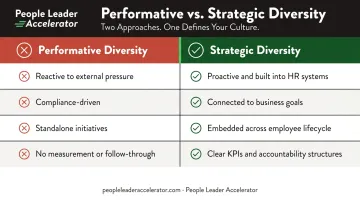
That table describes a real pattern. Organizations reducing or rebranding their DEI programs under political pressure often had programs that were never deeply integrated. A SHRM-reported survey of 60+ executives found slightly over 50% had changed DEI terminology and another 20% were considering it — evidence of reframing, not the goals being abandoned.
Communication Across Differences
Global, remote, and multigenerational teams face friction from communication style differences, language gaps, and varying cultural norms around directness, hierarchy, and disagreement. Practical responses include:
- Cross-cultural communication training for managers and team leads
- Inclusive meeting norms that create space for quieter voices
- Multilingual materials where the workforce requires them
- Deliberate psychological safety structures for dissenting viewpoints
How to Measure Diversity Initiatives
Measurement is what separates a diversity strategy from a diversity aspiration.
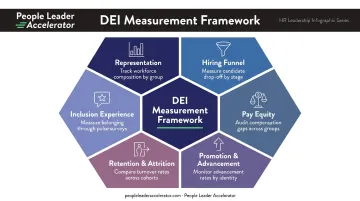
Key Metric Categories
| Category | What to Track |
|---|---|
| Representation | Workforce composition by level, function, department, and leadership layer |
| Hiring funnel | Diverse candidate rates at each stage — sourcing, screening, offer, acceptance |
| Pay equity | Compensation gaps among comparable employees across demographic groups |
| Promotion and advancement | Are all groups progressing at comparable rates? |
| Retention and attrition | Are certain groups leaving at higher rates? What are they citing? |
| Inclusion experience | Survey measures of voice, fairness, belonging, and acceptance — segmented by group |
CIPD and Gartner guidance both converge on this framework: track who is present, who advances, who leaves, what they're paid, and how they experience the workplace. Together, these data points reveal patterns that any single metric would obscure.
Building a Measurement Cadence
- Run workforce composition audits at least annually to track representation across levels and functions
- Conduct inclusion and belonging surveys every six months, aligned with Gallup's engagement benchmarking guidance
- Complete pay equity reviews annually, tied directly to compensation planning cycles
- Share results transparently with employees — visibility builds trust and creates shared accountability
A cadence only works if action follows. One risk worth naming: diversity fatigue — tracking 15 metrics without acting on any of them does more damage than good. Prioritize the metrics that connect to your specific organizational gaps, follow through visibly, and build toward a longitudinal picture rather than a one-time demographic snapshot.
Frequently Asked Questions
What are the main types of diversity in the workplace?
The four broad categories are internal (race, gender, age, neurodiversity), external (education, religion, socioeconomic background), organizational (seniority, function, employment type), and worldview (beliefs, values, perspectives). Within those categories, HR professionals commonly address racial, gender, generational, disability, and religious diversity as distinct priority areas.
What is the difference between diversity, equity, and inclusion in HR?
Diversity is the mix of people in your workforce. Equity means recognizing unequal starting points and designing systems to produce fair outcomes. Inclusion creates a culture where everyone belongs and has genuine voice. All three must work together. Diversity without equity and inclusion is just representation data — it won't translate into performance or retention.
Why is diversity important in HR management?
The ethical case is clear: everyone deserves equitable access to opportunity. The business case is equally strong — diverse, inclusive organizations show better financial performance, higher innovation, and lower attrition, especially among younger workers who weigh company values heavily.
What are the biggest challenges HR faces when managing diversity?
The three most persistent challenges are unconscious bias in hiring and promotion decisions, lack of genuine leadership commitment beyond the HR function, and the failure to build inclusive cultures that retain the diverse talent companies work to attract. Awareness campaigns alone won't solve any of them — each requires structural change.
How do HR leaders measure the success of diversity initiatives?
Effective measurement combines representation data, pay and promotion equity analysis, attrition by demographic group, and inclusion survey results. Tracking these consistently over time matters — but so does acting visibly on what the data reveals, not just reporting it.
What is the HR leader's role in building a diversity strategy?
HR leaders serve as both architect and advocate. They design inclusive systems across the employee lifecycle, build the case for leadership accountability, set measurable goals, and create the conditions where diversity translates into belonging and performance. That's a strategic function, not a compliance checkbox.