The problem usually isn't effort. It's focus. Programs built around generic curricula, off-the-shelf content, or whatever's trending in HR circles rarely produce lasting behavior change. In high-growth organizations especially, where leadership gaps compound as teams scale rapidly, the cost of picking the wrong topics is significant — McKinsey found that 65% of portfolio company failures were attributed to people and organizational issues.
This article lays out 14 proven leadership development topics organized into three practical categories, with guidance on how to prioritize them for your team's specific stage and needs.
Key Takeaways
- Topic selection should start with organizational gaps, not off-the-shelf curricula
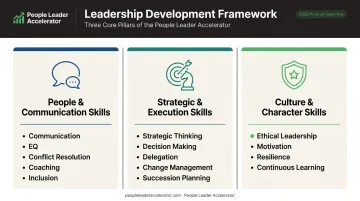
- The 14 topics span three categories: People & Communication, Strategic & Execution, and Culture & Character
- Prioritization depends on team stage, leadership level, and current performance data
- Programs need structured delivery and measurable outcomes to create real behavior change
- High-growth organizations need to sequence topics deliberately — the right focus at the wrong stage rarely sticks
Why Leadership Development Topics Matter for Team Growth
Leadership development is an ongoing investment in the specific behaviors that drive performance, retention, and organizational resilience — not a one-time training event to check off the calendar. The ROI case is clear: Gallup research shows that managers who complete strengths-based development programs improve their own engagement by up to 22%, with their teams showing 18% higher engagement and key performance metrics improving 20–28%.
The downside of poor topic selection is just as measurable:
- Leaders trained on irrelevant skills don't transfer learning back to their teams
- Budget gets spent without measurable behavior change
- In scaling organizations, underdeveloped leaders create bottlenecks that multiply as headcount grows
The best programs are intentional — selecting topics based on three intersecting factors: current leadership gaps, organizational stage, and business priorities. The 14 topics below reflect that framework, covering the competencies that matter most across each stage of team growth.
14 Top Leadership Development Topics for Team Growth
The 14 topics below are organized into three categories — People & Communication Skills, Strategic & Execution Skills, and Culture & Character Skills. This framework ensures leaders develop holistically, not just in one dimension.
People & Communication Skills
Topic 1 — Communication & Active Listening
Effective leaders communicate with clarity and empathy across formats: one-on-ones, all-hands, written updates, and difficult conversations. Active listening — genuinely understanding the message beneath the words — is a distinct skill, not just a personality trait. It's teachable, and it directly reduces misalignment.
The data supports the urgency: 29% of employees cite a lack of clear, honest, or consistent leadership communication as a workplace problem. Communication development delivers outsized returns — few other investments touch this many performance variables at once.
Topic 2 — Emotional Intelligence & Self-Awareness
EQ encompasses recognizing emotional triggers, demonstrating empathy, and managing reactions under pressure. A review of 104 peer-reviewed articles confirmed that emotionally intelligent leaders show improved leadership behaviors, stronger business results, and better team performance. Leaders with higher EQ are better equipped to maintain team morale and de-escalate tension before it costs performance.
Topic 3 — Conflict Resolution
Conflict is inevitable in high-performing teams. The differentiator is how leaders handle it. Nearly 50% of manager candidates assessed by DDI lacked effective conflict-management skills — and the organizational cost shows up in attrition: job satisfaction drops to 54% among employees experiencing conflict, versus 77% among those who aren't.
Effective conflict training develops two connected capabilities:
- Diagnosing root causes rather than managing surface symptoms
- Redirecting disagreements toward shared problem-solving
Topic 4 — Coaching & Developing Others
Great leaders build capability by asking growth-oriented questions rather than defaulting to directives. Coaching conversations shift the dynamic from dependency to ownership — critical in organizations where leaders can't afford to be the answer to every question.
Research confirms this works: executive coaching meta-analyses show large effects on cognitive outcomes like goal-setting and planning strategies, and managerial coaching correlates with employee innovation and engagement.
Topic 5 — Inclusion, Belonging & Psychological Safety
This topic goes well beyond DEI compliance. Leaders who actively foster inclusive environments — where team members feel safe to contribute and challenge ideas — see measurable differences in retention and performance.
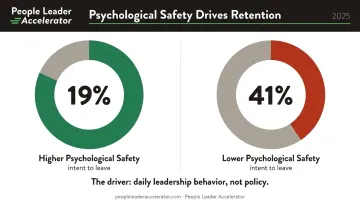
Among workers with higher psychological safety, only 19% intended to seek a new job within a year, compared to 41% of those with lower safety. The driver? Daily leadership behavior, not policy documents.
Strategic & Execution Skills
Topic 6 — Strategic Thinking & Goal Alignment
Most leaders at mid-level don't know their organization's strategic priorities well enough to translate them into team action. MIT Sloan research found that only 28% of executives and middle managers could name three of their organization's strategic priorities. Strategic alignment dropped from 51% at the top team level to just 22% among their direct reports.
When leaders can't connect daily decisions to organizational direction, execution breaks down — regardless of how sound the strategy is.
Topic 7 — Decision Making & Problem Solving
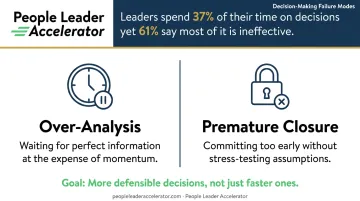
Leaders spend an average of 37% of their time making decisions — yet 61% say most of that time is ineffective. Structured decision-making training addresses the two most common failure modes:
- Over-analysis: Waiting for perfect information at the expense of momentum
- Premature closure: Committing too early without stress-testing assumptions
The goal is better judgment — not faster decisions, but more defensible ones.
Topic 8 — Delegation & Accountability
Delegation isn't task assignment. It's transferring authority alongside responsibility. Only 19% of assessed manager candidates demonstrated strong delegation skills, and DDI identified it as the skill most strongly linked to preventing leader burnout.
The accountability side matters equally: fewer than half of leaders excel at holding employees to commitments, which produces unclear expectations, missed follow-through, and teams that stall the moment their manager steps back.
Topic 9 — Change Management & Adaptability
Only 50% of business leaders believe their organizations are well-prepared to respond to external shocks. Change management training builds three capabilities most associated with successful transformations:
- Communicating the rationale for change in ways that reduce uncertainty
- Managing resistance without dismissing legitimate concerns
- Reinforcing new behaviors consistently until they stick
Topic 10 — Succession Planning & Talent Development
56% of HR professionals report their organization has no succession plan. Succession planning as a leadership topic (treated as a leadership skill, not just an HR process) trains leaders to identify and develop the people around them. The result: organizational resilience when key roles turn over, rather than scrambling to fill them.
Culture & Character Skills
Topic 11 — Ethical Leadership & Integrity
Leaders set the ethical tone through daily decisions, not annual compliance training. When leaders model transparency and handle gray-area decisions visibly, they signal what behavior is acceptable — more powerfully than any policy document. This topic focuses on values-based decision-making and creating conditions where concerns surface early, not after they've become crises.
Topic 12 — Team Motivation & Engagement
Managers account for 70% of the variance in team-level engagement — which means no culture initiative, compensation strategy, or perks program compensates for poor direct management. Sustainable motivation requires connecting individuals to purpose, recognizing contributions in ways that actually land, and designing work that supports autonomy and growth.
Topic 13 — Resilience & Stress Management
71% of leaders report significantly greater stress after entering their current role, and 54% of that group are concerned about burnout. In high-growth environments where ambiguity is constant, resilience isn't optional. Leaders who model healthy responses to setbacks and maintain composure under pressure also prevent burnout from cascading through their teams — a compounding effect that's difficult and expensive to reverse.
Topic 14 — Continuous Learning & Self-Development
The most effective leaders treat their own development as a permanent work in progress. This mindset topic — seeking feedback, reflecting on experience, staying curious — builds a learning culture from the top down. McKinsey's research on behavior change makes the mechanism clear: on-the-job application and repetition are required for sustained change; classroom instruction alone isn't enough.
How to Prioritize Leadership Development Topics for Your Team
Not all 14 topics deserve equal emphasis at every stage. Prioritization should be driven by a leadership gap assessment, not guesswork.
Start with a gap assessment using three data sources:
- 360-degree feedback to surface recurring behavioral gaps
- Performance and engagement data to identify where team outcomes are weakest
- Skip-level conversations to uncover what managers aren't hearing directly
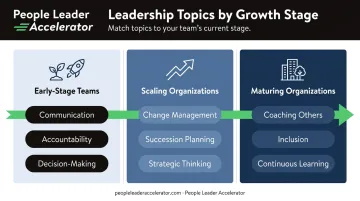
Once you have that data, use your organization's growth stage to filter which topics belong on the short list:
| Stage | Priority Topics |
|---|---|
| Early-stage teams | Communication, accountability, decision-making |
| Scaling organizations | Change management, succession planning, strategic thinking |
| Maturing organizations | Coaching others, inclusion, continuous learning |
Map topics to leadership level, not just seniority:
- First-time managers need foundational skills: communication, conflict resolution, and accountability
- Senior leaders require strategic and organizational scope — succession planning, change management, and strategic alignment
A one-size-fits-all curriculum is one of the most common failure modes in leadership development. Programs that skip this targeting step tend to generate attendance, not behavior change.
How to Build a Leadership Development Program Around These Topics
A list of 14 topics only creates value when embedded into a structured program. The delivery format matters as much as the content.
Key design principles for behavior change:
- Tie each topic to a measurable business outcome (conflict resolution → fewer escalated people issues; delegation training → improved manager spans of control)
- Use varied formats: cohort sessions, peer learning circles, and 1:1 coaching reinforce topics in ways a single workshop can't
- Sequence topics deliberately — don't cover succession planning before leaders have mastered delegation
- Measure behavioral indicators, not just completion rates
Programs without measurement consistently lose executive sponsorship. That outcome is predictable — and avoidable.
HR leaders building or upgrading their leadership development approach can explore People Leader Accelerator's programs, designed specifically for people leaders in high-growth organizations. The faculty — including Andrew Bartlow (25 years of HR and talent experience), Brad Harris, Ph.D. (Professor at HEC Paris), and Carmela Krantz (30 years building HR functions at start-ups and scale-ups) — are co-authors and practitioners who bring both research depth and real-world application.
The cohort-based model pairs live instruction with peer learning and immediately applicable frameworks. That combination aligns with what McKinsey's behavior-change research identifies as the conditions required for lasting development.
Conclusion
Strong leaders are built through intentional programs — the right topics, sequenced for your team's stage, delivered in formats that require application rather than just attendance.
The practical starting point isn't a 14-topic overhaul. It's identifying the two or three leadership gaps most limiting your team's growth right now, then building outward from there.
If you're an HR or people leader navigating these challenges, People Leader Accelerator offers programs built specifically for high-growth environments — practical frameworks, expert-led curriculum, and a peer community that moves well beyond generic training. Start with the gaps, then find the right tools to close them.
Frequently Asked Questions
What are good leadership development topics?
Communication, emotional intelligence, accountability, strategic thinking, and change management consistently surface across strong programs — but the right topics depend on your specific organizational gaps, not a generic curriculum. What a first-time manager cohort needs will differ significantly from what a senior leadership team requires.
What are the 5 C's of leadership development?
There's no single standardized "5 C's" framework — different sources use different variations. The Center for Creative Leadership points to four core skills across all roles — self-awareness, communication, influence, and learning agility — which is a more grounded starting point than any generic "C's" model.
How do you prioritize leadership development topics for a team?
Start with a gap assessment combining 360-degree feedback, performance data, and skip-level conversations to identify recurring gaps. Then filter by organizational stage and leadership level. Early-stage teams typically need communication and accountability; scaling teams usually add strategic thinking and change management.
What is the difference between leadership training and leadership development?
Training is a discrete, skills-focused event — typically a workshop or course with a defined endpoint. Development is an ongoing, holistic process that builds leadership capacity over time through experience, coaching, reflection, and repetition. Behavior change requires development; training alone rarely produces it.
How do you measure the effectiveness of a leadership development program?
Look at behavioral indicators (360 feedback trends, team engagement scores), business outcomes (retention, productivity), and leading indicators like observed behavior change. Participation and satisfaction scores tell you people showed up — not whether anything changed.
What leadership skills matter most in high-growth organizations?
In high-growth environments, the highest-leverage skills tend to be change management, delegation, strategic thinking, and coaching others. Leaders must scale their impact faster than headcount grows — which means these four topics determine whether growth amplifies or undermines team performance.