Introduction
When an HR investigation goes wrong, the damage is rarely contained. Bias in the process, delayed action, or incomplete documentation can expose your organization to litigation, erode employee trust, and fail the very people who took a risk by coming forward.
This guide is written for HR professionals, HRBPs, and people leaders in high-growth organizations who need a structured, defensible process they can apply consistently, at any level of complexity or seniority.
What follows is a practical breakdown of all 8 steps — the kind of process that holds up under legal scrutiny, treats all parties fairly, and gives you a clear record of every decision made.
Key Takeaways
- An HR investigation is a fact-finding process that must remain impartial from intake to conclusion — never a disciplinary hearing in disguise
- Both formal complaints and observed policy violations require a formal investigation response
- Investigator neutrality is essential — perceived bias is one of the most common grounds for challenging findings
- Documentation must be captured throughout — not reconstructed after the fact
- Post-investigation aftercare and retaliation monitoring are as important as the investigation itself
What Is an HR Investigation?
An HR investigation is a structured, internal fact-finding process used to determine whether a workplace policy was violated, who was involved, and what happened. It is not a legal proceeding, and it is not a disciplinary hearing — those come later, if at all.
Common triggers include:
- Harassment or sexual harassment allegations
- Discrimination complaints
- Workplace violence or threats
- Theft or fraud
- Retaliation claims
- Abuse of leave or attendance policy
- General misconduct or code of conduct violations
HR Acuity's 2025 employee survey of over 2,000 U.S. employees found that 55% had experienced or witnessed misconduct, with favoritism and bullying topping the list at 37% and 36% respectively. That prevalence makes it critical to know when a situation warrants a formal process — and when it doesn't.
Formal vs. Informal Resolution
Not every complaint requires a formal investigation. Minor miscommunications may be resolvable through conversation or mediation. A formal investigation is required when:
- A written complaint has been filed
- A serious policy violation is alleged
- Informal resolution has failed or isn't appropriate given the severity
When in doubt, investigate. Under-investigating a serious issue carries far greater organizational risk than over-investigating a minor one.
When to Conduct a Formal HR Investigation
Two situations make a formal investigation non-negotiable: a formal complaint has been filed, or a workplace policy has been visibly violated. In both cases, HR should initiate fact-finding promptly.
The legal stakes of delay are real. The Faragher/Ellerth framework permits an affirmative defense in certain harassment cases only where the employer exercised reasonable care to prevent and promptly correct the alleged conduct. In Swenson v. Potter, the Ninth Circuit held that an employer's total response — including its investigation — must be "prompt and appropriate." Courts and juries evaluate both timeliness and quality.
There's no universal legal deadline, but HR Acuity's benchmark data gives useful reference points:
| Issue Category | Average Days to Close |
|---|---|
| Policy violations | 23 days |
| Behavioral issues | 28 days |
| Sexual harassment | 30 days |
| Non-sexual harassment | 30 days |
| Retaliation | 32 days |
| Discrimination | 34 days |
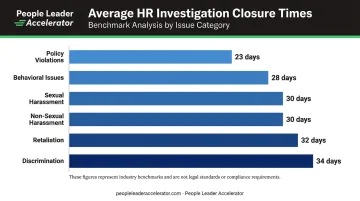
These are descriptive benchmarks, not legal standards. They do, however, define what "reasonable" looks like when courts and regulators review your process.
How to Conduct an HR Investigation in 8 Steps
Every investigation is unique. But a consistent methodology protects the organization and signals fairness to everyone involved. Here's the process.
Step 1: Take Immediate Action if Necessary
Before the formal investigation begins, assess whether the situation requires stabilization. This might mean:
- Temporarily separating the parties involved
- Reassigning duties or work locations
- Placing an employee on paid administrative leave if there's a safety concern
Critical distinction: these measures are about protecting the process and the people involved — not prejudging the outcome. SHRM specifically warns against unpaid administrative leave, which can constitute an adverse employment action. Paid leave, where separation is genuinely necessary, is the safer and more defensible option.
Step 2: Assign the Right Investigator
The investigator must have no personal stake in the outcome. Perceived bias is one of the most common grounds for challenging an investigation's findings.
In Kramer v. Wasatch County Sheriff's Office, investigation deficiencies and investigator bias were identified as material issues that prevented the employer from resolving its affirmative defense at summary judgment — a costly outcome that proper investigator selection would have avoided.
Use an internal HRBP when:
- The matter is routine and the HRBP has no prior relationship with the parties
- Organizational knowledge is useful to the fact-finding
Use an external investigator when:
- The allegation involves a senior leader or executive
- The internal HR team has a prior relationship with any party
- There is any doubt about perceived neutrality
- The stakes are high enough that independent credibility matters
Step 3: Define the Scope and Build a Plan
Before interviewing anyone, document the investigation's parameters:
- The specific allegation
- Which policies may have been violated
- Who is involved
- The timeframe under examination
- Planned evidence sources and witness list
A scoped, written plan prevents "scope creep" — where an investigation expands beyond its original mandate and becomes harder to defend or conclude. It also creates an accountability record for the process itself.
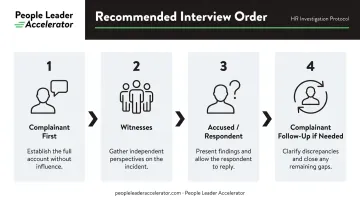
Interview sequencing matters. The standard recommended order is:
- Complainant first
- Witnesses
- Accused/respondent
- Complainant again (if later evidence warrants a follow-up)
This sequence preserves the integrity of fact-finding: you gather the full picture before confronting the respondent, and follow up with the complainant only when new material evidence requires it.
Step 4: Conduct Interviews Systematically
Open every interview the same way: introduce attendees, explain the purpose without over-disclosing, and set clear expectations for candor. Make confidentiality requirements explicit — parties should not discuss the investigation with colleagues while it's in progress.
Best practices for questioning:
- Lead with open-ended questions ("Tell me what happened on that day") before narrowing to specifics
- Ask interviewees to recount events in their own words, not respond to your framing
- Watch for behavioral cues — hesitation, inconsistencies, unprompted detail — that warrant follow-up
- Rephrase and revisit answers when something doesn't add up
Note-taking is essential. An Idaho federal court imposed an adverse-inference jury instruction after a university shredded notes from 32 witness interviews one week after issuing its investigation report. Those notes are evidence. Treat them accordingly.
Step 5: Gather and Analyze Evidence
Interviews alone rarely tell the complete story. Collect corroborating documentation throughout the process:
- Emails and chat logs
- Surveillance footage (where applicable)
- Attendance and timekeeping records
- Performance documentation
- Prior complaints or disciplinary records involving the parties
The evidentiary standard for HR investigations is preponderance of the evidence — meaning what is more likely than not to have occurred. This is a lower threshold than the criminal "beyond a reasonable doubt" standard, and it's appropriate for internal workplace matters. Apply it consistently.
When accounts conflict, assess consistency, corroboration, plausibility, and whether any party had a clear motive to misrepresent events.
Step 6: Reach a Conclusion
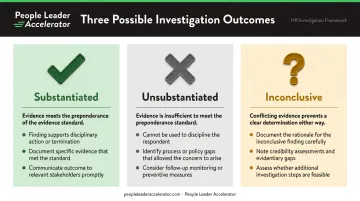
Review all evidence and interview notes together. Check for consistency across accounts, assess the credibility of each party, and compare the case against how similar situations have been handled in your organization. Every investigation resolves into one of three findings, each with distinct implications for what comes next:
Three possible outcomes:
| Outcome | What It Means |
|---|---|
| Substantiated | Evidence meets the preponderance standard; misconduct is confirmed |
| Unsubstantiated | Evidence does not meet the threshold; policy violation not confirmed |
| Inconclusive | Conflicting evidence prevents a reliable finding |
Each outcome carries different implications. Substantiated findings may lead to disciplinary action, termination, or policy changes. Unsubstantiated findings still require communication and follow-up. Inconclusive findings don't mean "nothing happened" — they mean the evidence was insufficient, and that distinction matters when documenting your rationale.
Applying different remediation standards based on seniority or popularity is one of the most common grounds for discrimination claims. The EEOC explicitly directs employers to identify comparable cases and confirm that policy was applied consistently across the board.
Step 7: Document Everything and Create a Report
A complete investigation file should include:
- A comprehensive written report
- Time-stamped, legible interview notes
- All supporting documentation with names and dates
- A summary of findings and the rationale for your conclusion
- A record of interim measures taken
The report is your primary protection in any subsequent legal proceeding. It should be factual and chronological — not editorialized — and organized so that evidence, credibility analysis, and findings are clearly identifiable.
Document throughout the investigation, not after — reconstructed notes are far less defensible than contemporaneous records. Store the complete file securely, with access limited to those with a direct need to know.
Step 8: Communicate Findings and Follow Up
Each party deserves a direct conversation about what was determined and what happens next.
- Complainant: Inform them of the outcome and the steps being taken, without revealing confidential details about the respondent's situation
- Respondent: Inform them of findings and any resulting action
- Witnesses: Briefly thank them for participating; no detailed outcome disclosure is necessary
Retaliation warnings must be explicit and specific. All parties — especially the respondent — must be told directly that retaliation of any kind is prohibited, and "retaliation" must be defined with examples. Well-intentioned actions (excluding someone from meetings, quietly shifting a work assignment) can still constitute retaliation under the law.
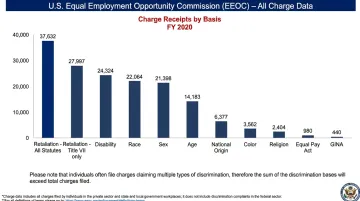
Retaliation was the leading EEOC charge category in FY2024, accounting for 42,301 charges — 47.8% of all 88,531 EEOC charges filed. Once findings are communicated, keep monitoring: document any behavioral changes involving the parties, and be prepared to act quickly if retaliation surfaces.
Common Mistakes That Derail HR Investigations
Even experienced HR teams stumble in predictable ways. The most damaging errors:
Treating the investigation as a formality. When the outcome feels predetermined, investigators skip steps, ask leading questions, or document inadequately. This exposes the organization to liability and fails the people involved.
Confidentiality mishandling. Over-restricting information from the complainant — telling them only that "it was handled" — can fuel retaliation claims. Sharing too much detail about the respondent can violate privacy and create additional legal exposure. The balance requires deliberate, legally vetted judgment.
The consistency trap. Picture two employees investigated for the same policy violation: a senior manager receives coaching; a junior contributor is terminated. That disparity alone can support a discrimination or disparate treatment claim, regardless of the intent behind each decision. Without consistent standards applied uniformly, even well-intentioned outcomes invite legal challenge.
What Happens After the Investigation Closes
Aftercare is not optional. Every person involved has been affected, and how HR manages the return to normal working conditions determines whether organizational trust holds or erodes.
HR Acuity found that among employees who experienced misconduct and left their organization, 65% said it contributed to their decision to leave. That's the cost of mishandling the aftermath.
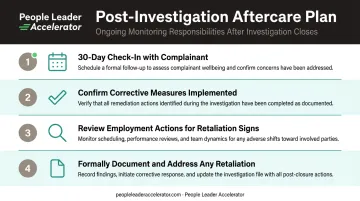
A structured aftercare plan includes:
- Check-ins with the complainant at 30 days post-close and at regular intervals thereafter
- Confirmation that any corrective measures were implemented
- Review of subsequent employment actions involving the parties for signs of retaliation
- Swift response if retaliation does occur — documented and addressed formally
Beyond individual aftercare, investigation findings are an organizational learning opportunity. Even when allegations are unsubstantiated, the process often surfaces team dynamics, management behavior patterns, or policy gaps that warrant attention. Strategic HR leaders treat investigation outcomes as signals, not just compliance obligations.
A pattern of complaints in one team, for example, is data worth acting on through coaching, training, or structural changes.
Monitor post-investigation conditions actively, not passively. Document every check-in. If something changes for the worse, you want a clear record showing your organization responded appropriately.
Frequently Asked Questions
What happens in an HR investigation?
An HR investigation is a structured internal fact-finding process. It involves interviews with the complainant, respondent, and witnesses, along with evidence collection, to determine whether a workplace policy was violated and what action, if any, is warranted. It is distinct from any subsequent disciplinary process.
Do HR investigations lead to termination?
Most don't. HR Acuity data shows an overall substantiation rate of about 41% among organizations that track it — and substantiation doesn't automatically mean termination. Outcomes range from no action to training, disciplinary measures, or termination, depending on the severity and circumstances of substantiated misconduct.
Who should conduct an HR investigation?
The investigator should be impartial and free from any personal stake in the outcome — typically an HRBP or HR leader with no prior relationship to the parties. For allegations involving executives, high-profile employees, or cases where neutrality might be questioned, an external investigator is the more defensible choice.
How long does an HR investigation typically take?
It depends on complexity. HR Acuity benchmarks show average closure times ranging from 23 days for policy violations to 34 days for discrimination cases. Matters involving multiple parties or extensive documentation can run longer.
What should be included in an HR investigation report?
The report should include a summary of the allegation, the investigation process, interview findings, evidence reviewed, the conclusion (substantiated, unsubstantiated, or inconclusive), and recommended next steps. Time-stamped notes and supporting documents belong in a separate, secured investigation file.
Can an employee refuse to participate in an HR investigation?
Employees can decline, but refusal carries professional consequences and may affect how the investigation proceeds. Organizations retain the authority to conduct investigations regardless of whether all parties agree to participate — and an employee's refusal to cooperate can itself be noted in findings.