Introduction
Manufacturing HR leaders carry a weight that few other HR professionals face. On any given shift, they're managing OSHA compliance documentation, covering unexpected absences that could halt production, and trying to figure out how to fill a welder vacancy that's been open for four months — all while leadership wants a retention strategy by Friday.
That pressure is structural, not situational. Manufacturing HR sits at the collision point between production floor realities and long-term people strategy. The stakes are higher than in most industries: a compliance failure doesn't just cost money — it can injure workers. A staffing gap can ripple into overtime violations, quality escapes, and missed delivery commitments.
This article covers what makes HR in manufacturing genuinely different, the core responsibilities the function owns, the most persistent challenges HR leaders face, and practical strategies for getting ahead of them.
Key Takeaways
- Manufacturing HR directly affects production continuity, safety records, and regulatory standing — not just people outcomes
- Skills shortages, high turnover, and OSHA compliance are structural challenges requiring proactive strategy, not reactive fixes
- Workforce planning, safety culture, continuous learning, and people analytics are the four levers that separate strategic manufacturing HR from administrative HR
- Industry 4.0 is forcing HR to lead large-scale reskilling, shifting the function toward workforce transformation
What Makes HR in Manufacturing Unique?
In manufacturing, HR decisions don't play out over weeks in email threads — they surface within hours on the production floor.
A poorly timed hiring gap doesn't just affect morale — it shuts down a shift. A compliance lapse doesn't just create paperwork — it can trigger an OSHA inspection, a six-figure fine, or a worker injury. That operational immediacy sets manufacturing HR apart from almost every other sector.
The Frontline Difference
Unlike office-based or service-sector environments, manufacturing HR manages a workforce where most roles are physically demanding, shift-based, and directly tied to safety outcomes. As of March 2026, U.S. manufacturing employed 12.6 million workers, with over half in direct production roles. The median worker age is 43.9 years, with nearly 3 million workers aged 55–64 — a retirement cliff HR can't afford to ignore.
Compliance Obligations at a Different Scale
The regulatory landscape in manufacturing is layered in ways most industries don't encounter:
- FLSA, FMLA, and ADA requirements apply at the federal level — with FMLA kicking in at 50+ employees
- OSHA's General Duty Clause and industry-specific standards require active documentation and ongoing hazard management
- State labor laws vary significantly by jurisdiction and frequently stack on top of federal minimums
- Where unions are present, collective bargaining agreements add another layer of enforceable obligations entirely
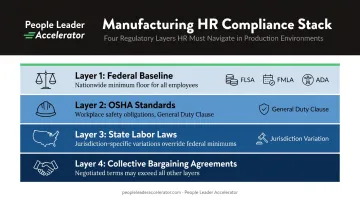
Miss any one of these layers, and the consequences land fast — on the floor, in the incident report, or in the courtroom.
The Core Role of HR in Manufacturing
Manufacturing HR is both strategic and operational, and the balance between those two modes shifts constantly depending on what's happening on the floor.
Workforce Planning and Recruitment
Manufacturing hiring rarely follows a clean, predictable rhythm. HR must align headcount with production schedules, manage a mix of full-time, part-time, and contract workers, and recruit proactively for skilled trades roles that can take months to fill.
Effective manufacturing HR teams don't wait for vacancies to post jobs. They build ongoing relationships with trade schools, community colleges, and apprenticeship programs, and they use workforce data to anticipate gaps before they become crises. People Leader Accelerator's Strategic People Planning Guide provides a structured methodology for aligning workforce decisions with business goals — particularly useful for HR leaders managing headcount fluctuations tied to production demand.
Health, Safety, and Compliance
In manufacturing, safety is central to HR's mandate, not a supporting function. HR owns:
- Developing, communicating, and enforcing safety protocols
- Ensuring mandatory training is completed, tracked, and documented
- Maintaining OSHA compliance and preparing for audits
- Investigating incidents and near-misses with documentation integrity
Noncompliance carries serious consequences. 2026 OSHA penalties for Serious violations reach $16,550 per citation, with willful or repeated violations hitting $165,514. One Chicago countertop manufacturer faced a $1 million fine in 2024 alone.
Training, Development, and Onboarding
Manufacturing training serves two purposes at once: meeting compliance requirements and building a workforce that stays. HR must coordinate:
- Role-specific safety certifications before workers operate equipment
- Ongoing refresher training with documented completion records
- Upskilling programs that keep pace with new technology and processes
Training that's only compliance-driven gets treated as a checkbox. Training that creates visible career progression becomes a retention tool.
Employee Relations, Performance, and Engagement
Performance management in manufacturing connects directly to production metrics: output, quality, efficiency, and safety records. HR sets the standards, builds manager capability to apply them consistently, and manages disciplinary processes that must be fair and well-documented.
Engagement is harder in manufacturing than in most sectors. Repetitive work, physical strain, and limited remote flexibility mean engagement programs need to be substantive, not just wellness newsletters. Effective approaches include:
- Structured recognition tied to performance and tenure
- Cross-training that expands skills and breaks routine
- Visible advancement paths from floor roles into leadership
Compensation, Payroll, and Benefits
Payroll complexity is a defining feature of manufacturing HR. HR must manage:
- Shift differentials and overtime premiums
- Skill-based pay scales and progression frameworks
- Union agreements and collective bargaining terms where applicable
- Benefits packages that account for the physical demands of the work
Getting pay structures wrong (inequitable, non-competitive, or non-compliant) accelerates turnover in a labor market that's already tight.
Key HR Challenges in Manufacturing
Manufacturing HR operates under pressures that most industries don't encounter at the same intensity. Five challenges dominate the landscape.
Persistent Skills Shortages and Talent Acquisition
The talent crisis in manufacturing is structural, not cyclical. The industry needs 3.8 million new employees by 2033, with roughly 2.8 million of those openings driven by retirements. As many as 2.1 million jobs could go unfilled by 2030 if hiring patterns don't shift.
The mismatch is specific: it's not a general labor shortage, it's a shortage of welders, machinists, CNC operators, and maintenance technicians. Roles that require credentials, hands-on experience, and years to develop. HR can't hire its way out of this problem. It has to build pipelines.
High Turnover and Retention Pressure
Frontline attrition exceeded 10% for 36% of manufacturers in 2023, and 48% of Gen Z workers in manufacturing report intending to leave within 3–6 months. Repetitive work, physical strain, inconsistent scheduling, and limited career visibility are the primary drivers.
These gaps create a cascading effect:
- Unplanned gaps disrupt shift coverage and production targets
- Overtime costs spike to compensate
- Remaining workers absorb additional load, accelerating further attrition
- Quality suffers as experienced workers are replaced by newer, less-trained ones
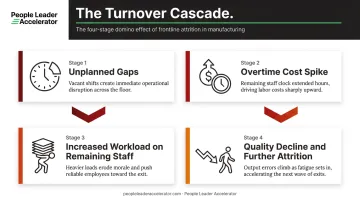
Manufacturing HR can't offer remote work or location flexibility as retention tools. The levers are compensation, culture, career pathways, and recognition.
Workforce Safety and OSHA Compliance
Manufacturing workers face higher-than-average injury and illness rates. The sector's 2024 Total Recordable Cases rate was 2.7 per 100 full-time employees, with a DART rate of 1.7 — meaning more than one in 100 workers experienced an injury or illness resulting in days away, restricted activity, or a job transfer.
HR's safety mandate goes beyond documentation. It requires:
- Building a culture where workers report near-misses without fear of reprisal
- Integrating safety standards into onboarding, performance reviews, and manager accountability
- Conducting regular audits that identify hazards before incidents occur
Complex and Evolving Compliance Requirements
The compliance landscape doesn't stay static. Federal regulations update, OSHA penalty thresholds increase annually, and state laws layer additional requirements on top of federal standards. Collective bargaining agreements add another layer of ongoing administration.
Staying current is an active, continuous responsibility. That means:
- Maintaining centralized, audit-ready documentation
- Conducting regular policy reviews as regulations shift
- Coordinating closely with legal counsel on state-specific requirements
Digital Transformation and the Skills Gap
Industry 4.0 is creating a dual pressure. Current employees may struggle to adapt to automation, AI-driven equipment, and digital production systems. At the same time, new roles require technical fluency that much of the available labor pool doesn't have. By 2029, 40% of skill requirements in manufacturing will have evolved, and demand for simulation software skills has already risen 75% since 2019.
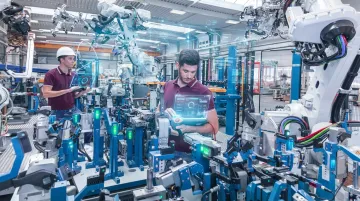
HR must manage the change communication, coordinate upskilling programs, and ensure technology adoption doesn't deepen the existing skills gap rather than close it.
Best Practices for Effective Manufacturing HR
The most effective manufacturing HR leaders treat these challenges as areas where strategic intervention creates real competitive advantage — not fixed constraints to manage around.
Build Proactive Talent Pipelines
Reactive recruiting — posting jobs when vacancies appear — doesn't work for skilled trades roles with long hiring cycles. Proactive pipeline development looks like:
- Sustained partnerships with vocational schools, community colleges, and registered apprenticeship programs
- Targeted outreach to veterans and career-changers who already have relevant discipline and technical aptitude
- Job descriptions that reflect actual shop-floor conditions honestly — not aspirational marketing copy
Embed Safety Into Culture, Not Just Policy
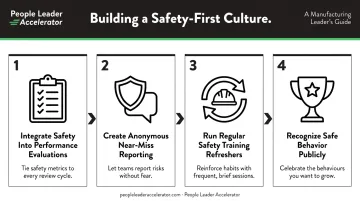
Organizations where safety is a lived value — not just a compliance checklist — have fewer incidents, better documentation, and stronger employee trust. Practical steps:
- Integrate safety into performance evaluations for frontline supervisors and managers
- Create anonymous near-miss reporting so workers surface hazards without fear
- Run regular safety training refreshers rather than annual check-the-box sessions
- Recognize safe behavior publicly — not just incident-free departments
Invest in Continuous Learning
Structured training programs serve both retention and performance goals. The approach that works in manufacturing:
- Combine hands-on skills development with digital literacy for equipment and systems
- Create visible career pathways from entry-level roles through skilled trades and supervisory positions
- Use a learning management system to track completion, certifications, and recertification deadlines centrally
Workers who can see where a role leads — not just what it pays — are more likely to stay and develop.
Use Data to Drive Workforce Planning
People analytics transforms manufacturing HR from reactive to anticipatory. Tracking the right metrics makes HR a credible partner to operations leadership — not just an administrative function. Key areas to measure include:
- Absenteeism patterns by shift, department, or season
- Turnover risk indicators by role or tenure cohort
- Training completion rates and recertification deadlines
- Cost-per-hire and time-to-fill for hard-to-source trades roles
People Leader Accelerator's People Analytics Guide offers a practical framework for HR leaders building this capability, including a free HR Dashboard Sample and Cost of Turnover Calculation Template.
Emerging Trends Reshaping HR in Manufacturing
Three trends are reshaping what manufacturing HR needs to do and how it needs to operate.
AI and Automation: Job Architecture Is Changing
As manufacturers invest in automated equipment and digital systems, HR must redesign roles, manage displacement concerns, and lead large-scale reskilling — not just administer the change. HR leaders who position themselves as workforce transformation partners carry far more organizational influence than those who stay in compliance management mode.
Wellness Has Become a Retention Variable
Burnout, fatigue, and physical overload aren't just safety concerns — they're turnover accelerants. Physical and mental wellness programs aren't soft benefits; they're measurable business investments. In most manufacturing organizations, HR owns the design and delivery of those programs.
DEI Is Moving From Messaging to Practice
Women currently hold 29.1% of manufacturing jobs. The industry's ability to attract younger workers and underrepresented groups will directly shape whether labor shortages improve or worsen. HR plays a concrete role here — reshaping recruitment messaging, onboarding experiences, and workplace culture to make manufacturing accessible to a broader talent pool.
Frequently Asked Questions
What is the role of HR in manufacturing?
HR in manufacturing manages the full employee lifecycle : recruiting, safety compliance, training, workforce planning, and employee relations. HR carries direct accountability for production continuity and regulatory standing — unlike most industries, these decisions carry immediate operational and legal consequences.
What are the biggest HR challenges in the manufacturing industry?
The top challenges are persistent skills shortages, high frontline turnover, OSHA compliance, multi-layered regulatory requirements, and managing the workforce impact of automation and digital transformation. Most require proactive strategy rather than reactive response.
How can HR reduce high turnover in manufacturing companies?
Effective retention levers include competitive compensation with shift premiums, career progression pathways, cross-training, recognition programs, and wellness initiatives. Honest job descriptions that set accurate expectations upfront also reduce early-tenure attrition significantly.
How does HR manage compliance in manufacturing environments?
HR must navigate FLSA, FMLA, ADA, OSHA, and state-specific labor laws simultaneously. This requires centralized documentation systems, regular policy audits, mandatory training tracking, and close collaboration with legal and operations teams.
What skills does an HR leader in manufacturing need?
Effective manufacturing HR leaders combine compliance and safety knowledge with strategic capabilities: workforce planning, people analytics, change management, and the ability to operate as a genuine business partner to operations — not just an administrative function.
How is digital transformation changing HR in manufacturing?
Automation and AI are reshaping job roles and creating skills gaps that didn't exist five years ago. HR must lead reskilling at scale, manage resistance to new technology, and integrate digital tools into planning and compliance tracking.