
Introduction
HR professionals in growing organizations face a constant tension: the day-to-day pull of employee requests, complaints, and inquiries competes directly with the strategic work that moves the business forward.
When an employee brings a payroll dispute, a harassment complaint, or a sensitive accommodation request, they need a structured, fair response — not whatever happens to be available that day.
Without a consistent system, even well-intentioned HR teams lose information across email threads, apply policies unevenly, and leave employees uncertain about what happens next.
The EEOC received 88,201 new discrimination charges in FY2025, which underscores a direct legal consequence: how organizations handle internal employee concerns matters.
This guide covers the definition of HR case management, why it matters, the types of cases it handles, the five-step process, the skills required, and best practices for getting it right.
Key Takeaways
- HR case management is the structured process of documenting, tracking, and resolving employee issues to ensure fair, consistent, and compliant outcomes
- A centralized approach cuts legal exposure, improves efficiency, and strengthens employee trust
- Effective case management combines the right operational systems with strategic HR skills like critical thinking and pattern recognition
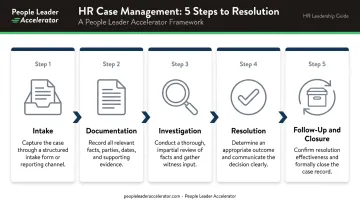
- The five core steps are: intake, documentation, investigation, resolution, and follow-up/closure
What Is HR Case Management?
HR case management is the structured organizational process by which HR teams receive, document, investigate, and resolve employee requests, concerns, and complaints — covering everything from routine administrative queries to complex employee relations issues.
Without a structured system, cases get managed through scattered email threads, verbal conversations, or spreadsheets. The result: inconsistent handling, lost records, and no audit trail to demonstrate that HR took the concern seriously and resolved it fairly.
Scope: Routine to Sensitive
HR case management spans two ends of a spectrum:
- High-volume, routine requests — benefits questions, leave requests, payroll discrepancies, onboarding access issues
- Sensitive, low-frequency situations — harassment complaints, workplace investigations, disciplinary actions, accommodation requests
Both categories require the same infrastructure: a defined intake channel, consistent documentation, and a clear path to resolution.
HR vs. Employee Relations vs. IT Help Desk
Three related functions are often conflated — but each plays a distinct role:
- HR owns policy and process — setting the standards that govern how cases are handled
- Employee Relations (ER) often manages the interpersonal, investigative, and conflict-related dimensions within that framework
- A general IT help desk handles routine service requests through ticketing
HR case management is purpose-built for situations requiring confidentiality, legal obligations, and escalation protocols — areas where generic ticketing tools fall short.
Why HR Case Management Matters
Consistency and Fairness
Standardized case workflows ensure every employee's concern is handled using the same criteria and process — regardless of who submitted it or which HR team member picked it up. This matters both for actual fairness and for perceived fairness. When employees see that outcomes vary based on who handles the case, trust erodes quickly.
Legal Compliance and Audit Readiness
Documented case records, timestamped activity logs, and clear resolution trails protect organizations during regulatory audits, EEOC inquiries, or employment disputes. Key U.S. employment laws create specific documentation obligations:
| Law | Minimum Record Retention | Key HR Case Records |
|---|---|---|
| FLSA | 3 years (payroll records) | Payroll, time records, wage computations |
| FMLA | 3 years | Leave dates, employee notices, dispute records; medical certifications kept separately |
| Title VII | 1 year from record creation | Hiring, promotion, termination, compensation records |
| ADA | 1 year | Accommodation requests, selection, discipline records |
| ADEA | 3 years (payroll); 1 year (personnel records) | Applications, promotion, termination, compensation |
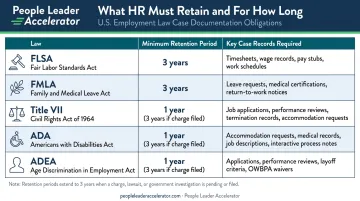
If a charge is filed, all relevant records must be retained until final disposition — regardless of the standard timeline.
A 2025 Seventh Circuit case (reported by SHRM) illustrates the stakes: inconsistent explanations for a performance plan and termination, combined with evidence of different treatment for younger comparators, was enough to allow a jury to infer pretext. The practical lesson: document the policy version applied, relevant comparators, and the rationale at the time of the decision — not after.
Employee Trust and Engagement
How HR handles cases directly affects whether employees trust the organization. Gallup research found that employees who trust organizational leaders are 61% more likely to stay and not seek another job. While that finding covers leadership trust broadly, the connection to case handling is real: status updates, clear process explanations, and reasoned closure are visible signals that the organization takes employee concerns seriously.
Data-Driven Pattern Recognition
Aggregated case data gives HR leaders something more valuable than individual case outcomes: organizational health signals. These signals only surface when cases are tracked consistently:
- A spike in grievances from one department
- A recurring policy misunderstanding driving repeat tickets
- A pattern of escalations tied to a specific manager
- A category of requests that spikes after a policy change
SHRM reports that 82% of organizations using people analytics apply it to employee retention and turnover. Case data belongs in that mix as an early-warning signal — one of the clearest indicators of where organizational friction is building before it becomes a larger problem.
Common Types of HR Cases
Not all HR cases are created equal — and treating them the same way leads to bottlenecks, compliance gaps, and frustrated employees. Understanding how cases differ by type shapes how you triage, route, and resolve them.
Operational and Administrative Cases
High-volume, lower-sensitivity requests that form the bulk of most HR case queues:
- Payroll errors and discrepancies
- Benefits enrollment questions
- Time-off requests requiring approval
- Onboarding access issues
- Employment verification
These cases are strong candidates for self-service tools or standardized workflows that reduce the manual burden on HR teams. McKinsey's HR Monitor 2026 found that organizations currently offer only 40% of HR processes through self-service — a significant gap that leaves HR teams absorbing avoidable transaction volume.
Employee Relations Cases
More sensitive cases requiring careful documentation, confidentiality, and often multiple stakeholders:
- Workplace conflicts between colleagues or managers
- Formal grievances
- Complaints of harassment or discrimination
- Policy violations
These cases frequently involve legal counsel and require investigators who are objective and free of conflict. EEOC guidance is clear: investigation information should be confidential only to the extent consistent with a thorough and impartial investigation — meaning confidentiality protects integrity, not outcome.
Performance and Disciplinary Cases
Cases tied to performance improvement plans (PIPs), conduct investigations, and termination processes. Documentation here is especially critical.
Inconsistent treatment of similarly situated employees — without a documented, supported rationale — can become evidence of discrimination in litigation. Every disciplinary case record should capture:
- The rule or policy applied
- The evidence considered
- The decision owner and their reasoning
The HR Case Management Process: 5 Key Steps
Step 1: Intake
Every case begins with a formal intake. The employee submits their request or concern through a defined channel (a portal, email, or in-person conversation) and provides enough detail for HR to categorize and prioritize it. A well-designed intake process captures the right information upfront, preventing back-and-forth delays that erode confidence before the case has even started.
Step 2: Documentation
HR formally records the case with all relevant details: employee information, submission date, nature of the concern, parties involved, and supporting evidence. Consistent documentation standards make case records defensible and searchable — and create the foundation for fair process when decisions are later reviewed or challenged.
Step 3: Investigation
HR reviews the documented case, gathers additional information (witness accounts, relevant policies, employment records), and determines the scope of the issue. For sensitive cases:
- Assign a designated investigator without a conflict of interest
- Define scope before beginning
- Preserve relevant material
- Document interviews, credibility assessments, and findings separately from allegations
- Record the rationale and any corrective response
Step 4: Resolution
HR determines the appropriate course of action based on findings, communicates the decision clearly and empathetically, and implements any necessary changes — policy updates, corrective action, compensation adjustments. Employees should understand not just the outcome but the reasoning behind it. When employees can follow the logic of a decision, they're more likely to accept it — even when the outcome isn't what they hoped for.
Step 5: Follow-Up and Closure
Closing a case involves formally documenting the resolution, confirming with the employee that the issue has been addressed, and capturing any lessons learned. This final step feeds directly back into the system: recurring patterns inform HR's proactive planning, and well-documented closure creates the audit trail required by law.
Essential Skills for HR Case Management Professionals
Strong case management requires more than following a process. Three skill areas separate effective HR case managers from those who simply move cases through a queue:
Communication and emotional intelligence — Active listening, empathetic written communication, and the ability to conduct sensitive conversations without escalating tension. These skills matter in every interaction, from initial intake to delivering a resolution the employee may not want to hear.
Critical thinking and sound judgment: Analyzing ambiguous situations, weighing evidence fairly, applying policy consistently, and making defensible decisions. Many cases don't have an obvious right answer. Bias and incomplete information are real risks, and the case record is the primary tool for demonstrating that a decision was reached fairly.
Strategic and analytical thinking — Effective case managers connect case data to organizational trends rather than treating each case as an isolated event. A spike in grievances from one team isn't just an HR problem. It's a signal about management quality, culture, or policy clarity that leadership needs to act on.
Building that strategic capability is where People Leader Accelerator's curriculum focuses. PLA helps HR leaders move beyond day-to-day operations by connecting people decisions to business outcomes and developing the judgment to act on what case data reveals — particularly in scaling organizations where those signals matter most.
Best Practices for Effective HR Case Management
Strong HR case management doesn't happen by accident. It's built on deliberate structure, proactive data use, and teams that are developed — not just deployed. These four practices separate high-performing HR functions from reactive ones.
Build a Consistent Intake and Escalation Foundation
Two structural decisions shape every case that flows through your system:
- Standardized intake: Consistent templates, required fields, and naming conventions are the foundation of a defensible, auditable system. Inconsistency — even in a well-intentioned process — carries real legal risk.
- Pre-defined escalation protocols: Determine before a case arrives which types automatically escalate (harassment allegations, potential retaliation, discrimination claims), at what threshold, and to whom. Time-sensitive situations can't stall in ambiguous handoffs.
Treat Your Case Log as an Organizational Health Signal
Most HR teams pull case data when something goes wrong. High-performing teams review it regularly — looking for patterns before those patterns become formal complaints.
At minimum, track and review:
- Allegation type and frequency by department
- Resolution time and cycle time by case category
- Manager- or location-level clusters
- Outcome trends over time
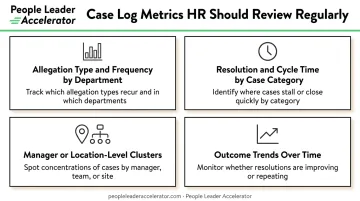
Investigating clusters proactively is far less costly than responding to them reactively.
Invest in Developing Your Case Managers
Case management competency — the judgment, communication, and strategic analysis it demands — is built through deliberate development, not just accumulated experience. HR leaders who invest in these skills see better case outcomes and stronger employee confidence in the process. Tenure alone doesn't build it; intentional practice does.
Frequently Asked Questions
What is HR case management?
HR case management is the structured process HR teams use to document, track, investigate, and resolve employee requests and concerns. It ensures consistent, fair, and legally compliant outcomes across the organization, replacing ad hoc handling with a repeatable, auditable system.
What are the 5 steps of case management?
The five steps are intake, documentation, investigation, resolution, and follow-up/closure.
What are red flag words for HR?
Terms like discrimination, harassment, retaliation, hostile work environment, and threats signal legal or safety risk in employee communications. HR teams should recognize these triggers and escalate immediately rather than treating them as routine concerns.
What types of cases does HR case management cover?
HR case management covers three major categories, each with distinct handling and documentation requirements:
- Operational/administrative: payroll, benefits, leave requests
- Employee relations: conflicts, grievances, harassment complaints
- Performance/disciplinary: PIPs, investigations, terminations
How does HR case management support compliance?
HR case management creates documented, timestamped records of every action taken — providing the audit trail required by laws like FLSA, FMLA, Title VII, ADA, and ADEA, and protecting the organization in the event of a legal dispute or regulatory inquiry.
What is the difference between HR case management and a general help desk?
A general help desk handles routine service requests like IT tickets or facilities issues. HR case management is built specifically for employee-facing situations requiring confidentiality, emotional sensitivity, and legal compliance — with investigation protocols and escalation paths that generic ticketing tools can't support.