
Introduction
The HR screening call is the most underestimated step in the hiring process. Candidates treat it like a warm-up. Overloaded HR teams treat it like a checkbox. Both assumptions cost people real opportunities.
Consider the volume problem: iCIMS's 2026 hiring benchmarks report an average of 110 applicants per job opening. The screening call is how companies filter that pile down to a manageable shortlist without burning hiring manager time on candidates who were never a real fit.
For candidates, the screening is the first live impression — and the first real opportunity to be eliminated. Misunderstanding what's being evaluated at this stage is why qualified candidates don't advance.
This guide covers what the HR screening process actually involves, what screeners are evaluating beyond your resume, and how to answer the questions that come up most often. HR professionals will also find a framework for designing screening processes that surface better candidates, faster.
Key Takeaways
- HR screenings are 15–30 minute conversations that assess qualifications, salary alignment, and genuine interest
- Screeners read energy and motivation, not just facts — preparation signals that you've done your homework
- Salary misalignment eliminates candidates regardless of qualifications, so address it proactively
- Expect structured, job-related questions designed to quickly assess fit across multiple candidates
- Preparation — not talent — is what separates candidates who advance from those who don't
What Is the HR Screening Process?
The HR screening process is a structured preliminary evaluation conducted by a recruiter or HR professional before a candidate meets the hiring manager. The goal is to determine whether someone meets the baseline requirements for a role and is worth advancing to a deeper interview round.
Screenings are not full interviews. They don't explore technical competency, leadership philosophy, or situational judgment in depth. They focus on verifiable facts and first impressions:
- Do your qualifications actually match what the role requires?
- Are your salary expectations within the hiring budget?
- Can you communicate clearly and professionally?
- Do you know what you're applying for — and why?
According to Indeed's employer guidance, most phone screens last around 15 minutes. Still, candidates should block at least 30 minutes in case the conversation runs long.
Screenings can happen over the phone, via video call, or through written questionnaires. Each format shapes how you present yourself, but the evaluation criteria stay consistent.
Why Companies Use HR Screening and What They're Really Evaluating
The Volume Problem
With 110 applicants per opening as a realistic benchmark, no hiring manager can personally evaluate every resume, let alone hold conversations with every plausible candidate. HR screening solves that problem by acting as a structured gate, surfacing the candidates worth the hiring team's time and filtering out misaligned ones early.
The operational value is real. An unstructured hiring process wastes time for everyone: candidates sit in pipeline stages they'll never clear, and hiring managers spend hours on conversations that should have been resolved in a 20-minute screen.
The Four Things Screeners Are Actually Evaluating
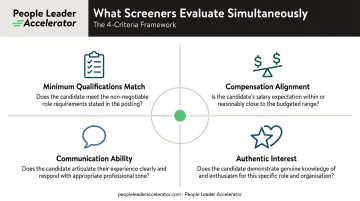
Most candidates think screenings are about confirming resume facts. They're not — or at least not only that. Screeners are assessing four things simultaneously:
- Minimum qualifications match — Do you actually have what the job description requires, or did you apply speculatively?
- Compensation alignment — Is your salary expectation within the hiring budget? Misalignment here ends candidacies regardless of qualifications.
- Communication ability — Can you speak clearly, listen well, and present your background coherently in a limited window?
- Authentic interest — Are you excited about this specific role, or are you bulk-applying and hoping something sticks?
The Cultural Fit Signal
Even in a 20-minute call, experienced screeners pick up signals about whether someone's values and working style fit the organization. Tone, enthusiasm, how someone talks about former employers, what questions they ask — all of it contributes to a fit impression that's often decisive.
Strong-on-paper candidates most commonly fall short here. A polished resume doesn't communicate energy or genuine curiosity. The screening call does.
Salary Alignment as a Gating Function
SHRM's 2024 compensation research found that 41% of professionals would lose interest in a role that didn't include a salary range in the posting. From the company's side, misaligned salary expectations are among the most common reasons promising candidates are screened out.
HR professionals raise salary expectations early precisely because discovering a $40,000 gap after three interview rounds wastes everyone's time. Candidates who come prepared with a researched, realistic range move through this moment cleanly.
For HR professionals designing or refining their screening process, People Leader Accelerator offers practical frameworks and toolkits — including compensation benchmarking guides and structured evaluation resources — built specifically for HR leaders who want to move beyond ad hoc hiring decisions.
How the HR Screening Process Works, Step by Step
Here's the typical flow from application to screening decision:
Application review → Screening outreach → The screening conversation → Post-screen evaluation → Candidate communication
Step 1: Before the Screening — What HR Does to Prepare
Before the call, a prepared HR screener will:
- Review the resume against the job description and minimum qualifications
- Confirm the approved salary range and reporting structure
- Prepare a standardized question set applied consistently across all candidates
- Flag specific points on the resume to clarify or probe
OPM's structured interview guidance recommends that all candidates receive identical predetermined questions in the same order, evaluated against the same rating standards. Standardization makes evaluation more consistent and legally defensible — two outcomes that matter whether you're the screener or the candidate.
Step 2: During the Screening Conversation
A typical screening call follows a predictable arc:
- Brief role overview from the screener (2–3 minutes)
- Candidate walk-through of their background at a high level
- Targeted questions on qualifications, motivation, and logistics
- Salary discussion
- Candidate questions
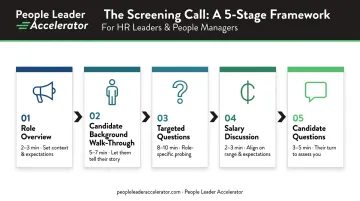
The screener is managing time deliberately. Candidates who give concise, relevant answers make the screener's job easier — and signal strong communication skills in the process.
Step 3: After the Screening — Evaluation and Next Steps
Post-screen, the HR professional documents notes and evaluates candidates against the hiring criteria. Strong candidates typically hear back within a few days to one week. Silence beyond that window is usually a soft rejection.
That silence is more common than it should be. Greenhouse's 2024 Candidate Experience Report found 24% of US candidates — and 45% of UK candidates — said they were most likely to be ghosted after an initial recruiter conversation. That's a candidate experience problem worth fixing on the HR side.
Candidates who advance receive an invitation to a hiring manager interview. Send a brief thank-you note within 24 hours — it reinforces genuine interest and keeps your name present during the decision window.
The Most Common HR Screening Questions and How to Answer Them
Every screening is different, but a handful of questions appear across nearly every industry and role type. How you answer them — not just what you say — is what determines whether you advance.
"Tell Me About Yourself"
HR is not asking for a resume recap. They want a concise, role-relevant narrative that answers one implicit question: why are you the right fit for this specific role?
How to answer:
- Open by positioning yourself against the most important job requirements
- Highlight one or two relevant achievements, not a career timeline
- Close with genuine enthusiasm for this specific opportunity
Keep it to 90 seconds. Candidates who ramble through their entire work history here signal poor communication skills from the first question.
"Why Are You Interested in This Role?"
This question separates candidates who researched the company from those sending the same application to 50 employers. Generic answers — "I'm looking for growth" — signal the latter.
How to answer:
- Reference something specific about the company: their mission, a recent initiative, the team's work
- Connect the role to your career trajectory in a concrete way
- Show you understand what the role actually involves
Even 30 minutes reviewing the company's website and LinkedIn page provides enough material for a compelling, differentiated answer.
"What Are Your Salary Expectations?"
This is often the most strategically consequential question in the screening. Answer too low and you undervalue yourself; anchor too high and you're screened out regardless of qualifications.
How to answer:
- Research market rates beforehand using multiple sources (Glassdoor, Payscale, LinkedIn Salary)
- Ask if the company has a range in mind before naming a number — this is a legitimate, professional move
- Provide a researched range rather than a single number or a vague non-answer
Refusing to answer or saying "I'm flexible" without any range doesn't come across as strategic — it reads as unprepared.
"Why Are You Leaving Your Current Role?"
Negativity about former employers is one of the most consistent red flags HR screeners report. Even if your last job was a difficult experience, this question requires a forward-looking answer.
How to answer:
- Keep it brief and honest
- Frame it around what you're moving toward: new challenges, a better skill fit, a larger scope
- Never criticize former employers, managers, or colleagues
A sentence or two is sufficient. If you find yourself justifying the departure at length, stop — brevity here reads as confidence.
Behavioral and Fit Questions
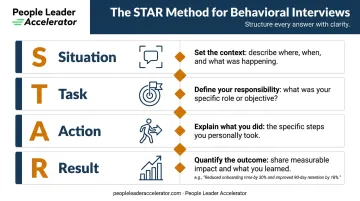
Questions like "How do you handle pressure?" or "What motivates you?" reveal personality and cultural alignment. Use the STAR method (Situation, Task, Action, Result) to structure behavioral answers — it keeps responses focused and grounded in real outcomes rather than vague claims.
For fit questions, align your honest motivators with what the role and company actually offer.
How to answer:
- Lead with a specific situation, not a general personality trait
- Quantify the result where possible ("reduced onboarding time by two weeks")
- If you say you thrive in fast-paced environments, that should match what you know about the organization's culture
- Avoid rehearsed-sounding answers — screeners hear the same STAR stories repeatedly
How to Succeed in Your HR Screening (and Common Pitfalls to Avoid)
For Candidates: What Actually Moves the Needle
- Research the company before the call — website, LinkedIn, recent news. Spend at least 30 minutes. Screeners notice when candidates can't speak to what the company does.
- Have your resume in front of you — you'll reference it, and having it visible prevents stumbling over your own timeline.
- Prepare two or three questions to ask at the close. Ask about team structure, what success looks like in the role, or what problem the team is actively solving — these signal genuine interest.
- Treat it like a final interview — the stakes are real. Candidates who advance earn the next conversation; those who don't rarely learn why.
The candidate perspective matters — but so does how the screening is designed on the other side of the call.
For HR Professionals: Designing a Better Screening
- Use a standardized question set across all candidates — this enables fair comparison and creates a more defensible process
- Document observations in real time, not after the call — memory degrades fast, especially when screening multiple candidates in the same week
- Avoid leading questions that signal the "right" answer
- Close every screening by communicating next steps and timeline — candidate ghosting at the recruiter screen stage damages employer brand and reduces offer acceptance rates
Even well-qualified candidates lose ground at the screening stage. These are the mistakes that show up most often.
Common Candidate Mistakes to Avoid
- Treating the screening as low-stakes and under-preparing
- Giving a vague or meandering answer to "tell me about yourself"
- Failing to research the company at all
- Offering an unrealistic or entirely unresearched salary number
- Asking no questions at the end of the call — this reads as disinterest
Frequently Asked Questions
What should I expect during an HR screening call?
A typical HR screening call lasts 15–30 minutes and covers a brief role overview, a high-level walk-through of your background, questions about qualifications and salary expectations, and time for your own questions. It's a fact-finding conversation, not a deep technical or behavioral interview.
What are the most common HR screening questions?
The five questions that appear most consistently: "Tell me about yourself," "Why are you interested in this role?", "What are your salary expectations?", "Why are you leaving your current position?", and "What do you know about our company?" Preparing specific, role-relevant answers to each is the most effective use of your prep time.
How long does an HR screening typically last?
Most HR screening calls last between 15 and 30 minutes. Indeed's guidance suggests phone screens typically run about 15 minutes, though candidates should reserve at least 30 minutes. More senior roles sometimes run longer.
What happens after the HR screening interview?
Candidates who advance move to a hiring manager or panel interview; those who don't are notified, though not always quickly. Send a brief thank-you email within 24 hours — it's a small step that keeps you visible while the decision is still being made.
How is an HR screening different from a final interview?
HR screenings are short, high-level, and focused on minimum qualifications and basic fit. Final interviews are longer, involve hiring managers and sometimes senior leadership, and explore technical competency, leadership behaviors, and situational judgment in depth. The screener's job is to determine whether you're worth the hiring manager's time — not to make the final call.
What's the biggest mistake candidates make in HR screenings?
Under-preparation — specifically, not researching the company and not having a clear, concise answer to "tell me about yourself." Both signal low engagement to a screener who's seen hundreds of candidates; fixing either one takes less than an hour.