Introduction
Most organizations treat HR compliance as a fire drill. An EEOC charge lands, a DOL audit begins, or an employment lawsuit gets filed — and suddenly everyone scrambles to find documentation that should have existed for years.
For HR leaders in high-growth organizations, this approach creates compounding risk. You can't retrofit a compliance infrastructure after the fact when you're simultaneously doubling headcount, expanding into new states, and managing a leadership team that hasn't yet seen what the exposure looks like.
The EEOC received 88,531 new discrimination charges in FY2024 — a 9.2% increase over the prior year. In FY2025, the agency secured nearly $660 million in monetary relief for discrimination victims. Compliance failures are not hypothetical.
This article covers what HR compliance actually is, the five areas every HR leader must own, the federal laws that form the regulatory backbone, common pitfalls in scaling organizations, and how to shift from reactive to proactive.
Key Takeaways
- HR compliance covers both building compliant policies and enforcing them
- Five areas drive most exposure: hiring, wage/hour, safety, anti-discrimination, and benefits/leave
- Federal law obligations grow as headcount crosses key thresholds
- Pay transparency and AI hiring rules are evolving faster than most HR teams realize
- Compliance accountability must be shared across HR, managers, and leadership
What Is HR Compliance?
HR compliance is the ongoing practice of aligning an organization's employment policies, processes, and decisions with applicable federal, state, and local laws and regulations.
That definition is deceptively simple. Most organizations conflate two distinct dimensions — and the gap between them is where legal exposure lives.
The Two Dimensions of HR Compliance
Structural compliance is about building the right foundation:
- Written policies and employee handbooks that reflect current law
- Offer letters, classification decisions, and job descriptions that hold up to scrutiny
- Documentation practices and record retention protocols
Operational compliance is what actually determines your legal exposure:
- Whether managers follow policies when making daily decisions
- Whether employees understand their rights and obligations
- Whether HR catches drift before it becomes liability
A policy handbook that sits on a shared drive unread is not a compliance program. Structural compliance sets the rules; operational compliance determines whether anyone follows them.
Three Types of Compliance HR Leaders Navigate
- Statutory compliance — adhering to government-enacted employment legislation, such as minimum wage requirements, FMLA, and anti-discrimination statutes
- Regulatory compliance — following rules set by specific agencies like the DOL, EEOC, and OSHA, which interpret and enforce statutory law
- Contractual compliance — honoring legally binding agreements with employees, independent contractors, vendors, or unions
Compliance Is an Organizational Responsibility
HR owns the compliance function, but it cannot execute alone. Leadership must model it. Managers must apply it. Employees must understand it.
A compliance program that lives only in the HR department will always be fragile. When a hiring manager asks an unlawful interview question or a supervisor retaliates against someone who filed a complaint, the entire framework is at risk.
Ignorance of the law is not a defense. The DOL's Wage and Hour Division recovered more than $259 million in back wages for nearly 177,000 employees in FY2025 — averaging $1,465 per worker. Most weren't malicious. They stemmed from underfunded, under-resourced compliance infrastructure.
The 5 Key Areas of HR Compliance
Hiring and Recruitment Compliance
Compliance obligations begin before a candidate ever interviews. HR leaders need systems in place across four areas:
Non-discriminatory job postings and interviews — job postings must avoid language that signals preference based on age, gender, disability, or other protected characteristics. Interview questions must steer clear of protected characteristics entirely.
Background checks under the FCRA — before obtaining a consumer report, employers must provide a standalone written disclosure and obtain written authorization. Before taking adverse action, they must provide the applicant a copy of the report and a Summary of Rights. After acting, an adverse-action notice is required. Skipping any of these steps creates FTC enforcement exposure.
"Ban the Box" laws — at least 12 states and Washington, D.C. restrict private employers from inquiring about criminal history early in the hiring process. Local ordinances add additional layers.
Form I-9 compliance — employees complete Section 1 no later than their first day; employers complete Section 2 within three business days. Retention rules require keeping the form for three years from the date of hire or one year after employment ends, whichever is later.
Wage, Hour, and Classification Compliance
This area generates the highest volume of compliance violations. There are three distinct failure points:
Minimum wage — the federal minimum remains $7.25/hour, unchanged since 2009. Most states exceed this floor. California, Colorado, Illinois, Massachusetts, New York, and Washington all set higher rates. The applicable rate is whichever is highest — federal, state, or local.
Overtime — non-exempt employees must receive 1.5x their regular rate for hours worked over 40 in a workweek. Following a federal court's November 2024 vacatur of the DOL's expanded rule, the current salary threshold for executive, administrative, and professional exemptions is $684/week ($35,568 annually).
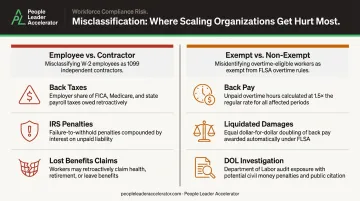
Worker classification — this is where scaling organizations get hurt most. Two classification errors dominate:
| Error Type | What It Looks Like | Consequence |
|---|---|---|
| Employee vs. contractor | Treating a W-2 employee as a 1099 contractor | Back taxes, penalties, lost benefits claims |
| Exempt vs. non-exempt | Misidentifying overtime-eligible workers as exempt | Back pay, liquidated damages, DOL investigation |
Multi-state employers must track wage obligations jurisdiction by jurisdiction. What's compliant in one state may be illegal in another.
Workplace Safety Compliance
OSHA sets industry-specific health and safety standards and requires employers to maintain hazard-free workplaces. Compliance obligations vary by industry — construction, healthcare, and manufacturing carry heavier burdens than typical office environments.
OSHA uses NAICS classifications to determine which industries qualify for partial recordkeeping exemptions.
Core recordkeeping requirements (for covered employers):
- Form 300 — injury and illness log
- Form 301 — incident details for each recordable case
- Form 300A — annual summary, posted February 1 through April 30
Severe incident reporting (no industry exemption):
- Work-related fatality: report within 8 hours
- In-patient hospitalization, amputation, or loss of an eye: report within 24 hours
Employers with 10 or fewer employees and operations in specified low-hazard industries may be partially exempt from routine recordkeeping, but severe-event reporting still applies. Federal OSHA conducted over 30,000 inspections in FY2025.
Anti-Discrimination and Equal Employment Compliance
The EEOC enforces a framework of federal laws that prohibits discrimination across the entire employee lifecycle — not just hiring.
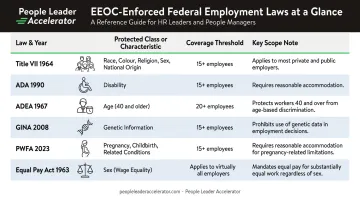
Key laws and coverage thresholds:
- Title VII (1964) — race, color, religion, sex, national origin; 15+ employees
- ADA (1990) — disability; requires reasonable accommodation; 15+ employees
- ADEA (1967) — age 40+; 20+ employees
- GINA (2008) — genetic information; 15+ employees
- PWFA (2023) — pregnancy accommodations; 15+ employees; effective June 27, 2023
- Equal Pay Act — wage discrimination based on sex
Retaliation is the most frequently alleged charge basis in EEOC filings. Employees who report discrimination, file a charge, or participate in an investigation are protected from adverse action — and retaliation claims are among the easiest for plaintiffs to establish.
That makes retaliation prevention a training priority, not just a policy checkbox. Every manager with direct reports needs explicit guidance on what constitutes adverse action.
Employee Benefits and Leave Compliance
FMLA provides up to 12 weeks of unpaid, job-protected leave for qualifying family and medical reasons. Coverage applies to private employers with 50 or more employees in 20 or more workweeks in the current or prior calendar year. Employee eligibility requires all three of the following:
- At least 12 months of employment with the organization
- At least 1,250 hours worked in the preceding 12 months
- A worksite where the employer has 50 employees within 75 miles
ACA employer mandate applies to organizations with 50 or more full-time or full-time-equivalent employees. In 2026, the Section 4980H(a) penalty is $3,340 per full-time employee (minus the first 30) for failing to offer minimum essential coverage when the threshold and premium tax credit trigger are met.
State paid leave complexity is growing fast. Thirteen states plus Washington, D.C. now have mandatory paid family and medical leave programs offering at least six weeks of benefits — including California, Colorado, New York, Massachusetts, and Washington. Benefit duration, contribution structure, wage replacement rates, and employer size thresholds differ in every jurisdiction. Multi-state employers cannot manage leave compliance from a single policy template.
Key HR Laws Every People Leader Should Know
Federal Employment Law Framework
| Area | Law | What It Covers |
|---|---|---|
| Wage & Hour | FLSA | Minimum wage, overtime, exempt/non-exempt classification, recordkeeping |
| Leave | FMLA | 12 weeks unpaid, job-protected leave for qualifying family/medical reasons |
| Safety | OSH Act | Hazard-free workplaces, industry standards, incident reporting |
| Anti-Discrimination | Title VII, ADA, ADEA, GINA, PWFA, Equal Pay Act | Protected classes across the employee lifecycle; EEOC-enforced |
| Labor Relations | NLRA | Protected concerted activity, union organizing rights |
| Immigration | IRCA / Form I-9 | Work authorization verification for all new hires |
| Background Checks | FCRA | Disclosure, authorization, and adverse-action requirements |
| Military Service | USERRA | Reemployment rights and benefits protections for service members |
Emerging Compliance Obligations Reshaping HR
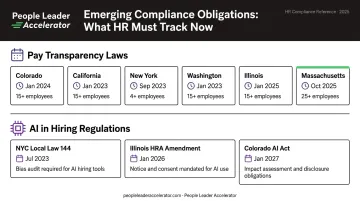
Pay transparency laws now require salary ranges in job postings across several states:
- Colorado — applies to employers with at least one Colorado employee (effective January 1, 2024 under SB23-105)
- California — 15+ employees; in effect since January 1, 2023
- New York — 4+ employees; in effect since September 17, 2023
- Washington — 15+ employees; in effect since January 1, 2023
- Illinois — 15+ employees; in effect since January 1, 2025
- Massachusetts — 25+ employees; in effect since October 29, 2025
AI in hiring regulations now carry real legal exposure — and the compliance window is closing fast. Key laws to track:
- NYC Local Law 144 (enforcement began July 5, 2023) — requires employers using automated employment decision tools to obtain an independent bias audit and publish results
- Illinois Human Rights Act amendment (effective January 1, 2026) — prohibits discriminatory AI use in employment decisions
- Colorado AI Act (effective January 1, 2027) — covers high-risk automated systems used in employment decisions
Remote Work and Multi-State Complexity
When employees work across state lines, employers must comply with each employee's state and local laws — not the employer's home state. That means tracking wage rates, paid leave requirements, and tax obligations jurisdiction by jurisdiction.
Pew Research found that 75% of U.S. adults with teleworkable jobs work remotely at least some of the time. For any employer that has hired outside its headquarters state since 2020, multi-state compliance is no longer a hypothetical — it's a current obligation that requires active management.
That active management means tracking:
- Minimum wage and overtime rules in each employee's work location
- State-specific paid leave mandates (sick leave, PFML, bereavement)
- Applicable tax registration and withholding requirements
- Local ordinances that may exceed state-level protections
Common HR Compliance Challenges in High-Growth Organizations
High-growth companies face a specific compliance trap: the organization scales faster than the infrastructure designed to support it.
The four challenges below account for the majority of compliance exposure in scaling and PE-backed companies:
- Hiring ahead of policy infrastructure: At 20 employees, informal processes feel manageable. At 100, they become liability. Classification decisions made at founding, offer letter templates never reviewed by counsel, and onboarding gaps that skip I-9 steps all compound as headcount grows.
- Geographic expansion without jurisdiction awareness: Opening a remote role in California, Colorado, or New York without understanding local wage, leave, and pay transparency requirements is one of the most common failures for scaling companies. Each state's obligations attach the moment you have an employee there.
- Worker misclassification: This carries the highest dollar risk for early-stage and PE-backed companies. Contractors who should be employees trigger back payroll taxes, overtime, and potentially benefits. Exempt employees who don't meet the duties and salary tests create overtime exposure that accrues silently until a claim is filed.
- Regulatory change velocity: Pay transparency laws, state-specific paid leave mandates, and AI hiring regulations are expanding faster than most HR teams can track. Staying ahead requires more than legal counsel on speed dial — it requires HR leaders who understand the regulatory environment well enough to spot risk before it becomes a violation.
Why HR Compliance Is a Strategic Priority
The Business Case Is Not Just About Avoiding Fines
Non-compliance costs extend well beyond legal fees and settlements. Reputational damage from public EEOC charges or labor violations affects recruiting pipelines. Employees who witness compliance failures — particularly around pay equity, accommodation denials, or retaliation — lose trust in leadership. That trust erosion shows up in retention data, engagement scores, and employer brand perception.
Organizations that treat people fairly and operate within the law attract stronger candidates and keep them longer. Employees actively evaluate how organizations handle pay equity, accommodations, and workplace disputes — and that evaluation shapes employer brand more than any recruitment marketing campaign.
Compliance Literacy Is a Strategic Leadership Competency
HR leaders who understand the regulatory environment are better positioned to advise the business, protect the organization, and design people programs that scale without creating legal exposure.
That fluency goes beyond knowing what the laws require. It means recognizing when a new hire's state of residence changes the company's obligations, how a job posting triggers pay transparency requirements, or why a contractor arrangement that worked at 30 employees creates IRS exposure at 150.
For HR professionals looking to build this kind of strategic fluency — moving from compliance as paperwork to compliance as business function — People Leader Accelerator develops the frameworks and practical tools needed to lead at that level.
How to Build a Proactive HR Compliance Program
Start With an Audit
Before you can manage compliance proactively, you need to know where the gaps are. A compliance audit should cover:
- Hiring processes (job postings, interview guides, background check procedures, I-9 files)
- Pay practices (minimum wage compliance, overtime calculations, exempt classification)
- Leave administration (FMLA designations, state leave tracking, accommodation requests)
- Safety protocols (OSHA recordkeeping, incident reporting, training documentation)
- Worker classification (contractor arrangements, exempt/non-exempt designations)
Establish a regular cadence — at minimum annually — with additional reviews triggered by geographic expansion, significant headcount growth, or major regulatory changes.
Build Compliance Into Operations
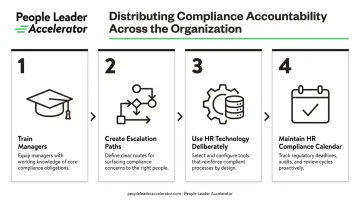
Compliance fails when it lives only in HR. Distribute accountability:
- Train managers on interview law, FMLA trigger recognition, accommodation request handling, and OSHA reporting. They make the decisions that create liability.
- Create clear escalation paths so managers know exactly what to do when an employee discloses a medical condition, requests a religious accommodation, or raises a pay concern.
- Use HR technology deliberately to automate documentation, track leave deadlines, and build audit-ready records. Manual processes at scale create gaps.
- Maintain an HR compliance calendar so key dates — OSHA 300A posting, ACA reporting deadlines, state leave open enrollment periods — are tracked proactively, not discovered after the fact.
Stay Current Through Systematic Monitoring
Subscribe to updates from the DOL, EEOC, and relevant state agencies. The regulatory environment is not static — the pay transparency and AI hiring landscapes alone have shifted materially in the last 24 months. Use employment counsel, professional networks, and ongoing training to keep your compliance posture ahead of enforcement shifts, not behind them.
Frequently Asked Questions
What is HR compliance?
HR compliance is the practice of aligning an organization's employment policies, processes, and decisions with applicable federal, state, and local labor laws and regulations. It encompasses both building compliant policies and actively enforcing them across the organization — not just having documentation on file.
What are the 5 key areas of HR compliance?
The five core areas are: (1) hiring and recruitment compliance, (2) wage, hour, and worker classification compliance, (3) workplace safety compliance, (4) anti-discrimination and equal employment compliance, and (5) employee benefits and leave compliance. Each area carries distinct legal obligations and enforcement risks.
What is the difference between statutory and regulatory compliance in HR?
Statutory compliance means adhering to laws enacted by government — for example, the FLSA or FMLA. Regulatory compliance means following the rules and standards set by specific government agencies (like the DOL, EEOC, or OSHA) that interpret and enforce those statutes.
What are the consequences of HR non-compliance?
Consequences include financial penalties, back-pay obligations, employment lawsuits, government audits, and reputational damage. Difficulty attracting talent, increased turnover, and erosion of employee trust are downstream effects that often exceed the direct legal costs.
How often should an organization conduct an HR compliance audit?
At a minimum, organizations should audit annually. Additional reviews are warranted by geographic expansion, significant headcount growth, major regulatory changes, or any significant update to employment policies or practices. High-growth organizations often need more frequent reviews during scaling phases.
How does company size affect HR compliance requirements?
Many federal laws apply only above specific employee thresholds. FMLA covers employers with 50 or more employees; the ACA employer mandate applies at 50 full-time equivalents; Title VII and the ADA apply at 15 or more. Compliance obligations expand in scope and complexity as organizations scale, making proactive planning critical during periods of rapid growth.