

Introduction
Waiting for candidates to apply is a strategy — just not a winning one. In competitive talent markets, the organizations that consistently hire well are the ones already building pipelines before a role opens.
The numbers bear this out. Employ's 2024 survey of more than 1,500 U.S. workers found that 52% were not actively job-seeking — yet 54% of that group would consider applying if contacted by a recruiter. That's a massive, reachable talent pool that inbound job postings will never touch.
This guide covers what HR leaders need to build a proactive sourcing function:
- What HR sourcing is and how it differs from recruiting
- The main sourcing types and when to use each
- Proven strategies for finding passive and active candidates
- A step-by-step plan for building your sourcing process
- How to measure sourcing effectiveness and ROI
Key Takeaways
- HR sourcing is proactive: it identifies and engages qualified candidates before a role is open, including passive talent who aren't actively job hunting.
- Sourcing builds the pipeline. Recruiting selects from it. The two functions are distinct — and both matter.
- The strongest sourcing programs combine multiple channels: LinkedIn, Boolean search, referrals, niche platforms, and internal mobility.
- Track source-of-hire, pipeline conversion, and quality-of-hire by channel to turn a functional sourcing program into a strategic one.
What Is HR Sourcing?
HR sourcing is the proactive process of identifying, contacting, and engaging qualified candidates for current or anticipated roles — rather than waiting for them to apply. It sits at the foundation of talent acquisition, driving pipeline before a role ever goes live.
The HR Sourcer's Role
Understanding what sourcing is starts with knowing who does it. A dedicated sourcer's responsibilities typically include:
- Partnering with hiring managers to define role requirements and candidate criteria
- Researching candidates across LinkedIn, professional networks, and other platforms
- Building relationships with passive talent over time
- Maintaining candidate records in the ATS for future pipeline activation
Sourcing is a specialized function. Sourcers focus on top-of-funnel research and engagement — not evaluation, offer management, or the broader recruiter workflow.
When Sourcing Has the Most Impact
That specialization matters most in specific hiring contexts. Sourcing isn't deployed for every opening — it's most critical for:
- Senior leadership and executive roles — only 35% of executive hires come through inbound, according to Ashby's analysis of nearly 250,000 hires
- Specialized technical roles where active candidate supply is thin
- High-growth environments where workforce needs outpace organic application volume
Across that same dataset, proactive sourcing contributed 16% of total hires — a smaller share than inbound by volume, but far more efficient per application.
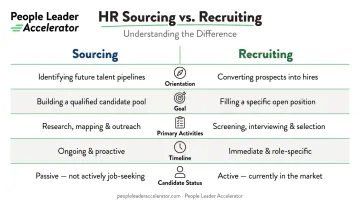
Sourcing vs. Recruiting: Key Differences
These two functions are often conflated, especially in smaller organizations. They're not the same, and treating them as interchangeable creates real inefficiencies.
| Dimension | Sourcing | Recruiting |
|---|---|---|
| Orientation | Proactive, ongoing | Reactive, role-specific |
| Goal | Build a qualified pipeline | Fill an open position |
| Primary activities | Research, outreach, relationship-building | Screening, interviewing, offer management |
| Timeline | Continuous | Bounded by requisition lifecycle |
| Candidate status | Often passive | Often active or pre-screened |
Why They're Stronger Together
The table above shows distinct functions — but the real value comes from connecting them. Sourcers pass pre-vetted candidates to recruiters, reducing screening time and improving offer acceptance rates. When both functions operate in sequence — sourcing feeding a pipeline that recruiters draw from — time-to-fill drops and hire quality improves.
According to Aptitude Research's 2023 sourcing report, 42% of companies had built dedicated internal sourcing teams by 2023, up from just 28% in 2018. Yet 75% of those same organizations reported dissatisfaction with their current sourcing approach — suggesting that structure alone isn't enough.
What Happens Without Dedicated Sourcers
In organizations without this specialization, recruiters absorb the sourcing function. That works for predictable, low-volume hiring — but it breaks down fast under high requisition loads or for hard-to-fill roles where passive candidate outreach is essential. High-growth organizations especially benefit from separating these responsibilities early.
Types of HR Sourcing
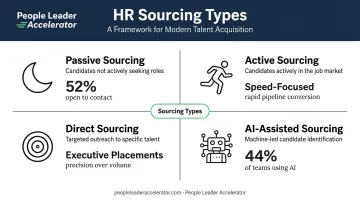
Understanding the four main sourcing types helps HR leaders choose the right approach for each hiring need.
Each type serves a different hiring scenario:
- Passive sourcing — targets candidates not actively job-seeking; 52% of workers are open to being contacted, making this pool valuable for senior and niche roles
- Active sourcing — engages candidates already in the market; faster and better suited to volume hiring where speed matters more than exclusivity
- Direct sourcing — goes after a specific individual without agency involvement; most common for executive placements where the ideal hire is already known to the organization
- AI-assisted sourcing — uses algorithms to identify and match candidates at scale; Employ found 44% of recruiting teams using AI for candidate sourcing in 2024, and SHRM reported 32% of organizations automating candidate searches, with 24% of AI adopters reporting improved ability to identify top candidates
The Overlooked Option: Internal Sourcing
Those four types focus outward — but before going external, organizations should look inward. Internal hiring — promotions, lateral moves, project-based transfers — can shorten recruitment by up to 20 days, according to Bersin's analysis of five years of hiring data.
The gap between potential and practice is stark: SHRM's 2025 benchmark found only 7% of nonexecutive roles were filled internally. That's an underused lever, particularly for mid-level and functional leadership positions where institutional knowledge matters.
Top HR Sourcing Strategies That Work
No single channel wins consistently across every role and market. The strongest sourcing programs layer multiple approaches.
LinkedIn and Social Media Sourcing
LinkedIn remains the dominant professional network for sourcing. Pew Research data from 2025 shows 25% of U.S. adults use LinkedIn — a narrower reach than mass platforms, but far more professionally concentrated.
Effective LinkedIn sourcing means more than running basic searches. Tactics that work:
- Use Boolean operators (AND, OR, NOT) to filter for specific skill combinations, titles, and locations
- Apply those same strings to Google (for example,
site:linkedin.com/in "senior data engineer" "Snowflake" "Chicago") to surface profiles outside LinkedIn's native search - Craft outreach messages specific to the candidate's background — generic InMails get ignored
- Build a multi-touch sequence: initial message, a follow-up at day 5-7, and a content-based nurture if there's no reply
On outreach cadence: Gem's platform data found that a four-stage sequence generated twice the replies of single-touch emails. Vendor data, so context matters — but the finding aligns with what experienced sourcers report in practice.
Employee Referral Programs
Referrals consistently punch above their weight. CareerPlug's 2024 data found referrals represented 2% of applications but 11% of hires — a yield ratio that no other channel approaches.
Structuring a program that actually works:
- Define clear incentive tiers (cash, PTO, recognition) and pay promptly
- Make the submission process simple — friction kills referral volume
- Communicate open roles regularly, not just when desperate
- Track referral-to-hire ratios by department to identify your best internal advocates
Niche Platforms and Talent Communities
General job boards attract volume. Niche platforms attract fit. Candidates with rare skill sets tend to concentrate on platforms built for their craft:
- GitHub — engineers and open-source contributors
- Behance — designers and creative professionals
- Industry Slack communities and forums — specialists across technical and functional domains
The long-term play here is building owned talent communities: curated groups of candidates who've opted in to hear from your organization. These aren't active applicants, but they're warmer than cold outreach and can be activated quickly when a relevant role opens.
Employer Brand as a Sourcing Multiplier
A strong employer brand reduces how hard you have to work to find candidates. 83% of job seekers research company reviews and ratings before deciding where to apply, according to Glassdoor's employer branding data. That means your Glassdoor profile, LinkedIn company page, and employee testimonials are sourcing infrastructure — not just marketing.
Key brand levers:
- Authentic employee stories (not polished corporate copy)
- Responsive career page with honest role previews
- Consistent social media presence that reflects actual culture
The practical result: organizations with a strong employer brand report up to 50% lower cost-per-hire, because inbound volume increases and outreach response rates follow. Brand investment isn't separate from sourcing strategy — it's what makes sourcing cheaper over time.
How to Build a Step-by-Step HR Sourcing Plan
Effective sourcing plans adapt as the business changes — they're built once, then continuously refined based on what's actually working.
Step 1 — Align Sourcing with Business Goals
Before selecting channels or writing outreach templates, understand what the business needs. Which teams are growing? What roles will be critical in 6–12 months? Where are current quality gaps?
HR leaders who tie sourcing to business outcomes — not just open requisitions — get pulled into workforce planning conversations earlier. That's where the real influence is.
Step 2 — Define Your Ideal Candidate Profile
Go beyond the job description. Build a talent persona that includes:
- Required and preferred technical skills
- Experience level and company stage fit
- Career motivators (growth, comp, impact, stability)
- Where this person likely spends professional time online
Vague profiles produce broad outreach and weak pipelines.
Step 3 — Select and Prioritize Sourcing Channels
Match channels to where your candidate actually is. Channel selection varies significantly by role type:
- Tech roles: Weight LinkedIn and GitHub heavily; sourcing contributed 24% of tech hires versus 18% for business roles in Ashby's dataset
- Executive roles: Direct outreach and referrals dominate; only 35% of executive hires come through inbound
- Volume roles: Active platforms and employee referrals offer better efficiency
Evaluate channel effectiveness using past source-of-hire data, not assumptions. Shift budget toward what converts, not what's familiar.
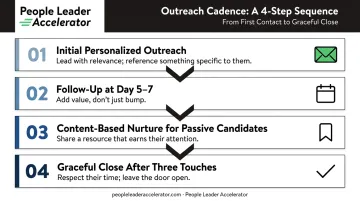
Step 4 — Build Outreach Cadences
Every first message should reference something specific to the candidate's background. Generic outreach gets ignored; specific outreach gets replies.
Multi-touch structure:
- Initial personalized outreach
- Follow-up at day 5–7 (add value, don't just bump the thread)
- Content-based nurture for passive candidates staying warm
- Graceful close if no engagement after three touches
Step 5 — Maintain the Pipeline and Iterate
Sourcing value compounds when pipelines are maintained. Best practices:
- Log every candidate interaction in the ATS with context notes
- Re-engage cold leads when new relevant roles open
- Conduct post-hire reviews by source — which channels produced your best hires, not just your most hires
Post-hire source analysis is what separates teams that improve their channel mix from teams that keep repeating it.
How to Measure HR Sourcing Effectiveness
Most organizations track sourcing volume. Fewer track sourcing quality. Tracking both is what separates reactive from strategic.
Key Metrics to Track
| Metric | Why It Matters | Benchmark Reference |
|---|---|---|
| Time-to-fill | Measures end-to-end hiring speed | SHRM 2026: 39-day median for nonexecutive roles |
| Source-of-hire | Shows which channels produce hires | Inbound ~43–52%, sourced ~16%, referrals ~18% (Ashby, 250K hires) |
| Source efficiency | Applications-to-hire ratio by channel | Sourced candidates are nearly 8x more likely to be hired than inbound applicants (Gem, 1.2M hires) |
| Quality-of-hire by source | Identifies which sources produce your best performers | Only 20% of organizations currently measure this (SHRM 2026) |
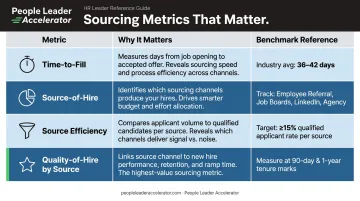
The quality-of-hire gap is worth highlighting. SHRM's 2026 benchmark found that just one in five organizations formally measures it. Yet it's the only metric that tells you whether your sourcing is producing good hires — not just fast ones. Common components include 90-day performance ratings, manager assessments, first-year retention, and early promotion rates — each of which reveals whether a source is producing performers, not just placements.
Building the Feedback Loop
Closing that measurement gap requires connecting two data streams: ATS data tells you where candidates came from, and recruiter and hiring manager feedback tells you whether those candidates were worth finding.
Organizations that build a structured feedback loop — where recruiter observations on candidate quality by source feed directly back into sourcing strategy — consistently improve channel allocation over time. Without that loop, you're allocating sourcing budget based on volume signals rather than performance ones — optimizing for activity instead of outcome.
Frequently Asked Questions
What is HR sourcing?
HR sourcing is the proactive process of identifying, contacting, and engaging qualified candidates, including those not actively job-seeking, to build a talent pipeline before or alongside open roles. It's distinct from waiting for applications to come in.
What is an HR sourcer?
An HR sourcer is a talent acquisition specialist focused on top-of-funnel activities: researching candidates, building pipelines, and passing qualified prospects to recruiters for evaluation. Their role is pipeline building, not hiring decisions.
What is the difference between recruiting and sourcing?
Sourcing is proactive and ongoing — it builds a pipeline of potential candidates. Recruiting is more reactive and focused on evaluating and selecting candidates to fill a specific open position. The two work in sequence, with sourcing feeding the pipeline recruiters draw from.
What are the 7 steps of sourcing?
The core steps are:
- Align with business needs
- Define the ideal candidate profile
- Choose sourcing channels
- Research and identify candidates
- Execute personalized outreach
- Screen and shortlist
- Maintain the pipeline for future roles
What are the best sourcing channels for finding passive candidates?
LinkedIn (especially with Boolean search), niche professional communities like GitHub and Behance, employee referrals, and industry events are the most effective channels for reaching candidates who aren't actively job-seeking.
How do you measure the success of a sourcing strategy?
Track time-to-fill contribution from sourcing, source-of-hire breakdown, source efficiency (applications to hires by channel), and quality-of-hire by source. Monitoring these over time reveals which channels deserve more investment and which to cut.