
The gap isn't usually about the severity of the issue. It's about preparation, framing, and process. Complaints fail because employees go in without documentation, use vague language that gives HR room to treat the issue as a general morale problem, or make only a verbal complaint that leaves no official record.
This guide covers when to report to HR, exactly how to do it step by step, what to prepare beforehand, and what to do if the process stalls.
Key Takeaways
- Report to HR for harassment, discrimination, illegal activity, and safety violations — not routine workplace frustrations
- Always submit complaints in writing using specific, legally recognized language (name the protected class)
- Document incidents before you file: dates, times, witnesses, exact words or actions
- Formal written complaints trigger a mandatory HR investigation, though timelines vary
- Escalate to the EEOC, state agencies, or an employment attorney if HR fails to act
When Should You Report to HR?
Not every workplace frustration belongs in an HR report. Going to HR prematurely — or for the wrong issue — can dilute your credibility when you actually need it.
Situations That Require Immediate Reporting
These issues carry legal obligations and should not be handled informally:
- Harassment or discrimination based on a protected class (race, gender, age, disability, religion, national origin, pregnancy, and others) — HR is legally obligated to investigate these
- Illegal activity: theft, fraud, drug use, unauthorized disclosure of proprietary information
- Safety violations: dangerous equipment, hazardous conditions, or credible threats of physical harm
A 2026 HR Acuity survey of 2,043 U.S. employees found that 55% had experienced or witnessed workplace misconduct — yet fear of retaliation remains the leading barrier to reporting. Delay on any of these issues can work against you legally. For safety concerns specifically, OSHA also accepts confidential or anonymous complaints directly.
Situations That May Warrant HR Involvement
- Interpersonal conflict that has persisted after direct attempts at resolution and is now affecting your productivity or creating a hostile work environment
- Retaliation you believe is occurring because you previously reported an issue or participated in an investigation
- Repeated policy violations by a colleague or manager that your direct supervisor has failed to address
When HR Is Not the Right First Step
Minor personality clashes or one-time friction are usually better resolved with a direct conversation or through your manager. Bringing HR into low-severity situations prematurely can escalate rather than resolve them.
How to Report to HR: Step-by-Step
The order of these steps matters. Skipping any one of them is among the most common reasons HR complaints fail to produce outcomes.
Step 1: Evaluate Whether HR Is the Right Channel
Before you file anything, confirm the issue is HR-reportable:
- Is it illegal, safety-related, or involves harassment/discrimination?
- Has conflict reached a level that is legally relevant or creating a hostile environment?
- Have you already attempted a direct conversation or manager involvement for lower-severity issues?
If yes to the first two and no to the third, proceed. If the issue is still at the direct-conversation stage, try that first.
Step 2: Gather and Organize Your Documentation
Do not approach HR relying on memory alone. Before filing, compile:
- Emails, text messages, or written communications that support your account
- An incident log with: date, time, location, exact words or actions, names of people involved, names of witnesses, and how the incident affected you
- Performance records or other documentation relevant to your claim
Organize everything chronologically. Keep all originals — do not alter records or pull only the excerpts that favor your position.
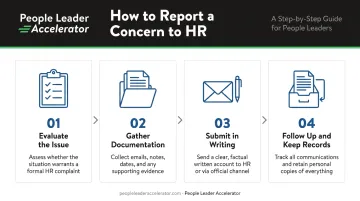
Step 3: Submit Your Complaint in Writing
Verbal-only complaints create no official record and are easily disputed. Always submit in writing — email or a formal complaint form — and:
- Use specific, legally recognized language — write "harassment based on [protected class]" or "discrimination based on [protected class]," not vague phrases like "unfair treatment" or "toxic behavior"
- Keep it factual and concise: describe what happened, when, who was involved, and why it constitutes a violation — don't pad it with every minor grievance accumulated over months
- Use your company's designated reporting channel (HR portal, HR email, anonymous hotline) to ensure it's routed correctly and creates an official record
EEOC guidance notes that precise legal terminology isn't strictly required, but the complaint must clearly communicate that you're opposing perceived unlawful discrimination.
Step 4: Follow Up and Maintain a Paper Trail
After any verbal conversation with HR — in-person or by phone — send a follow-up email that same day confirming what was discussed, any commitments made, and next steps.
Additional follow-up actions:
- Request written confirmation that your complaint was received
- Ask for an estimated investigation timeline
- Keep personal copies of all correspondence outside company systems — in a personal email account or printed copies — in case access is restricted later
What to Prepare Before Filing Your Report
Preparation directly affects whether an HR complaint gets taken seriously. An undocumented complaint puts the entire weight of the investigation on HR's discretion.
The Documentation You Need
Your incident log should include, at minimum:
- Date and time of each incident
- Location (in-person, virtual meeting, email, etc.)
- Exact words spoken or specific actions taken
- Names of anyone who witnessed the incident
- How it affected you professionally or personally
Collect supporting evidence alongside the log: emails, screenshots, written communications — even records that seem tangential may become relevant.
Understanding Your Company's Reporting Process
Review your employee handbook before filing. Identify:
- The correct reporting channel (HR portal, direct HR Business Partner, anonymous hotline)
- Any required format for submitting complaints
- Internal deadlines — some companies require complaints within a specific timeframe
Using the wrong channel can delay action or route your complaint to someone without authority to act on it.
Know the Legal Baseline
Internal processes matter, but so does the external legal framework. Federal laws establish the floor for employee protections — and knowing them helps you understand whether your situation may warrant action beyond an internal complaint. The table below outlines the key statutes:
| Federal Law | Protected Basis |
|---|---|
| Title VII | Race, color, religion, sex (including pregnancy, sexual orientation, gender identity), national origin |
| ADA | Disability |
| ADEA | Age 40 or older |
| GINA | Genetic information |
| Equal Pay Act | Sex-based wage discrimination |
| Anti-retaliation provisions | Opposition to covered discrimination; participation in EEO proceedings |
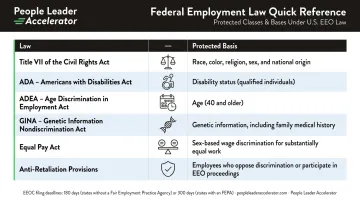
Pay close attention to timing: EEOC charges must generally be filed within 180 calendar days of the discriminatory act — extended to 300 days when a qualifying state or local agency covers the same basis. Filing an internal HR complaint does not pause this clock, so don't assume internal action protects your external options.
Common Mistakes When Reporting to HR
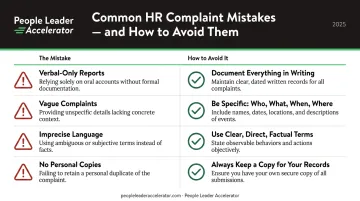
Even serious, well-founded complaints fail because of how they're reported. These are the most frequent mistakes:
- Verbal-only reports: Without a written record, HR can claim no formal complaint was ever made. Follow up every conversation in writing — same day if possible
- Vague or emotionally driven complaints: Long grievances covering every frustration make it harder to investigate a specific claim. Focus on the most legally significant incidents with precise dates and details
- Imprecise language: "They're unfair" gives HR room to treat the issue as a morale problem. "Harassment based on my race" or "discrimination based on my disability" signals a legal matter that requires a formal investigation
- No personal copies: If the situation escalates to an attorney or an EEOC filing, you'll need records that may no longer be accessible — or that could be altered — once employment ends
What Happens After You Report to HR
Once HR receives a formal written complaint, an investigation is generally required. How quickly it moves — and what the outcome looks like — depends on company size, issue severity, and how thoroughly the complaint was documented.
The Investigation Process
HR will typically conduct confidential interviews with you, the accused party, and any witnesses. During this period:
- Expect limited updates — HR rarely provides ongoing status reports during an active investigation
- You may be asked to provide additional documentation
- Temporary workplace adjustments (schedule changes, remote work, reporting structure shifts) may be implemented
On confidentiality: HR cannot guarantee anonymity, particularly when witnesses must be interviewed. Be prepared for the accused to become aware a complaint was filed. Per EEOC guidance, information is shared only with those who need it — but complete confidentiality cannot be promised.
Internal investigations typically close within 30–36 days for most allegation types, according to HR Acuity's benchmark data.
If HR Fails to Act or the Situation Escalates
If HR doesn't respond within a reasonable timeframe, dismisses the complaint without investigation, or if retaliation follows your report, external options include:
- Filing a charge with the EEOC at publicportal.eeoc.gov — within the 180-day (or 300-day) deadline
- Contacting your state Fair Employment Practices Agency (FEPA)
- Consulting an employment attorney — particularly if retaliation has occurred
Retaliation is not a minor risk: retaliation appeared in 47.8% of all EEOC charges in FY2024, making it the most frequently alleged basis across all charge types.
HR professionals looking to build complaint-handling processes that hold up under scrutiny can find structured frameworks — covering intake, investigation, and resolution — through People Leader Accelerator's HR Leadership programs.
Frequently Asked Questions
What does it mean to report to HR?
Reporting to HR means formally bringing a workplace concern — harassment, discrimination, safety violations, or unresolved conflict — to the Human Resources department so it can be investigated and addressed under company policy and applicable employment law. A casual hallway mention doesn't qualify — the concern needs to be submitted through an official channel to trigger any formal process.
Can I report to HR anonymously?
Some companies offer anonymous reporting hotlines or portals. True anonymity isn't always guaranteed, though — especially when the investigation requires witness interviews. Anonymous complaints may also limit HR's ability to fully investigate or follow up with you directly.
How do I report a toxic coworker to HR?
Document specific behaviors with dates, times, and exact words or actions — not general personality assessments. Frame the report around how the behavior violates company policy, or constitutes harassment or discrimination if a protected class is involved. HR needs documented specifics to open a formal investigation.
What should I avoid saying when filing an HR complaint?
Avoid vague language ("they're unfair"), emotional hyperbole, padding the complaint with minor grievances, and making accusations beyond what documented evidence supports. Specificity and factual grounding are what make a complaint actionable.
What happens if HR ignores my complaint?
File a charge with the EEOC within the applicable time limit — typically 180 days from the incident, or 300 days if your state has a qualifying enforcement agency. You can also contact a state employment agency or consult an employment attorney.
Can my employer retaliate against me for reporting to HR?
Retaliation for filing a protected complaint is illegal under federal law. If you experience demotion, termination, schedule changes, or hostile treatment after reporting, that conduct itself constitutes a reportable violation — and can be filed as a separate charge with the EEOC.