The right resources close that gap. They're the difference between reacting to workforce problems after the fact and shaping organizational outcomes before they become crises. This post curates the 10 best HR websites and resources — covering compliance, strategy, community, and professional growth — so you can build a stack that actually serves your work.
Key Takeaways
- SHRM and DOL.gov are non-negotiable for compliance, credentials, and federal law
- HR Brew and Deloitte Insights are the strongest options for staying current on trends and workforce strategy
- For practical, community-grounded content, HR Bartender, HR.com, and CultureAmp each serve a distinct niche
- BambooHR Blog and TLNT are well-suited for research-backed tactical guidance
- People Leader Accelerator targets HR leaders ready to move from operational execution into strategic business partnership
What Makes an HR Resource Worth Your Time?
Much of what circulates online as "HR guidance" is produced by vendors with a product to sell, written at a surface level, or simply outdated. In a regulatory environment where laws like the PWFA (effective June 2023) and the DOL's independent contractor rule (effective March 2024) can reshape compliance overnight, that gap matters.
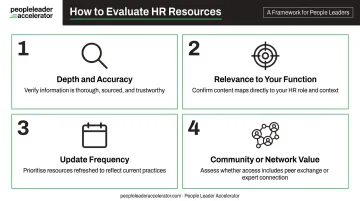
When evaluating any resource, apply these four criteria:
- Depth and accuracy — Cites primary data or original research, not a third-hand summary of someone else's findings
- Relevance to your function — Generalist vs. specialist framing, and startup vs. enterprise context, will determine whether guidance is actually applicable to your situation
- Update frequency — At least six state or local pay-transparency laws took effect in 2025 alone; resources that aren't current aren't useful for compliance work
- Community or network value — Does it connect you to peers facing the same challenges?
The resources below were selected for practitioners across career levels — from new HR managers to senior CPOs. Some will be daily reads; others are reference tools for specific situations. Use this list to build a focused stack that serves your actual work — not a collection of bookmarks you never revisit.
The 10 Best HR Resources and Websites
These resources were selected based on content credibility, practical value, breadth of coverage, and usefulness across different HR career levels and organization sizes.
1. SHRM (Society for Human Resource Management)
SHRM is the largest professional HR association in the world, with nearly 340,000 members across 180 countries. It offers news, toolkits, how-to guides, policy templates, and compliance resources — including a dedicated toolkit for building an HR department from the ground up.
What makes SHRM the baseline resource every HR professional should bookmark:
- It's the credentialing body for SHRM-CP (early-to-midcareer practitioners) and SHRM-SCP (senior strategic leaders)
- Its 2025 Employee Benefits Survey drew 3,969 respondents, making it one of the most cited compensation and benefits benchmarks in the field
- It publishes the SHRM Body of Applied Skills and Knowledge (BASK), the formal competency framework underlying both credentials
Access is mixed — nonmembers get one free article per month, while members unlock full research, templates, and professional development tools. For compliance, credentialing, or benchmarking work, SHRM is where you start.
2. HR Brew
HR Brew is a Morning Brew publication delivering concise, practitioner-focused news on HR strategy, workforce trends, talent management, and DEI. With more than 170,000 HR professional subscribers, it's built a strong reputation for making complex developments accessible without oversimplifying them.
It covers topics like:
- AI's impact on HR functions and compensation tools
- Pay transparency legislation and employer compliance strategies
- The evolution of HR from administrative to data-driven business function
The format matters: HR Brew lands in your inbox and takes under 10 minutes to read. For HR leaders who need to stay current without carving out hours each week, it's one of the highest-ROI subscriptions available — and it's free.
3. DOL.gov (U.S. Department of Labor)
DOL.gov is the authoritative federal source for employment law and regulatory compliance. For any HR professional doing compliance-oriented work, it's not optional.
Key resources available free on DOL.gov:
- Required federal workplace posters — use the FirstStep Poster Advisor to determine which apply to your organization, since requirements vary by statute and employer size
- FMLA and wage-and-hour guidance through the Wage and Hour Division
- Independent contractor classification rules (the 2024 final rule uses a multifactor economic-reality test)
- Occupational Outlook Handbook (via BLS) for workforce planning, role design, and labor supply analysis
One note: EEO enforcement for private-sector employers falls primarily under the EEOC, not DOL. Keep both bookmarked and understand where each agency's jurisdiction begins and ends.
4. HR.com
HR.com claims a self-reported reach of over 2 million HR professionals and offers free membership access to a broad resource library — including HR forms, templates, webcasts, and topical community forums.
What free members get:
- Employee handbook sections, onboarding documents, and direct deposit forms
- Unlimited access to live and on-demand webcasts
- Up to five recertification credits per year (qualifying for SHRM-CP/SCP and HRCI credentials, though HR.com is a recertification provider, not the credentialing body itself)
- Peer forums organized by HR specialty
HR.com is particularly valuable for new or solo HR practitioners who need fast access to vetted templates alongside a peer network. The resource library functions as a practical starting point; the community extends its value beyond one-time downloads.
5. Deloitte Insights (Human Capital)
Deloitte's Human Capital section publishes the most rigorous large-scale workforce research available outside of academic journals. Its 2024 report, Thriving Beyond Boundaries, surveyed more than 14,000 respondents across 95 countries — a sample size that distinguishes it from most vendor-produced content.
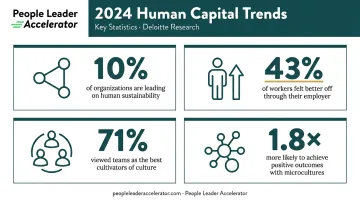
Selected findings from the 2024 report worth knowing:
- Only 10% of organizations were leading on human sustainability metrics
- 43% of workers believed their employer had left them better off
- 71% viewed individual teams as the best place to cultivate organizational culture
- Organizations embracing microcultures were 1.8 times as likely to report positive human outcomes
The report is publicly accessible without a subscription. Deloitte Insights earns its place because it operates where HR meets business strategy — making it the go-to reference when you need to frame people recommendations in financial or operational terms for a board or executive team.
6. HR Bartender
HR Bartender is a long-running blog by Sharlyn Lauby, president of ITM Group and a practicing HR consultant. SHRM has recognized it as one of the top five blogs read by HR professionals. Posts are grounded in real workplace scenarios — not theoretical frameworks — which makes it useful for both new managers and veteran practitioners.
Topics covered include:
- Performance management and difficult conversations
- Employee engagement and retention strategies
- HR career development and time management for people leaders
- Recruiting strategy and workforce planning fundamentals
It's independently produced, though affiliated with Lauby's consulting business. That context is worth keeping in mind, but it doesn't diminish the practical value.
7. BambooHR Blog and Resource Library
BambooHR's content hub is one of the stronger free HR resource libraries available, particularly for professionals at small-to-mid-sized companies. The team commissions original workforce research — their 2025 Employee Happiness Index analyzed 2.38 million self-reported eNPS scores from more than 60,900 employees at 1,700+ companies — and translates findings into recommendations practitioners can act on.
The resource library includes:
- Research reports on employee engagement, onboarding, and compensation
- How-to guides and downloadable templates (some gated, most accessible)
- Webinars and blog posts regularly updated for current workforce conditions
Their onboarding research found that 89% of employees who experienced effective onboarding felt engaged — a useful benchmark for making the internal case for onboarding investment. The SMB orientation of the content makes it a strong complement to more enterprise-focused platforms.
8. CultureAmp Resources
CultureAmp's free resource library covers employee engagement, performance management, DEI, and workplace culture. What separates it from typical vendor content is the benchmark data underneath it: Their benchmarks aggregate data from 8,900+ organizations, 74.15 million surveys completed, and 1.61 billion questions answered, refreshed twice per year.
The library includes guides, toolkits, research reports, and webinars — many publicly accessible without a platform subscription. For HR leaders building or refreshing an engagement strategy, the benchmark data provides a credible peer comparison that most internal surveys can't replicate on their own.
The caveat: this is a vendor resource, and some assets are gated. The benchmark insights, however, are empirically grounded — built on a dataset few independent research firms can match.
9. TLNT (by ERE Media)
TLNT is ERE Media's editorial platform dedicated to talent management, talent acquisition, and HR strategy. It covers sourcing, retention, workforce planning, and HR tech with a distinct editorial voice that treats HR as a strategic business function rather than a support service.
It's especially useful for HR professionals who specialize in talent acquisition or talent management — the coverage goes past general HR news to address the mechanics of building and retaining high-performing teams. Content is publicly accessible, and ERE also offers webinars and practitioner-focused commentary through its broader publication network.
For compliance, SHRM is your foundation. For workforce strategy, Deloitte sets the benchmark. TLNT is where you stay current on the operational discipline of talent.
10. People Leader Accelerator
People Leader Accelerator occupies a different category than the other nine resources on this list. It's not a news platform, a compliance database, or a vendor blog — it's a professional development platform built specifically for HR and people leaders in high-growth organizations.
The faculty brings practitioner experience from startups, private equity-backed companies, and high-growth tech organizations. Marie Szuts led the people function at Figma during rapid expansion. Andrew Bartlow brings 25 years of HR and talent leadership experience and co-authored Scaling for Success: People Priorities for High Growth Organizations (Columbia Business School Press). Carmela Krantz has served as the first VP of HR at nine companies, including six startups.
What PLA offers:
- Expert-led programs delivered in a cohort model with weekly live sessions and applied coursework
- Downloadable guides and toolkits covering people analytics, compensation benchmarking, organizational culture design, and new hire onboarding
- Mastermind peer groups — curated small groups of HR leaders from similar organizations, meeting monthly
- An active alumni community operating through a private Slack workspace, monthly virtual workshops, and an annual in-person retreat (PLA Propel)
- On-demand faculty mentorship from practitioners who've held senior HR roles across the organizational types most PLA participants are working inside
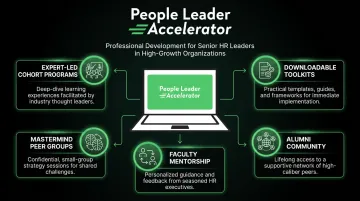
The curriculum is built for HR leaders who already know the fundamentals — and need to show up as strategic business partners, not just functional experts.
How We Selected These Resources
Each resource on this list was evaluated against four criteria:
- Content credibility and editorial independence — who produces it, how it's funded, and whether editorial decisions are insulated from commercial pressure
- Relevance across HR specializations — does it serve generalists and specialists, not just one narrow function?
- Currency — is it updated frequently enough to remain useful in a fast-changing regulatory and talent environment?
- Accessibility — is it free or freemium where possible, without sacrificing quality?
The goal was a deliberately varied stack — compliance, community, strategy, and professional growth each have a place here.
A practical note on how to use this list: pick 2–3 as regular reads and treat the rest as reference tools you return to when specific situations come up. Subscribing to everything at once tends to produce a crowded inbox, not a sharper HR practice.
Conclusion
HR practice doesn't hold still. Federal regulations shift, state laws multiply, and workforce expectations change faster than most training programs can keep up with. Staying current isn't optional — it's part of the job.
Knowing where to find credible information is step one. The harder work is applying it — translating what you read into decisions, programs, and leadership moves that fit your specific organization.
For HR leaders who want structured support in making that translation, People Leader Accelerator offers practitioner-taught programs, applied frameworks, and a peer community of professionals working through the same challenges. It's a different kind of resource than the ones listed above — and for many leaders, a necessary complement to them.
Frequently Asked Questions
What are HR resources?
HR resources are tools, platforms, publications, and communities that help HR professionals do their jobs more effectively. They include compliance guides, industry research, training materials, professional networks, and HR-specific news outlets — ranging from government databases like DOL.gov to practitioner communities like HR.com.
What are the 7 pillars of HR?
The commonly referenced pillars are: recruitment and staffing, training and development, compensation and benefits, employee relations, compliance and legal, organizational development, and HR information systems (HRIS). SHRM's BASK competency framework organizes these areas somewhat differently, and definitions vary across organizations.
What are red flag words for HR?
In HR, "red flag" language typically refers to job posting or policy wording that signals legal exposure or discriminatory intent — such as age-coded phrases like "digital native" or "recent graduate," which the EEOC notes may discourage applicants over 40. Context matters; these are review triggers, not automatic violations.
What is the best website for HR professionals?
SHRM is the most broadly authoritative resource given its credentialing infrastructure, compliance coverage, and research depth. The "best" resource depends on your role: DOL.gov for compliance, Deloitte Insights for strategy, HR Brew for staying current, and People Leader Accelerator for structured professional development.
Are there free HR resources available online?
Yes — many of the strongest resources are free or freemium. SHRM offers limited free access, while DOL.gov, HR Brew, HR Bartender, BambooHR's blog, and HR.com's basic membership are all accessible at no cost. You can build a solid HR resource library without any paid subscriptions.