

Introduction
When HR and legal operate in silos, organizations pay for it — through employment claims, compliance failures, and decisions that unravel because no one thought to loop in counsel before the offer letter went out or the termination meeting happened.
The EEOC received 88,531 new charges in FY2024 — a 9.2% increase from the prior year — and secured nearly $700 million in relief for almost 21,000 workers. It's a measure of how many organizations got the people-law intersection wrong.
This article is for HR leaders who want to move from a reactive "call legal when something breaks" posture to a structured, proactive partnership — one that protects the organization and enables faster, more confident decisions.
Key Takeaways
- Every people decision — from hiring to termination — carries legal weight. HR and legal alignment is a business requirement.
- The highest-risk areas include hiring documentation, terminations, investigations, RIFs, and policy development.
- HR leaders don't need to memorize statutes — they need to recognize the patterns that signal legal exposure.
- The fix for most HR-legal friction is earlier touchpoints, not more reviews after the fact.
- A joint responsibility matrix and a recurring sync cadence are the two structural moves that make the biggest difference.
Why the HR-Legal Partnership Is a Business-Critical Relationship
HR and legal share more surface area than any other two functions in an organization. Every hire, every termination, every leave request, every policy update — all of it lands somewhere in the employment law landscape. That overlap makes alignment between the two teams a prerequisite for organizational health, not a scheduling nicety.
The financial stakes are real and specific. Per-violation exposure accumulates fast when processes aren't documented or consistently followed:
- I-9 violations: $281–$2,813 per substantive error; up to $27,894 per unauthorized worker for repeat violations
- OSHA: Up to $165,514 per willful or repeated violation
- WARN Act: Back pay and benefits for each affected employee for up to 60 days, plus $500 per day for failure to notify local government
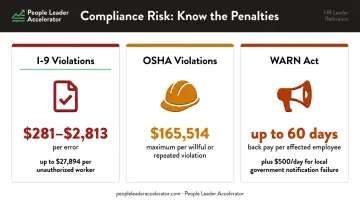
These are the published penalty structures. They apply any time documented processes are missing, inconsistent, or out of date.
The Distinct but Complementary Roles
The dynamic works best when each function stays in its lane while actively informing the other:
- HR owns people processes, culture, and employee experience
- Legal owns risk interpretation, regulatory guidance, and defensibility
When those roles blur — or go undiscussed — both teams end up exposed. HR makes decisions without understanding the legal implications; legal gets called in too late to do anything but block.
Why High-Growth Organizations Face Amplified Risk
For HR leaders in startups and scaling organizations, the stakes increase as headcount grows. New jurisdictions bring distinct compliance obligations. Federal law requirements also shift at key headcount milestones:
- 15 employees: Title VII, ADA, and GINA protections apply
- 20 employees: Age Discrimination in Employment Act (ADEA) kicks in
- 50 employees: FMLA obligations begin; ACA reporting thresholds apply
The volume of legally sensitive decisions tends to outpace the infrastructure built to handle them — which is exactly where an underprepared HR-legal relationship creates the most exposure.
The Key Areas Where HR and Legal Must Work Together
The following areas represent the highest-stakes intersection points between HR and legal — where undefined ownership or poor communication creates the most risk.
Hiring and Onboarding
Job postings, offer letters, employment agreements, I-9 verification, and onboarding documentation all carry legal exposure. HR needs legal input to ensure templates are current, jurisdiction-appropriate, and free of language that creates unintended obligations or discrimination claims.
A few specifics that often get missed:
- I-9 timing: Section 1 must be completed by the employee's first day; Section 2 within three business days
- Background checks: FCRA requires a standalone disclosure, written authorization, and specific adverse-action notices before and after a negative decision
- Pay transparency: California (15+ employees), New York (4+ employees), and Illinois (15+ employees) all now require salary ranges in job postings — and the rules differ by jurisdiction
Performance Management and Terminations
How HR documents performance issues, progressive discipline, and terminations directly determines how defensible those decisions are. Documentation doesn't guarantee a favorable outcome, but the absence of it routinely undermines one.
Legal should co-create the documentation standards and review separation agreements before they go out — as a design partner in the process, not a last-minute reviewer at the end of it.
Employee Relations and Investigations
Performance breakdowns often surface employee relations issues — which is why clear escalation protocols matter here more than anywhere. Teams need agreed-upon answers to:
- Which complaints does HR handle independently?
- Which require legal involvement from the start?
- How is information shared between teams without creating privilege issues?
One note worth flagging: copying legal counsel on an HR investigation doesn't automatically protect it under attorney-client privilege. Privilege depends on whether the communication was made for the purpose of obtaining legal advice — and disclosure outside that purpose can create waiver risk.
Layoffs and Workforce Restructuring
When employee relations escalate to workforce restructuring, the stakes shift considerably. Reductions in force require HR and legal to plan together before action is taken — not during. Key legal dimensions:
- WARN Act: 60-day notice required for qualifying events (generally 50+ employment losses at a single site); liability includes back pay and benefits per employee plus $500/day for failure to notify local government
- Disparate impact analysis: EEOC guidance advises testing proposed RIF criteria for disproportionate effects on protected groups before the selection is finalized
- Severance agreements: Age-differentiated agreements (for employees 40+ under OWBPA) require specific compliance steps that vary from standard separation documents
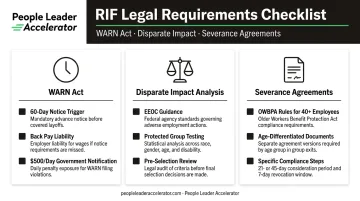
PLA's Reduction In Force Toolkit includes separation agreement templates (both over-40 and under-40 versions), notification letters, RACI timelines, and severance calculation frameworks — designed as a starting point for legal review, not a substitute for it.
Policy Development and the Employee Handbook
Policies covering harassment, leave, remote work, contractor classification, and social media need both HR's operational perspective and legal's compliance lens. The most practical structural fix: establish a recurring annual HR-Legal policy review as a standing ritual, not a reactive project triggered by a complaint or audit.
What HR Leaders Should Know About Foundational Employment Laws
Legal fluency for HR leaders means knowing which situations carry elevated risk, which decisions need legal sign-off, and how to ask the right questions when consulting counsel. Statute memorization isn't the goal. Pattern recognition is.
Here are the major federal frameworks that govern most day-to-day HR decisions:
| Law | What It Covers | Threshold |
|---|---|---|
| Title VII | Anti-discrimination (race, sex, religion, national origin) | 15+ employees |
| ADA | Disability discrimination and accommodation | 15+ employees |
| ADEA | Age discrimination (40+) | 20+ employees |
| FLSA | Minimum wage, overtime, classification | Most employers |
| FMLA | Job-protected leave | 50+ employees |
| OSHA | Workplace safety | Most private employers |
| COBRA | Health coverage continuation | 20+ employees |
| ACA | Employer shared responsibility | 50+ FTE |
| ERISA | Benefits plan fiduciary standards | Plan sponsors |
Crossing one threshold doesn't mean you've crossed all of them. HR leaders in scaling organizations need to track which laws apply at which headcount milestones — and update that map as they grow.
The Regulatory Environment Doesn't Hold Still
Pay transparency laws illustrate how quickly the landscape shifts. California, New York, and Illinois each enacted distinct pay posting requirements between 2023 and 2025, with different employer size thresholds, different content requirements, and different effective dates. A job posting compliant in 2022 may not be compliant today, depending on where the role is posted and where the employee will work.
Remote work adds another layer: employees working from a different state than your headquarters can trigger that state's employment laws, minimum wage rates, and leave requirements, without a formal HR process to flag it.
Common Friction Points Between HR and Legal — and How to Address Them
The most common source of tension is a structural mismatch: HR prioritizes speed and employee experience; legal prioritizes documentation and risk reduction. Both are legitimate. Without explicit communication norms, they collide.
The "Legal as Gatekeeper" Problem
This dynamic emerges when HR only brings legal in at the last minute — when an offer letter is already drafted, a termination decision already made, or a policy already in circulation. At that point, legal is forced into a reactive, blocking role. The fix isn't more legal review; it's earlier touchpoints that give legal context while there's still room to shape the decision.
The Information-Sharing Challenge
This challenge becomes acute during investigations. Attorney-client privilege doesn't apply automatically just because HR sends an email to legal — it protects confidential communications made specifically for the purpose of obtaining legal advice. When HR and legal haven't agreed in advance on how sensitive communications are documented and what triggers privilege protection, the investigation can lose protections it was assumed to have.
Practical fixes:
- Establish a written protocol before an investigation starts, not during it
- Distinguish between communications that are HR business records and those that reflect legal advice
- Include legal in the investigation design phase, not just the review phase
How to Build a Proactive HR-Legal Partnership That Lasts
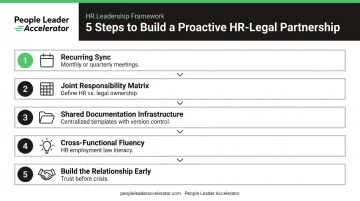
Structure is what makes the relationship work when things get busy or complicated. A few concrete investments pay consistent dividends:
1. Establish a recurring HR-Legal sync Monthly for high-growth or high-volume organizations; quarterly at minimum for others. Use it to review pending policy updates, flag emerging legal issues, and audit high-risk processes. This prevents the relationship from only activating in crisis.
2. Build a joint responsibility matrix Define clearly which matters HR owns, which require legal involvement, and which require legal to lead. Cover investigations, separations, accommodation requests, and contractor classification at minimum.
3. Create shared documentation infrastructure Templatized agreements, offer letters, and policies stored centrally with version control. HR shouldn't be pulling documents from email chains; legal shouldn't be reviewing the same thing from scratch each time.
4. Invest in cross-functional fluency HR leaders who understand basic employment law communicate more effectively with counsel and ask sharper questions. Legal professionals who understand how HR operates day-to-day give more practical, actionable guidance.
That's the gap People Leader Accelerator directly addresses — equipping HR leaders with strategic frameworks and business-decision-making skills so they can walk into a conversation with general counsel prepared to discuss risk, documentation, and organizational exposure on equal footing. That fluency is developed, not assumed.
5. Build the relationship before you need it Mutual respect, transparency about constraints, and a shared goal of protecting both the organization and its people — this relational foundation is what makes the structural elements actually work. Start building it now, in normal operations, so there's actual trust in the room when something difficult lands on the table.
How to Know If Your HR-Legal Partnership Is Working
You don't need a formal scorecard to diagnose this. A few honest conversation topics surface alignment gaps quickly:
Signals of a healthy partnership:
- Legal is involved early in sensitive decisions, not called in after documents have gone out
- HR rarely gets surprised by legal objections to policies or offers already in motion
- Both teams agree, without ambiguity, on who owns what

Once you've assessed the qualitative picture, these measurable indicators help sharpen the conversation:
Practical indicators worth tracking (not as KPIs, but as conversation starters):
- How many employment-related complaints are resolved at the HR level vs. escalated?
- How long does a policy review typically take from HR draft to legal sign-off?
- Do HR and legal leadership share the same view of the organization's highest people-related risks?
If the answer to that last question is "I'm not sure," that gap in shared risk awareness is exactly where the partnership work needs to start.
Frequently Asked Questions
How do HR and legal work together?
HR and legal collaborate across the full employee lifecycle — from hiring documents and policy design to investigations and terminations. HR owns the people processes; legal provides regulatory guidance and risk oversight.
What is HR and legal?
"HR and legal" refers to the intersection of HR management and employment law. HR manages the people function; legal interprets the laws governing that employment relationship and advises on how to stay compliant and defensible.
What are the three most important HR laws?
Title VII of the Civil Rights Act (anti-discrimination), the Fair Labor Standards Act (wage and hour requirements), and the Family and Medical Leave Act (job-protected leave) are three foundational federal laws that shape the most common HR decisions. State and local laws frequently add additional requirements that override or extend federal protections.
Who should lead the HR-Legal partnership initiative?
The CHRO or VP of HR typically drives the relationship from the HR side, ideally in direct partnership with the General Counsel or Head of Employment Law. The initiative works best when both leaders are equally invested, not when one function defers entirely to the other.
How often should HR and legal teams meet?
Monthly check-ins work well for organizations with active growth or high employee relations volume. Add a quarterly strategic review to address policy gaps, regulatory changes, and emerging risks. Whatever cadence you choose, keep it consistent.