

Introduction
HR has moved from the back office to the boardroom — and that shift has changed what success in this field actually requires. Processing payroll correctly and maintaining compliance still matter. But today's organizations expect HR professionals to do something harder: shape culture, anticipate workforce disruptions, and influence business strategy at the executive level.
That gap between operational competence and strategic leadership is where many HR careers stall. Understanding it is the first step to closing it.
This guide covers what HR leadership is, why it matters, which roles it encompasses, the traits that define effective HR leaders, and how to build those capabilities deliberately.
Key Takeaways
- HR leadership focuses on strategy, culture, and organizational direction — not day-to-day administration
- Effective HR leaders combine strategic thinking, empathy, ethical grounding, and data fluency
- HR leadership roles span from HR Manager to Chief Human Resources Officer (CHRO)
- Development paths blend formal learning, stretch assignments, mentorship, and peer community
- AI, hybrid work, and generational complexity are rapidly reshaping the skills HR leaders need
What Is HR Leadership?
HR leadership is the practice of guiding an organization's people function with strategic intent. It goes beyond policies, procedures, and transaction processing to shape how talent, culture, and business goals connect.
The easiest way to understand it: HR leadership asks why and where are we going, while HR management asks how and is this compliant.
HR Leadership vs. HR Management
The distinction matters more than most organizations realize.
| Dimension | HR Management | HR Leadership |
|---|---|---|
| Primary focus | Operational execution | Workforce strategy |
| Time horizon | Current cycle | Long-term capability |
| Key activities | Hiring, payroll, compliance | Culture design, succession planning, talent strategy |
| Organizational role | Functional delivery | Executive advisory |
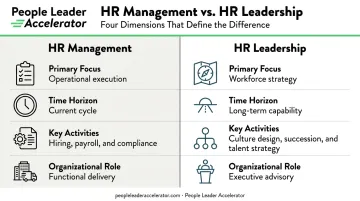
A concrete example: an HR manager handles a termination correctly, following the right process and documentation. An HR leader, anticipating a broader reduction in force, designs a communication strategy that addresses employee anxiety, protects morale, and preserves the organization's reputation as an employer.
Organizations that keep HR in a purely administrative capacity consistently find themselves unprepared when workforce disruptions arrive — because no one has been building the people infrastructure to respond. The external market reflects the same expectation.
Deloitte's analysis of 748 CHRO job postings across 20 industries found that business management, operations, and business strategy appeared in 64%, 54%, and 49% of postings respectively. The market has already defined what it expects HR leaders to deliver. The question is whether HR professionals are building those capabilities.
Why HR Leadership Matters for Organizations
The business case for strategic HR leadership is no longer theoretical. The data is clear, and the organizational consequences of getting it wrong are measurable.
Culture, Engagement, and Retention
HR leaders directly shape how employees experience their workplace — how conflicts are resolved, how achievements are recognized, and whether inclusion is practiced or just stated.
According to Gallup, highly engaged teams deliver 23% higher profitability and 18% higher sales productivity than less-engaged peers. Managers account for 70% of the variance in team-level engagement — which means the quality of HR leadership cascades directly into every team in the organization.
Global employee engagement fell to 20% in 2025, costing an estimated $10 trillion in lost productivity. That's not a training problem. It's a leadership problem.
Change Management
Employees now experience an average of 10 planned organizational changes per year — five times the level of a decade ago. HR leaders are the stabilizing force when restructurings, technology shifts, or external disruptions hit.
McKinsey reports that well-informed leaders who engage employees proactively can achieve 70–80% change success rates, compared to the widely cited 70% failure rate for reactive approaches. HR leaders who get ahead of change — communicating early, involving employees, and addressing concerns before they compound — are what separates a successful transition from an expensive failure.
Business Outcomes and Measurement
When HR has a seat at the strategic planning table, the business benefits are concrete: fewer talent gaps, lower workforce costs, and stronger candidate pipelines.
60% of CEOs in PwC's 2024 Pulse Survey rated their CHROs as highly effective strategic partners. Executive expectations have already shifted — HR leaders who can't demonstrate business impact get repositioned back into an administrative function.
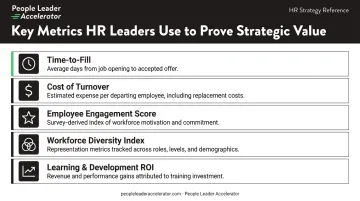
Key metrics HR leaders use to prove strategic value:
- Time-to-fill for critical roles
- Voluntary turnover rate and cost-per-turnover
- Employee engagement and satisfaction scores
- Diversity representation benchmarks
- ROI of training and development programs
These metrics matter in every organization, but the stakes are highest in high-growth environments — startups, scale-ups, and PE-backed companies where speed compounds every decision. People strategy built reactively in fast-scaling organizations creates cascading problems: culture drift, hiring errors, and leadership gaps that slow growth at exactly the wrong moment.
Common HR Leadership Roles and Titles
HR leadership spans a wide range of seniority levels and specializations — no two organizations structure it exactly the same way.
Core HR Leadership Titles
| Title | Scope |
|---|---|
| HR Manager | Leads a team or function; balances operational and strategic responsibilities |
| HR Director | Oversees multiple HR functions; significant strategic input at the business unit level |
| VP of Human Resources | Senior leader; partners directly with executive team on workforce strategy |
| SVP of People Operations | Broad organizational scope; typically leads large, complex people functions |
| Chief Human Resources Officer (CHRO) | Top HR executive; C-suite advisor on all people and culture matters |
The Bureau of Labor Statistics reported a median annual wage of $140,030 for HR managers in May 2024, with the top 10% earning more than $239,200. Employment is projected to grow 5% from 2024–2034, faster than the average for all occupations — with approximately 17,900 annual openings over that period.
Specialized HR Leadership Paths
Many HR leaders build careers around a specific discipline rather than climbing a generalist hierarchy. These specialized paths include:
- Talent Acquisition Leader — owns recruiting strategy, employer brand, and hiring pipelines
- Director of Employee Engagement — designs and measures the employee experience
- Labor Relations Director — navigates union relationships and workforce compliance
- Director of People Analytics — translates workforce data into business intelligence
- Head of Diversity, Equity & Inclusion — builds equitable systems across the organization
Knowing which path fits your strengths — generalist, specialist, or a mix of both — is one of the earliest and most consequential decisions in an HR leadership career.
Key Traits of Effective HR Leaders
What separates HR professionals who advance into leadership from those who plateau in operational roles? A consistent set of capabilities appears across the research and in practice.
Strategic thinking and business alignment sit at the top of the list. Effective HR leaders connect people priorities to business outcomes. They design engagement programs to solve a specific business problem, not because they seem like a good idea. Deloitte found that initiative and leadership appeared in 74% of CHRO job postings analyzed, with business management close behind at 64%.
Communication and Empathy
Strong HR leaders communicate difficult information clearly and respectfully across every level of the organization. A CHRO who can explain a workforce reduction to employees with transparency — and simultaneously brief the board on the strategic rationale — is exercising a form of leadership that most HR practitioners never develop.
Empathy means understanding employee perspectives before designing solutions — that understanding drives the trust that makes those solutions work. Organizations where employees don't trust HR have low psychological safety, and that shows up in engagement scores and attrition.
Ethical and Values-Based Leadership
HR leaders hold significant power: access to sensitive employee data, influence over hiring and termination decisions, and proximity to the organization's highest-stakes moments. Integrity in those moments — handling a performance exit with dignity, conducting a fair investigation, being honest when a policy has failed — is what builds or destroys credibility.
Values-based leadership is not aspirational language. It's what makes HR trustworthy enough to be strategic.
Data-Driven Decision Making
Boards and executive teams expect HR leaders to be analytically fluent. That means building and reading HR dashboards, evaluating retention strategies using real data, and presenting workforce analytics in the language of business impact: cost, revenue, and risk.
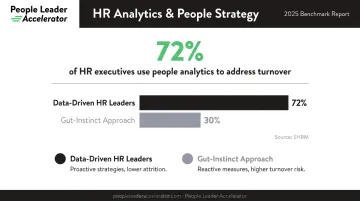
SHRM reports that 72% of HR executives now use people analytics to address turnover. HR leaders who rely on gut instinct instead of data are operating at a disadvantage in organizations that expect evidence-based decisions.
Forward-Thinking and Adaptability
The best HR leaders anticipate trends rather than react to them. That means tracking workforce demographics and emerging technologies before they affect retention or hiring — not scrambling to respond after the fact.
Adaptability is the other side of that equation: when conditions change faster than strategy can keep pace, resilient HR leaders adjust without losing organizational stability.
How to Develop Your HR Leadership Skills
Development into HR leadership is deliberate. It doesn't happen through tenure alone.
Formal Learning and Structured Programs
Graduate education, HR certifications, and structured leadership programs provide the strategic frameworks that operational experience doesn't automatically build.
Relevant credentials for senior HR leadership include:
- SPHR — Senior Professional in Human Resources
- SHRM-SCP — SHRM Senior Certified Professional
- CECP — Certified Executive Compensation Professional
- Executive coaching certifications — varied providers, including Hudson Institute and Emory University
People Leader Accelerator's flagship program is a 16-week, cohort-based experience designed specifically for HR professionals stepping into top-of-function roles. Faculty bring 25–30+ years of practitioner experience across high-growth organizations, private equity, and scaling tech companies. The program is SHRM-recognized and offers Professional Development Credits for SHRM-CP® and SHRM-SCP® holders.
For professionals earlier in the journey, PLA also offers a free Strategic HR Planning Resource Package that includes a Role of a Strategic HR Leader matrix — for assessing where your current work sits on the operational-to-strategic spectrum.
On-the-Job Experience and Stretch Assignments
Classroom learning builds frameworks. Stretch assignments build the judgment that frameworks alone can't teach.
High-stakes assignments develop the decision-making instincts no curriculum can replicate on its own. Seek out experiences like:
- Leading a company-wide policy rollout
- Supporting a merger or acquisition integration
- Managing a workforce reduction or RIF process
- Representing HR in a board or executive leadership presentation
Cross-functional projects are especially valuable — they increase your visibility with senior leadership and expose you to how other parts of the business prioritize and decide.
Mentorship, Networking, and Peer Community
Accelerating development means getting access to real decision-making contexts outside your own organization. Mentors who have navigated the situations you're approaching offer something case studies can't replicate: lived judgment built through actual experience.
Peer communities — through professional associations, alumni networks, or structured groups like PLA's Mastermind membership — provide ongoing exposure to diverse organizational challenges. Hearing how a peer CHRO handled a similar workforce issue is often more instructive than a formal training module on the same topic.

The Evolving Landscape of HR Leadership
Three forces are reshaping what HR leadership requires right now.
Technology and AI
SHRM's 2026 study of 1,908 HR professionals found 39% already using AI in HR functions, with another 7% planning to launch during 2026. Recruiting leads adoption at 27%, followed by HR technology work (21%) and learning and development (17%).
Navigating AI adoption means managing two responsibilities at once: capturing efficiency gains and controlling legal risk. The EEOC has made clear that AI tools used in hiring, performance management, or promotion decisions can violate federal anti-discrimination laws. Yet 56% of organizations aren't formally measuring their AI investment outcomes — which means most are taking on that liability without a governance framework to manage it.
Hybrid and Remote Work
Among remote-capable U.S. employees, Gallup reports that 52% are currently hybrid, 26% exclusively remote, and only 22% on-site — against employee preferences that skew even further toward hybrid and remote.
The people challenges this creates aren't about logistics. They're about equity: ensuring remote employees have equal access to development opportunities, maintaining culture across distributed teams, and preventing proximity bias from skewing performance evaluations and promotion decisions. Treating hybrid work as a scheduling problem misses the structural equity issues underneath it.
Generational and Demographic Complexity
SHRM identifies five generations now working simultaneously in U.S. organizations:
- Silent Generation — 2%
- Baby Boomers — 18.6%
- Generation X — 34.8%
- Millennials — 38.6%
- Generation Z — 6%
Each cohort brings different expectations around career development, feedback frequency, work flexibility, and organizational purpose.
The design challenge is building people strategies that serve this full range — not one-size-fits-all programs that work for the dominant cohort and alienate everyone else.
Frequently Asked Questions
What is the role of HR leadership?
HR leaders guide the strategic direction of an organization's people function — shaping culture, enabling change, and aligning talent priorities with business goals. They serve as a bridge between employees and the executive team, translating workforce realities into decisions that affect organizational performance.
What are the 4 pillars of HR?
The four pillars are recruitment and staffing, employee development and training, compensation and benefits, and employee relations/compliance. HR leadership elevates these from operational tasks to strategic levers tied to business outcomes.
What is the difference between HR leadership and HR management?
HR management executes operational functions — hiring processes, payroll, compliance, and benefits administration. HR leadership sets people strategy, shapes culture, and contributes to executive-level decisions about organizational direction.
Who is higher in the company hierarchy: HR leader or CEO?
The CEO is the top executive. The senior-most HR leader (typically a CHRO or VP of HR) reports to the CEO or C-suite and serves as a strategic advisor on all people-related matters.
What is the highest paid HR position?
The Chief Human Resources Officer (CHRO) is generally the highest-paid HR role. The BLS reports a median of $140,030 for HR managers as of May 2024, with the top 10% earning above $239,200 — figures that CHRO compensation at large organizations typically exceeds.