Introduction
Most HR professionals enter the field to serve people—but find themselves fighting to be taken seriously at the leadership table. That tension is real, and the data reflects it: according to Lattice's 2024 State of People Strategy Report, only 27% of HR respondents said their C-suite saw a connection between HR programs and revenue growth. Closing that gap takes more than enthusiasm—it takes a deliberate strategic shift.
Strategic HR is the practice of aligning people decisions, talent programs, and HR policies directly with an organization's long-term business goals. It's distinct from administrative HR, which focuses on day-to-day operations like payroll, compliance, and reactive hiring. Both matter. Strategic HR is what earns people leaders a genuine seat at the leadership table.
This article covers what that shift actually looks like:
- The five strategic roles HR plays in modern organizations
- The 5 P's framework for building a business-aligned people strategy
- Five actionable steps to build a strategic HR function
- How to measure impact once you do
Key Takeaways
- Strategic HR connects people decisions to long-term business outcomes—not just operational efficiency
- HR earns leadership credibility through data, business fluency, and consistent delivery
- The 5 P's framework (Purpose, People, Process, Performance, Progress) maps a clear path from reactive HR to strategic partner
- Turnover costs range from 40% to 200% of an employee's salary depending on role level—retention is a financial priority, not just a culture one
- People analytics shifts HR from reporting history to predicting workforce needs
Strategic HR vs. Traditional HR: Understanding the Shift
Most HR teams are good at keeping the organization running. Payroll goes out, roles get filled, compliance stays current, grievances get resolved. That work is real and necessary.
Strategic HR does something different: it forecasts where talent gaps will emerge before they become crises, designs culture intentionally, and positions HR as a driver of competitive advantage.
The contrast is clearest in hiring. Traditional HR fills vacancies when asked. Strategic HR models workforce needs 12–24 months out, identifies which roles are most critical to business growth, and builds pipelines before urgency forces a bad hire.
The Mindset Shift That Makes It Real
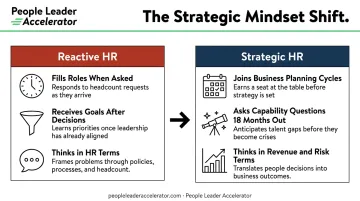
Strategic HR requires a behavioral shift, not just a structural one. Moving from reactive order-taker to proactive business partner means:
- Joining business planning cycles, not receiving goals after decisions are made
- Asking different questions: not "what roles do we need filled?" but "what capabilities does the business need in 18 months?"
- Thinking in business terms: revenue impact, operational risk, cost of inaction
This shift is most urgent in high-growth and PE-backed environments, where people decisions have disproportionate consequences. In scaling organizations, a single bad leadership hire or an unexpected attrition wave can derail a critical growth phase. In these environments, slow or misaligned people decisions don't just create friction — they stall growth phases that won't come back around.
Andrew Bartlow, Core Faculty at People Leader Accelerator and co-author of Scaling for Success: People Priorities for High Growth Organizations, has spent 25 years working at exactly this intersection: helping HR leaders in high-growth companies make the transition from competent operator to strategic contributor.
The Strategic Roles of HR in Modern Organizations
Role 1 — Strategic Workforce Planning
Strategic workforce planning replaces reactive hiring with forward-looking talent architecture. Rather than responding to open roles, HR models future capability needs based on where the business is headed: new markets, product launches, headcount targets, technology changes.
In practice, this means:
- Running skills gap analyses to identify where current capabilities fall short
- Building succession pipelines for critical roles before vacancies appear
- Conducting scenario planning across different growth trajectories
When the business decides to expand into a new geography, HR should already have a view of what talent that requires—not be scrambling to figure it out three months later.
Role 2 — Culture Architect
Culture doesn't manage itself. HR's role is to define what the organization's values look like in practice—not just on a wall—and embed them into the systems people actually experience: hiring criteria, onboarding programs, performance reviews, and leadership behavior.
When culture is left to chance, it defaults to the habits of whoever has the most influence. When HR architects it deliberately, it becomes a retention tool, a performance driver, and a genuine edge in attracting and keeping top talent.
Role 3 — Talent Acquisition and Retention Strategist
Strategic talent acquisition goes beyond filling seats. It designs for long-term fit, evaluates candidates against future role requirements, and builds employer brand deliberately. On the retention side, it means understanding the actual drivers of voluntary departure—career growth, manager quality, compensation equity—and addressing them before employees start looking elsewhere.
The business case is straightforward: Gallup estimates replacement costs at roughly 40% of salary for frontline roles, 80% for technical roles, and 200% for leaders and managers. Retention isn't a culture initiative—it's a financial one.
Role 4 — Change Champion
Organizations face constant disruption: new technology, restructuring, market pivots, leadership transitions. HR's role is to prepare people to absorb that disruption rather than resist it. That means:
- Communicating proactively before uncertainty sets in
- Targeting upskilling to the specific capabilities disruption demands
- Applying structured change management frameworks that maintain momentum
HR leaders who build organizational agility before disruption hits are the ones the C-suite calls first when it does.
Role 5 — Strategic Business Partner to Leadership
Building that agility is also what earns HR a seat at the table. At the most senior level, HR translates business strategy into people priorities and brings a workforce perspective to decisions typically owned by finance or operations. That includes M&A due diligence, geographic expansion analysis, leadership succession planning, and workforce risk assessment.
This role requires HR leaders to speak the language of the C-suite—revenue, margin, risk, and return—not just the language of engagement scores and headcount.
The 5 P's of HR Strategy
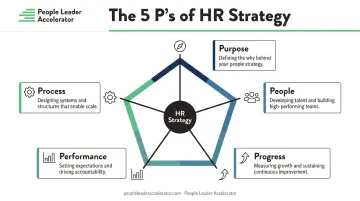
Frameworks matter because they force structure. Without one, HR priorities become a disconnected list of programs rather than a coherent strategy. The 5 P's—Purpose, People, Process, Performance, and Progress—provide a practical lens for building a business-aligned HR function.
Purpose
Every HR initiative should connect back to the organization's mission and strategic objectives. HR priorities without organizational context become programs in search of a problem. Before launching anything—a new performance management system, a culture initiative, a leadership development track—HR leaders should be able to articulate exactly which business goal it serves.
People
This is the talent strategy dimension. Who does the organization need now, and who will it need in 12–24 months? How will it attract, develop, and retain those people?
Answering these questions requires clarity on:
- Current capability gaps versus what the strategy demands
- Where development can close the gap versus where hiring is necessary
- Which roles are critical enough to warrant succession planning now
Process
Operational infrastructure enables strategy. If HR systems are broken—manual processes, outdated policies, inefficient workflows—HR leaders spend their time on administration instead of strategy. The goal isn't process for its own sake; it's building operational efficiency that frees up bandwidth for higher-value work.
Ready-to-use templates and frameworks—rather than building everything from scratch—are one of the fastest ways to reclaim that bandwidth.
Performance
Strategic HR connects individual work to organizational outcomes. That means goal-setting systems that align with business priorities, feedback mechanisms that drive development, recognition structures that reinforce the right behaviors, and accountability frameworks that don't just measure activity.
The cleaner that line of sight is—from individual goals to company objectives—the less performance management has to rely on enforcement.
Progress
This is the measurement dimension—and the most important for earning influence. HR needs to track whether its initiatives are working, demonstrate ROI to leadership, and iterate based on evidence rather than assumption. Without this, HR's contributions remain invisible even when they're substantial.
How to Build a Strategic HR Function: 5 Actionable Steps
Step 1 — Align HR Priorities to Business Goals
HR leaders should be in the room during business planning cycles—not handed goals after decisions are made. The practical question to anchor every HR priority: "What does the business need from its people in the next 12–24 months, and what does HR need to do to make that possible?"
This reframes HR planning from an internal exercise to a business-linked one.
Step 2 — Build Business Acumen
Many HR professionals have deep people expertise and shallow business fluency. That gap limits strategic influence. Strategic HR leaders understand the P&L, know their company's competitive position, and can translate people decisions into financial terms that resonate with CFOs and CEOs.
Business acumen is a learnable competency, but it requires deliberate development. People Leader Accelerator was built for exactly this: its faculty includes practitioners from high-growth tech, private equity, and scaling organizations who teach HR leaders how to connect people decisions to business outcomes.
Step 3 — Use Data to Make the Business Case
Activity metrics don't move executives. Impact metrics do. The shift looks like this:
| Activity Metric | Impact Metric |
|---|---|
| Number of hires completed | Time-to-productivity for new hires |
| Training hours delivered | Internal promotion rate vs. L&D investment |
| Engagement survey completed | Voluntary turnover correlation to engagement score |
| Headcount report | Revenue per FTE |
SHRM's 2025 benchmarking data reports a U.S. median of $172,926 revenue per FTE—the kind of figure that gives HR a language for workforce productivity that finance understands.
Step 4 — Communicate in Business Terms
Reframing how HR talks about its work is as important as the work itself. The difference:
- Weak: "We improved employee engagement scores by 8 points"
- Strong: "Our engagement initiative reduced voluntary turnover by 12%, avoiding an estimated $2.4M in replacement costs based on our average technical salary"
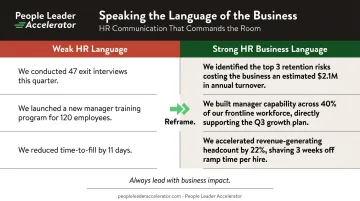
Every HR initiative has a business translation. Find it, and lead with it.
Step 5 — Build Trust Through Consistent Results
Strategic credibility is earned through consistent delivery. HR leaders who overpromise and underdeliver lose influence quickly. Those who set realistic commitments, communicate progress transparently, and hit their targets earn the authority to be included in bigger decisions.
Start with one well-executed initiative that demonstrates business impact, measure it rigorously, communicate the results clearly, and build from there.
Measuring Strategic HR Impact With People Analytics
Without measurement, HR's contributions remain invisible to leadership. The shift is from vanity metrics to business-linked indicators that executives actually care about.
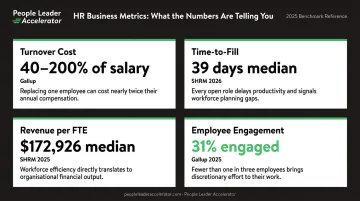
Four Metrics That Connect HR to Business Performance
| Metric | What It Reveals | Benchmark |
|---|---|---|
| Turnover cost | Financial impact of attrition by role level | 40–200% of annual salary (Gallup) |
| Time-to-fill | Operational risk from open critical roles | 39 calendar days median (SHRM 2026) |
| Revenue per FTE | Workforce productivity | $172,926 U.S. median (SHRM 2025) |
| Employee engagement | Leading indicator of retention and performance | 31% engaged in U.S./Canada (Gallup 2025) |
That engagement figure—only 31% of U.S. and Canadian employees engaged at work—points to a significant and largely addressable performance gap. Gallup's meta-analysis across 347 organizations found that top-quartile engagement units reported 23% higher profitability and 21–51% lower turnover compared to bottom-quartile units.
From Reporting History to Predicting the Future
The most sophisticated use of people analytics isn't backward-looking—it's predictive. Strategic HR teams use this capability to:
The most sophisticated use of people analytics is predictive. Strategic HR teams use this capability to:
- Identify flight risks before employees resign
- Forecast hiring needs based on business growth plans
- Model workforce impact across different strategic scenarios
This forward-looking orientation is what separates strategic HR from operational HR.
People Leader Accelerator's People Analytics Full Guide addresses exactly this challenge: helping HR leaders identify which metrics drive the most business value, build dashboards that surface actionable intelligence, and use data to influence executive decisions. The program also includes a free Cost of Turnover Calculation Template—a practical starting point for HR leaders who want to demonstrate the financial stakes of retention.
Modern HRIS platforms increasingly make these capabilities accessible. The real work is knowing which questions to ask and translating the answers into language that moves executives to act.
Frequently Asked Questions
What are the strategic roles of HR?
The five core strategic roles are: workforce planning, culture architecture, talent acquisition and retention strategy, change management, and serving as a strategic business partner to leadership. Each role shifts HR from administrative overhead into a direct contributor to organizational performance.
What are the 5 P's of HR strategy?
The 5 P's—Purpose, People, Process, Performance, and Progress—are a framework for structuring a business-aligned people strategy. HR leaders use this model to evaluate whether each initiative connects to a specific business outcome rather than existing as a standalone program.
What is the difference between strategic HR and traditional HR?
Traditional HR handles day-to-day administrative tasks reactively: hiring, payroll, compliance, and grievances. Strategic HR proactively aligns people programs with long-term business objectives and positions HR as a contributor to organizational performance and competitive advantage.
How does strategic HR contribute to business performance?
Strategic HR improves business performance through several direct levers:
- Fills critical roles with the right talent before gaps affect output
- Reduces voluntary turnover and the replacement costs that follow
- Builds cultures that sustain engagement and productivity over time
- Gives leadership people data that sharpens decision quality
What skills do HR leaders need to become strategic business partners?
HR leaders need five competencies to operate as true strategic partners:
- Business acumen — P&L fluency and competitive landscape awareness
- Data literacy — interpreting people metrics and workforce trends
- Executive communication — presenting insights in financial and operational terms
- Change management — leading organizations through transitions with minimal disruption
- Strategic translation — converting people insights into decisions the C-suite acts on