That gap didn't appear overnight. The expectations placed on modern people leaders are the product of a century of industrial, legal, social, and technological change — and understanding that history matters if you want to navigate where the profession is heading next.
This article traces HR's five historical stages, examines the turning points that redefined the function, explores how technology accelerated that transformation, and outlines the trends shaping HR's next chapter.
Key Takeaways
- HR evolved through five distinct stages — from informal labor management to today's data-driven strategic function
- The shift from "personnel management" to "human resource management" marked a fundamental change: employees became assets to develop, not costs to control
- Landmark legislation (Civil Rights Act 1964, OSHA, ADA) forced HR into a compliance role before it could evolve into a strategic partner
- Technology has been the single greatest accelerant of HR's evolution, from early HRMS platforms to today's AI-powered analytics
- Operating at the intersection of people, data, and organizational strategy defines the next generation of HR leadership
The 5 Stages of HR: A Historical Overview
Stage 1 — Pre-Industrial Origins (Before the 1900s)
Before industrialization, labor management was entirely informal. Business owners, master craftsmen, and guild leaders handled worker relations directly. There were no formal protections, no dedicated "people function," and no concept of HR as a discipline. The conditions that would create it — large workforces, complex organizational hierarchies, and recurring labor disputes — simply didn't exist yet.
Stage 2 — The Birth of Personnel Management (Early 1900s–1930s)
The Industrial Revolution created a workforce management crisis almost overnight. Factory-scale operations brought immediate, urgent problems — worker grievances, safety hazards, discipline failures, and high turnover — at a scale no individual owner could handle alone.
According to SHRM, National Cash Register established one of the first personnel departments in 1900, following a significant labor strike. By 1915, only 5% of large U.S. companies had personnel departments — but that figure climbed to 20% by 1920, reflecting how quickly the need spread.
The intellectual foundation for modern HR came from the Hawthorne Studies (1924–1933), conducted at Western Electric's Hawthorne Works under Elton Mayo of Harvard Business School. The research revealed that productivity wasn't purely a function of physical conditions or wages — psychological factors, social norms, and worker participation mattered enormously. That insight reshaped how organizations thought about their people.
Stage 3 — Formalization and Compliance (1940s–1960s)
World War II forced HR to professionalize fast. Mass mobilization created urgent demand for structured workforce planning, rapid recruitment, and systematic training. What had been informal became institutionalized.
Key milestones from this period:
- 1948: The American Society for Personnel Administration (later SHRM) was founded
- 1954: SHRM attributes the popularization of the term "human resources" to Peter Drucker's The Practice of Management
- 1964: The Civil Rights Act, Title VII, prohibited employment discrimination based on race, color, religion, sex, or national origin
- 1965: The EEOC opened its doors to administer and enforce federal employment discrimination law
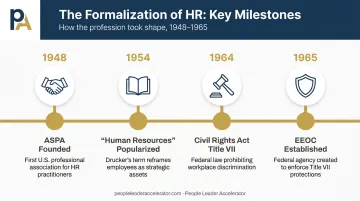
That last shift was defining. For the first time, personnel departments had genuine legal accountability — and the compliance burden that came with it fundamentally changed what the function was for.
Stage 4 — Strategic HRM Emerges (1970s–1990s)
That compliance mandate didn't ease — it expanded. Legislation through the 1970s and '80s added new layers of legal obligation:
- The Occupational Safety and Health Act (1970) required employers to maintain safe workplaces
- The WARN Act (1988) mandated 60 days' advance notice for plant closings and mass layoffs
- The Americans with Disabilities Act (1990) prohibited discrimination against qualified individuals with disabilities at companies with 15 or more employees
Even as legal obligations grew, the strategic case for HR was taking shape. Dave Ulrich's landmark 1998 HBR article, "A New Mandate for Human Resources", argued that HR should focus on deliverables rather than activities — becoming a genuine partner to senior leadership on strategy execution, organizational change, and employee contribution.
Technology entered the picture too. PeopleSoft incorporated in 1987 and shipped its first human resources management system in December 1988, marking the beginning of HR's software era.
Stage 5 — The Digital and Strategic Era (2000s–Present)
The 21st century brought integrated HRMS platforms, people analytics, AI-assisted hiring, and a fundamental repositioning of HR as a driver of organizational culture and business outcomes. The function's scope expanded from administering processes to actively influencing how organizations are built and led.
COVID-19 was the most recent inflection point. HR leaders were simultaneously managing crisis response, remote work transitions, employee well-being at scale, and mass organizational restructuring — all at once, with no playbook. For many organizations, it was the moment HR's strategic value moved from boardroom talking point to operational reality.
The Turning Point: From Personnel Management to Strategic HR Partner
The Core Philosophical Shift
Personnel management viewed employees as costs to be controlled. The work was transactional: compliance, record-keeping, labor discipline, payroll. Strategic HRM treats employees as the organization's primary competitive differentiator, particularly in a knowledge economy where talent and ideas determine who wins.
What Changed the Economics
As the U.S. economy moved from industrial manufacturing to service and knowledge-based work, "able-bodied labor" became less relevant than skills, engagement, and institutional knowledge. Talent attraction, development, and retention became strategically critical, not just administratively important.
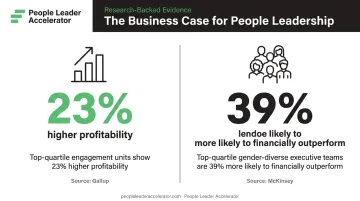
The numbers bear this out: Gallup's meta-analysis reports that top-quartile engagement business units show 23% higher profitability, 18% higher sales productivity, and 51% lower turnover in low-turnover organizations compared to bottom-quartile units. When engagement has that kind of financial footprint, HR can no longer be treated as overhead.
McKinsey's 2023 research adds another dimension: companies in the top quartile for gender diversity on executive teams were 39% more likely to financially outperform bottom-quartile companies. DEI isn't just a compliance checkbox: it's a performance driver.
The "HR as Cop" Problem
The compliance-heavy era of the 1970s and 80s created lasting reputational damage. HR became associated with enforcement, risk management, and telling employees "no." That "fun-killer" stereotype took decades to overcome, and many HR leaders are still actively working to rebuild credibility as employee advocates and culture champions rather than corporate police.
What Strategic HR Requires Today
Overcoming that legacy requires more than good intentions. Modern people leadership demands a specific set of capabilities that don't develop automatically with tenure:
- Reads workforce analytics and builds evidence-based cases for leadership decisions
- Understands how the organization creates value and where HR choices affect financial outcomes
- Guides teams through transformation without losing the people inside them
- Shapes decisions at the C-suite and board level, rather than just implementing them
These are learnable skills — but they require deliberate, structured investment to develop.
How Technology Transformed the HR Function
From Software to Systems of Intelligence
PeopleSoft's 1988 HRMS launch marked the beginning of HR's technology era. What followed was a 35-year progression:
- Late 1990s: Cloud-hosted HR platforms reduced infrastructure barriers and made integrated systems accessible to mid-market organizations
- 2000s–2010s: Systems expanded to cover the full employee lifecycle — payroll, onboarding, performance, learning, offboarding
- 2010s–present: People analytics layers emerged, turning data captured in HRMS platforms into workforce insights
- Now: AI-powered tools handle candidate screening, chatbot onboarding, predictive attrition modeling, and performance management at scale
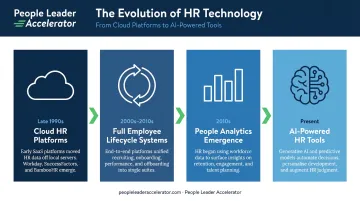
Each generation reduced administrative burden and freed HR capacity for strategic work. The real shift is what HR leaders do with the time and data that recovered capacity makes possible.
The People Analytics Shift
HR once operated on intuition and anecdote. Now workforce data drives decisions on flight risk, succession gaps, L&D ROI, and compensation benchmarking.
The adoption rates are high: SHRM reports that 82% of organizations use people analytics to assess retention and turnover, and 71% use it to assess employee performance. But adoption doesn't equal impact. Deloitte's research found that 65% of organizations said their people analytics created no commercial benefit — a finding that separates organizations that collect data from those that actually use it to drive decisions.
AI: Opportunity and Real Risk
SHRM's 2025 research reports that 43% of organizations used AI in HR tasks in 2025, up from 26% in 2024. The growth is significant. So are the risks.
In 2023, the EEOC settled a case against iTutorGroup after its application software automatically rejected female applicants aged 55 or older and male applicants aged 60 or older. The settlement required $365,000 for more than 200 rejected applicants. AI can embed discrimination at scale — and HR leaders who adopt these tools without governance frameworks are accepting serious liability.
The organizations extracting real value from HR technology have one thing in common: they treat AI as an input to human decisions, not a substitute for them. That distinction — between automating judgment and informing it — is where HR governance frameworks earn their keep.
What Modern HR Leadership Requires
Many mid-career HR professionals face a real competency gap. Trained in an era of administrative HR, they now face expectations to serve as organizational strategists, analytics interpreters, change management leaders, and culture architects — often without formal preparation for any of these roles.
The skills that bridge operational HR and strategic business partnership aren't innate — they're learnable:
- Translate workforce data into executive-level narratives that drive decisions
- Connect HR investments directly to financial outcomes through structured business cases
- Anticipate talent gaps before they become urgent through strategic workforce planning
- Shape organizational decisions rather than simply implementing them
- Guide people through transformation with minimal disruption
This is the gap that People Leader Accelerator is built to close. Designed for senior HR leaders — Heads of People, VPs, and first-time CHROs — PLA combines 16 weeks of cohort-based instruction with 1-on-1 mentoring from faculty who bring 25–30 years of real-world experience.
Faculty member Marie Szuts led the people function at high-growth tech organizations including Figma. Co-founder Andrew Bartlow co-authored Scaling for Success: People Priorities for High Growth Organizations and brings 25 years of HR and talent leadership experience across high-growth environments.
The program works on participants' actual organizations — not generic case studies — so every framework gets tested against real, live challenges from day one. Alumni consistently report the same transformation: a shift from executing HR tasks to genuinely influencing business decisions.
For HR leaders in fast-scaling environments, the question isn't whether to invest in strategic development — it's how quickly you can close the gap.
The Future of HR: Trends Shaping the Next Era
AI and Human Collaboration
As AI handles more administrative, analytical, and even coaching tasks, the irreplaceable value of HR leaders shifts toward emotional intelligence, ethical judgment, culture stewardship, and complex human situations that algorithms can't navigate. The tension between AI capability and human judgment will define HR's next decade.
PwC estimates AI agents could reduce human effort across HR by roughly 40%, with agent-assisted or automated work exceeding 60% in some day-to-day processes. That's not elimination — it's redirection. The HR leaders who thrive will be those who use that recovered capacity for higher-order work.
Employee Well-Being as a Strategic Priority
The pandemic normalized conversations about mental health, burnout, and work-life design. Those are now table-stakes expectations from employees — not perks.
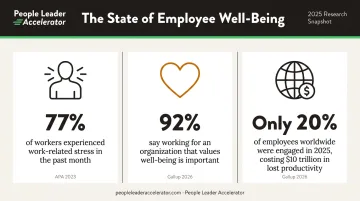
The APA's 2023 Work in America Survey found that 77% of workers experienced work-related stress in the prior month, and 57% reported at least one negative effect of workplace burnout. Critically, 92% said working for an organization that values emotional and psychological well-being was important to them.
Gallup's 2026 global report puts the financial stakes in perspective: only 20% of employees worldwide were engaged in 2025, with low engagement associated with an estimated $10 trillion in lost global productivity. HR leaders will be increasingly responsible for designing organizations where people genuinely thrive — and making the business case to leadership for why that investment matters.
HR as a True C-Suite Partner
The Conference Board reports that CHRO engagement with corporate boards increased during the preceding three years at nearly 70% of surveyed public companies. Mercer's survey of more than 100 CHROs found that a majority believed the role's future requires stronger strategic management skills and better use of analytics and technology.
The next generation of HR leaders will be defined by a specific set of capabilities:
- Connecting people data to financial outcomes that resonate in board rooms
- Speaking the language of business strategy, not just HR operations
- Treating DEI as a performance variable, not a compliance obligation
Those who master this shift will shape what HR looks like for the decade ahead.
Frequently Asked Questions
How has HR evolved over the years?
HR started as informal labor management during the Industrial Revolution, focused on worker discipline and basic administration. It moved through a compliance-heavy personnel era before becoming today's strategic function, responsible for organizational culture, talent strategy, and business performance. Technology and post-pandemic workplace change accelerated that shift significantly.
What are the 5 stages of HR?
The five stages of HR are:
- Pre-industrial informal labor management
- Early personnel management and the Human Relations Movement
- Formalization and compliance driven by landmark legislation (1940s–60s)
- Strategic HRM emerging in the 1970s–90s
- The digital and strategic era from 2000 to present
What is the difference between personnel management and human resource management?
Personnel management focused on administrative and compliance tasks — payroll, record-keeping, labor discipline — treating employees primarily as costs. HRM takes a strategic view, treating employees as organizational assets to be developed, engaged, and retained in direct alignment with business goals.
How has technology changed HR practices?
Technology moved from basic HRMS software in the late 1980s through cloud platforms, to today's AI-powered tools and people analytics. Each wave automated administrative work while opening up data-driven capabilities that let HR operate more strategically.
What skills do modern HR leaders need to succeed?
Modern HR leaders need business acumen, people analytics literacy, change management fluency, and strategic workforce planning skills. These build on the foundational interpersonal and compliance capabilities that have always defined effective HR leadership.
What does the future of HR look like?
The future of HR will be shaped by AI-human collaboration, elevated employee well-being expectations, DEI as a measurable business driver, and the growing expectation that HR leaders function as data-savvy C-suite partners who can connect people strategy to measurable organizational outcomes.