Most organizations still equate leadership with authority, titles, and hitting quarterly numbers. But a growing number of high-performing companies are discovering that the leaders who drive the best outcomes aren't the ones who manage most tightly — they're the ones who invest most genuinely in their people.
This post breaks down what a people leader actually is, how the role differs from traditional management, the qualities that define it, and why developing this skill set has become one of the most consequential investments an organization can make.
Key Takeaways
- A people leader prioritizes team growth, engagement, and alignment alongside outputs and deadlines
- People leadership is defined by mindset and behavior — independent of title or seniority
- Managers account for 70% of the variance in team engagement scores, according to Gallup
- Great people leaders hold empathy and accountability at the same time, without trading one for the other
- The transition from task-oriented manager to people leader requires deliberate, ongoing effort
What Is a People Leader?
A people leader is someone responsible for leading, developing, and supporting a group of employees — with primary focus on their growth, engagement, and alignment to organizational goals, rather than simply managing outputs or enforcing process.
That distinction matters. A people leader isn't just completing performance reviews on time or making sure work gets done. They're asking deeper questions: Is this person growing? Do they understand why their work matters? What's getting in their way?
People leadership is not a job title. It's a philosophy and a set of behaviors that can show up at any level — from an HR Business Partner to a Chief People Officer to a first-time team lead at a scaling startup.
How the Concept Has Evolved
The shift toward people-first leadership didn't happen overnight. Command-and-control management worked reasonably well when work was predictable and employees had few alternatives. Neither of those things is true anymore.
Among remote-capable US employees, the share working entirely on-site fell from 60% in 2019 to just 20% in 2023. That shift alone reshaped what employees expect from their managers.
Younger cohorts, in particular, want more than task direction. They expect autonomy, genuine development opportunities, and a manager who treats the relationship as worth investing in. Those expectations have pushed organizations to rethink what good leadership actually looks like.
Gallup's research across more than 10,000 people identified four things followers consistently need from their leaders:
- Trust — confidence that their leader is honest and follows through
- Compassion — genuine care for their wellbeing, not just their output
- Stability — clarity and consistency, especially through uncertainty
- Hope — a believable path forward for their work and their career
People leaders are uniquely positioned to deliver on all four. That capacity doesn't come from a title or org chart position — it comes from how they show up in everyday interactions.
People Leader vs. Traditional Manager: Key Differences
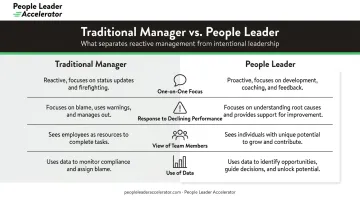
People leaders and traditional managers operate from different starting assumptions — and those assumptions shape every decision, conversation, and outcome on their teams. Understanding the distinction helps clarify which orientation actually produces the results you're after.
The Traditional Management Model
Traditional management is defined by authority, outputs, and accountability to metrics. It measures success through results: revenue closed, deadlines met, budgets managed. People, in this model, are largely resources in service of those results.
When performance drops, a traditional manager typically responds by adding oversight, tightening deadlines, or increasing reporting requirements. The question being asked is: why aren't they performing?
The People Leadership Model
A people leader asks a different question: what got in their way?
Success, in this model, is measured through the health of the team — engagement, growth, alignment, and retention. The behavioral differences show up across every interaction:
| Dimension | Traditional Manager | People Leader |
|---|---|---|
| One-on-one focus | Task updates and status reports | Growth, obstacles, and motivation |
| Response to declining performance | Add oversight, tighten deadlines | Explore root causes, remove barriers |
| View of team members | Roles to fill | Whole human beings with individual needs |
| Use of data | Monitoring performance | Coaching toward improvement |
The Cost of Getting This Wrong
In a McKinsey survey of employees who had recently left their jobs, 52% said they didn't feel valued by their manager and 51% lacked a sense of belonging. Gallup found that 42% of voluntary turnover is preventable — meaning it could have been addressed before the resignation letter arrived.
Gallup's State of the Global Workplace report puts the productivity cost at $10 trillion annually from disengaged employees worldwide. That figure reflects the cumulative effect of managers who prioritize compliance over connection.
People leaders still hit their numbers. The difference is that they do it without burning through the people who make those numbers possible.
Core Qualities of a People Leader
Effective people leadership is a set of learnable behaviors that, practiced consistently, build the conditions for sustained team performance.
Five behaviors show up consistently in leaders who earn genuine trust and sustain team performance:
- Empathy paired with accountability. These aren't opposites — they're codependent. Empathy gives you the context to hold someone accountable in a way that actually lands. Without it, accountability turns punitive; without accountability, empathy turns permissive.
- Servant orientation. People leaders position themselves as part of the team, not above it. They ask what their people need to succeed, remove barriers proactively, and own failures rather than deflecting to team error — a principle Robert Greenleaf placed at the center of effective leadership.
- Genuine curiosity about individuals. The best people leaders invest time in understanding what motivates each team member, what obstacles they face, and what growth looks like for them specifically. People are treated as whole human beings, not job functions.
- Transparent, consistent communication. Trust is built through reliability. That means keeping teams informed, sharing the context behind decisions, acknowledging uncertainty honestly, and following through on commitments. Consistency over time matters more than any single conversation.
- Active commitment to developing others. This isn't reserved for performance issues — it's a daily practice. Coaching, real-time feedback, stretch assignments, and specific recognition are all part of how strong people leaders show up.
Why People Leadership Matters: The Business Case
People leadership sometimes gets dismissed as a "soft" investment. The data says otherwise.
Gallup's research is unambiguous on one point: managers account for 70% of the variance in team engagement scores. That single finding reframes the entire conversation. Engagement isn't primarily a culture initiative or a perks question — it's a management quality question.
The downstream effects of that engagement are measurable:
- 23% higher profitability in top-quartile engagement business units vs. bottom-quartile
- 18% higher sales productivity
- 78% less absenteeism
- 51% less turnover in low-turnover organizations
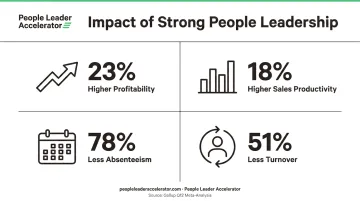
These figures come from Gallup's Q12 meta-analysis, which covered more than 183,000 business units and 3.3 million employees. At that scale, the findings are difficult to dismiss.
McKinsey's research reinforces the point: organizations with strong middle-management capabilities were 1.5 times more likely to achieve top-quartile financial performance across more than 1,000 companies globally.
Engaged, well-led teams innovate more, turn over less, and create better experiences for customers. Organizations that invest in developing people leaders — rather than simply promoting their top individual contributors — consistently outperform those that don't.
How to Grow Into a People Leadership Role
The hardest part of becoming a people leader isn't learning new frameworks. It's a mindset shift: moving from measuring your success by what you accomplish to measuring it by what your people accomplish.
That transition — from "doing" to "enabling" — is difficult. CCL research found that 26% of first-time managers felt unready to lead, and 60% of new managers receive no training during the transition. The gap between being a strong individual contributor and an effective people leader is real, and most organizations do almost nothing to bridge it.
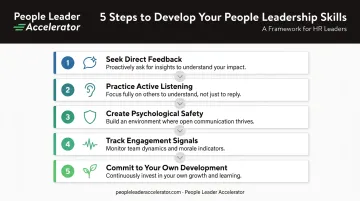
Practical starting points for anyone working through this shift:
- Seek direct feedback from your team — not once, but regularly. Ask specific questions about what's helping and what's getting in the way.
- Practice active listening in one-on-ones — resist the urge to solve immediately; ask questions first.
- Create psychological safety deliberately — acknowledge your own uncertainty, welcome dissenting views, and make it safe to fail in low-stakes situations.
- Track engagement signals alongside output metrics — notice energy, participation, and collaboration patterns, not just deliverables.
- Commit to your own development — the best people leaders treat their growth as seriously as their team's growth.
Self-directed practice gets you far. But for leaders who want a faster, more structured path, a cohort program offers something solo effort can't: accountability, expert feedback, and peers who are navigating the same transition.
People Leader Accelerator runs a 16-week cohort program built for HR professionals and aspiring people leaders in high-growth environments. It pairs practitioner-led instruction with 1-on-1 executive mentoring and a peer community of professionals working through the same shift — from operational HR to strategic people leadership.
Frequently Asked Questions
What is a people leader?
A people leader is someone who prioritizes the growth, engagement, and success of their team members — not just outputs and metrics. The distinction lies in mindset and approach, not title. People leadership can show up at any level of an organization.
What is the difference between a manager and a people leader?
A manager focuses primarily on tasks, processes, and results. A people leader focuses on the individuals doing the work — coaching them, removing obstacles, and building the conditions for sustained performance rather than just monitoring it.
What are the 7 types of leaders?
There is no single universal list, but widely cited frameworks identify seven styles: servant, transformational, transactional, coaching, democratic, pacesetting, and authoritative. Of these, people leadership overlaps most strongly with servant, coaching, and transformational approaches.
Can anyone become a people leader?
Yes. People leadership is a set of learnable behaviors, not an innate personality trait. In a Center for Creative Leadership (CCL) survey of C-level executives, 52% believed leaders are more made than born. With intentional effort, self-awareness, and the right guidance, anyone can develop these capabilities.
How do people leaders impact organizational performance?
Strong people leadership is directly linked to higher employee engagement, lower voluntary turnover, greater team productivity, and stronger organizational culture. Gallup's research shows that manager quality alone accounts for 70% of the variance in team engagement scores. That makes leadership development one of the highest-leverage investments an organization can make.