
Introduction
Somewhere around 15 employees, HR stops being something you can handle on the side. Payroll errors creep in, compliance deadlines slip, and staff start asking about benefits or policies that nobody has a clear answer for. That's when "I'll just handle it myself" stops being a plan.
This guide breaks down what you need to make the right call: what an HR manager actually does at small-business scale, the signals that it's time to hire one, what it costs (in-house vs. outsourced), which compliance areas carry the most risk, and how to find someone who will grow with the company.
Key Takeaways
- An HR manager handles recruiting, onboarding, compliance, performance management, and benefits—freeing founders to focus on growth
- Dedicated HR support typically makes sense around 10–15 employees, but compliance exposure and industry risk matter just as much as headcount
- In-house HR builds cultural alignment; outsourced HR delivers flexibility and specialized expertise at lower direct cost
- Compliance gaps—misclassification, missing documentation, wage-and-hour errors—carry real financial penalties
- The best small-business HR managers think strategically, not just administratively
What Does an HR Manager Do in a Small Business?
Most small businesses don't have the luxury of specialized HR roles. One person handles the full employee lifecycle — sourcing candidates, managing performance, keeping the business compliant, and everything in between. That person is the HR manager, and the scope of the job is wider than most founders expect.
Here's what that looks like in practice.
Talent Acquisition and Onboarding
The HR manager owns full-cycle recruiting: writing job descriptions, sourcing candidates, coordinating interviews, and extending offers. Beyond hiring, they're accountable for what happens next.
This matters more than most founders realize. According to Gallup, replacing an employee conservatively costs between one-half and two times that person's annual salary—and that estimate doesn't include the downstream effects on team morale or customer relationships. A poor hire or a slow hiring process is an expensive problem.
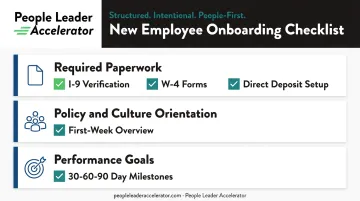
Structured onboarding is equally important. A good HR manager builds a process that includes:
- Required paperwork: I-9 verification, W-4 withholding forms, direct deposit setup
- Policy and culture orientation during the first week
- 30-60-90 day goals that set clear performance expectations from day one
Performance Management and Employee Relations
Getting the right people in the door is only half the equation. Keeping them engaged and performing is where HR earns its keep day to day.
HR sets up the review cycle, trains managers to give useful feedback, and handles conflict resolution when it arises. Every step in a disciplinary or performance improvement process needs documentation — not because you're expecting litigation, but because consistent records protect the business if something later goes sideways.
Compensation, Benefits, and Payroll Oversight
The HR manager benchmarks salaries against market data, manages benefits vendor relationships, and oversees payroll accuracy. This last point ties directly to retention. Gallup's 2023 research on preventable turnover found that 42% of voluntary departures were preventable—and additional compensation or benefits was cited by 30% of those leavers as something that could have changed their decision.
Policy Development and Compliance Monitoring
HR maintains the employee handbook, tracks regulatory changes, and keeps the business audit-ready. For a small business without a legal team on retainer, a missed compliance update can translate directly into fines or litigation exposure. A compliance calendar, regular internal audits, and current documentation aren't optional — they're what keeps the business protected.
Signs Your Small Business Needs a Dedicated HR Manager
SHRM's guidance for small businesses suggests a full-time HR professional becomes warranted around 80–100 employees, while acknowledging that workload, growth rate, and compliance complexity can justify earlier support. Many businesses benefit from part-time or outsourced HR well before that threshold.
Headcount alone doesn't tell the whole story. Watch for these signals.
Workload and Time Signals
These are the clearest indicators that HR has outgrown a side-responsibility model:
- Founders or office managers are spending 10+ hours per week on HR tasks
- Hiring timelines are slipping consistently—open roles sit unfilled for months
- Payroll errors are recurring, not occasional
- Employee questions about benefits or leave go unanswered for days
When leadership absorbs that much HR administration, strategic decisions get pushed aside. The opportunity cost compounds quietly until it shows up in missed growth targets or stalled hiring.
Compliance and Risk Signals
Some triggers are less about volume and more about exposure:
- You've received a compliance warning or notice from a regulatory agency
- The business operates in a highly regulated industry (healthcare, financial services, construction)
- You're expanding to a new state with different labor laws
- Your headcount is approaching a federal compliance threshold—Title VII and ADA apply at 15 employees; FMLA kicks in at 50
Culture and Retention Signals
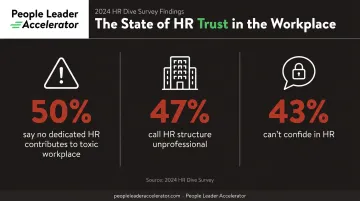
The cultural cost of no dedicated HR function is real. A 2024 HR Dive survey of 1,005 U.S. workers found that 50% believed lacking a dedicated HR department contributes to a toxic workplace. Among employees at companies with fewer than 50 employees, 47% called the HR structure unprofessional and 43% said they couldn't confide in HR.
When HR responsibilities fall to the founder or an office manager by default, policies get enforced inconsistently, concerns go unaddressed, and voluntary turnover climbs.
For businesses focused on scaling, the hire that moves the needle isn't an HR generalist managing paperwork—it's someone who can connect people decisions to business outcomes. People Leader Accelerator's strategic HR frameworks and development programs are designed specifically for this transition, helping HR professionals move from reactive administration to proactive business partnership.
In-House HR Manager vs. Outsourcing: Cost and Value Breakdown
Most small business leaders face this question at some point: hire someone full-time, or bring in outside support? The right choice depends on your headcount, budget, compliance complexity, and how much direct control you want.
The Real Cost of an In-House HR Manager
Start with the salary. According to BLS May 2024 data, the national median annual wage for HR managers is $140,030. That's before benefits.
BLS employer compensation data shows that at private-sector companies with 1–99 employees, benefits account for roughly 27% of total compensation. For management-level roles specifically, that figure rises to about 32.7%. On top of base pay, factor in:
- HRIS software subscriptions
- Professional development and certifications
- Recruiting costs to fill the role itself
- Office overhead if the role is on-site
All-in, the burdened cost for an HR manager at a small business typically runs 30–40% above base salary—pushing total annual cost well above $180,000 at median.
Outsourced HR: ASO, PEO, and Hybrid Models
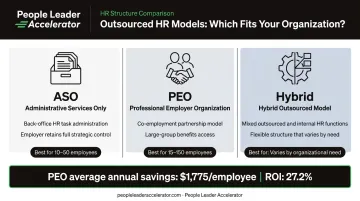
Three primary models exist for outsourcing HR:
| Model | What It Does | Best Fit |
|---|---|---|
| ASO (Administrative Services Only) | Handles back-office HR tasks; employer retains full control | 10–50 employees |
| PEO (Professional Employer Organization) | Co-employment relationship; access to large-group benefits and compliance support | 15–150 employees |
| Hybrid | Mix of outsourced functions with internal execution | Varies by need |
On the ROI question, a NAPEO study of 132 PEO clients calculated average annual savings of $1,775 per full-time employee against an average PEO cost of $1,395 per employee—a 27.2% annual ROI from cost savings alone. That figure comes from industry-association research, so treat it as a directional benchmark rather than a guarantee.
When In-House Makes More Sense
Once a company reaches roughly 75–100 employees, the math shifts. At that point, the strategic value of an internal HR leader—someone who builds culture, runs performance cycles, and sits in leadership meetings—often outweighs the cost flexibility of outsourcing. That's also when the role stops being purely administrative: an internal HR leader can shape hiring decisions, influence compensation philosophy, and align people strategy with business goals in ways an outside vendor typically cannot.
Critical Compliance Areas Your HR Manager Must Own
For small businesses without an in-house legal team, the HR manager carries the compliance burden directly. Gaps in employment law coverage can trigger back-wage liabilities, civil penalties, and regulatory scrutiny that most small businesses aren't equipped to absorb.
Worker Classification and Wage-and-Hour Rules
Misclassification is one of the most common and costly HR errors. Under the FLSA, getting classification wrong creates exposure on two fronts:
- Exempt vs. non-exempt: The salary threshold for executive, administrative, and professional exemptions is $684/week ($35,568/year). Meeting that threshold isn't sufficient on its own — the salary-basis test and duties test must also be satisfied.
- Employee vs. independent contractor: Willful or repeat FLSA violations carry a maximum civil penalty of $2,515 per violation (effective January 2026). Back wages compound quickly when multiple workers are affected.
Recordkeeping Essentials
Documentation is your first line of defense in any audit or employment dispute. At minimum, every small business must maintain:
- I-9 forms (stored separately from personnel files)
- W-4 withholding forms for each employee
- Offer letters that include at-will employment language
- Performance documentation for any disciplinary actions
- Leave records for FMLA, state leave, or ADA accommodations
Key Federal Thresholds and State Law Variations
| Law | Employee Threshold |
|---|---|
| Title VII, ADA | 15 employees |
| ADEA | 20 employees |
| FMLA | 50 employees (in 20+ workweeks) |
State and local laws frequently exceed federal minimums — particularly around minimum wage, paid sick leave, and family leave. As the business grows or expands into new states, staying current on these variations is an ongoing part of the HR manager's role.
How to Hire the Right HR Manager for Your Small Business
The goal isn't finding someone who can process paperwork. A small-business HR manager needs to operate independently, handle ambiguity, and think about people decisions in terms of business outcomes. Here's how to approach the search.
Define the Role Before You Recruit
Before posting the job, answer these questions:
- Which HR functions are most neglected right now—recruiting, compliance, performance management?
- What's the headcount trajectory for the next 18–24 months?
- Should this person be a generalist, or does the business need a lean toward a specific area?
Use those answers to separate must-have qualifications from nice-to-haves. A business hiring its first HR manager at 20 employees needs someone different from one bringing on HR at 80.
What to Look For: Skills and Qualities That Matter
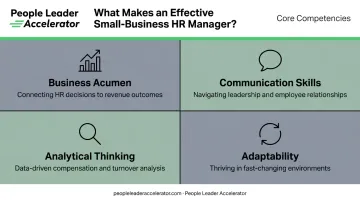
Four qualities consistently separate effective small-business HR managers from those who struggle:
- Business acumen — the ability to connect hiring, compensation, and culture decisions to revenue and growth outcomes, not just HR metrics
- Communication and interpersonal skills — HR sits between leadership and employees; someone who can't navigate both relationships will struggle
- Analytical thinking — comfort with data, whether that's turnover analysis, compensation benchmarking, or headcount planning
- Adaptability — small businesses move fast and change direction; an HR manager who needs stable systems and defined processes everywhere will get frustrated quickly
During interviews, ask candidates directly how they've developed these skills. The development path matters—practitioners who've invested in strategic HR programs tend to show up as business partners rather than administrators from day one.
Structuring the Hiring Process
A structured interview process outperforms unstructured conversations at predicting job performance—meta-analytic research from McDaniel et al. puts the validity coefficient at 0.44 for structured interviews versus 0.33 for unstructured ones.
For this role specifically:
- Use behavioral questions (e.g., "Tell me about a time you managed a compliance issue with limited resources")
- Use a scoring matrix so multiple interviewers can compare candidates consistently
- Build a 30-60-90 day onboarding plan for the hire—most companies skip onboarding the HR manager themselves, but starting someone in a new function without clear priorities is a fast path to a slow ramp
Frequently Asked Questions
Do small businesses need an HR manager?
There's no legal requirement, but the practical risk of going without is real. As headcount grows, so does exposure to employment law violations, inconsistent policy enforcement, and employee dissatisfaction. Most businesses benefit from at least part-time HR support well before the 50-employee mark.
When should a small business hire an HR manager?
Key triggers include spending 10+ hours weekly on HR admin, approaching employee-count thresholds where new federal laws activate, experiencing recurring payroll errors, or facing elevated voluntary turnover. If leadership can't focus on growth because HR issues keep surfacing, that's the clearest signal.
How much does an HR manager cost for a small business?
The national median HR manager salary is $140,030 (BLS, 2024), but salary is only part of the picture. Benefits, HRIS subscriptions, and overhead push the total burdened cost significantly higher. Outsourced HR models typically offer lower direct costs with more flexibility for businesses that aren't ready for a full-time hire.
What is the difference between a PEO and in-house HR?
A PEO enters a co-employment relationship and handles payroll, benefits, and compliance using its own infrastructure—giving small businesses access to large-group benefit rates. In-house HR provides direct cultural integration and institutional knowledge. PEOs generally suit businesses in the 15–75 employee range; in-house HR becomes more cost-justified above 75–100.
What are the core responsibilities of an HR manager in a small business?
Five areas: talent acquisition and onboarding, performance management and employee relations, compensation and benefits oversight, policy development, and compliance monitoring. In most small businesses, one person covers all five.
Can a small business outsource HR instead of hiring a full-time manager?
Yes—through ASO, PEO, or hybrid models. Outsourcing works particularly well for businesses in the 10–75 employee range that need expert support without the overhead of a full-time hire. As headcount and complexity grow, the case for bringing HR in-house strengthens.