Introduction
HR job postings have contracted sharply — according to SHRM's labor demand research, the 12-month average of new HR postings sat at just 78% of pre-pandemic levels by December 2025, after peaking above 150% in 2022. Fewer openings means more competition for every role.
A generic skills list won't survive that environment. Hiring managers scan resumes for evidence of strategic thinking, not just task familiarity. Candidates who land interviews aren't necessarily more experienced — they've just made their skills section work harder.
This article covers the 11 HR skills most worth highlighting right now, from soft skills that build organizational trust to hard skills that signal technical credibility. Each entry includes guidance on how to frame it so it reads as evidence, not filler.
Key Takeaways
- HR resumes need both soft skills (communication, coaching, strategic thinking) and hard skills (HRIS, people analytics, compliance) to compete.
- The most in-demand skills reflect a shift toward data-driven, strategic HR — not just administrative competency.
- Presentation matters as much as the skills themselves — show context and measurable impact, not just a list.
- Structured development — cohort programs, certifications — builds the competency and credibility signal hiring managers want.
What Are HR Skills and Why Do They Matter on Your Resume?
HR skills are the combination of interpersonal, technical, and strategic capabilities that allow HR professionals to manage people, advise leaders, and connect people practices to business outcomes. On a resume, they function as proof points — signals to hiring managers about fit, competence, and potential impact.
The critical word is targeted. A long, undifferentiated skills list reads as filler. A focused list — backed by concrete examples — signals that you understand the role and can deliver on it.
The right mix depends on the role:
- HR Coordinator: Prioritize HRIS proficiency, organization, and process accuracy
- HR Generalist: Balance employee relations, compliance, and communication
- HR Business Partner: Lead with strategic thinking, business acumen, and data literacy
- People Director / CHRO: Center leadership, people analytics, and organizational design
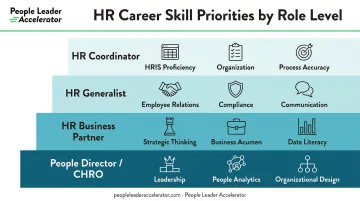
The candidates who move forward are the ones who match their skills to the seniority and scope of the role — not just list everything they've ever touched.
Essential Soft HR Skills to Put on Your Resume
Soft skills in HR are the interpersonal and cognitive capabilities that allow you to build trust, lead difficult conversations, and influence decisions across the organization. They're harder to prove on paper, which is exactly why you need to be deliberate about how you frame them.
Communication and Stakeholder Management
Effective HR communication isn't just about clarity. It's about adapting your approach for different audiences — delivering a policy update to employees, translating attrition data for a CFO, and facilitating a difficult performance conversation with a manager all require different tones entirely.
One sub-skill worth naming explicitly on your resume: storytelling with data. The ability to take workforce metrics and shape them into a compelling narrative for senior leaders is increasingly valued and relatively rare.
Emotional Intelligence and Active Listening
High EQ allows HR professionals to navigate sensitive situations — performance issues, accommodation requests, DEI concerns — with empathy and consistency. Active listening is the practice dimension of EQ: the ability to hear what someone isn't saying, not just what they are.
On a resume, surface this through specific scenarios. Instead of listing "empathy," describe a situation where you identified an underlying issue that wasn't initially presented — and what you did about it.
Coaching and Employee Development
Coaching helps managers and employees grow, not just comply. This includes supporting performance conversations, designing development plans, and building onboarding experiences that set people up for success rather than just orienting them to the org chart.
Organizations now expect coaching competency at the HRBP and manager level, not just in L&D. If you've guided a manager through a difficult feedback conversation or built a structured development track, that belongs on your resume.
Strategic Thinking and Business Acumen
Coaching individuals is one dimension of impact. Business acumen is what lets you connect that development work to organizational outcomes. HR professionals with genuine business acumen understand how the organization makes money, what drives performance, and where people risk intersects with operational risk — and they use that understanding to shape decisions, not just support them.
This skill is often probed in interviews through situational questions: How did you align this HR initiative to a business goal? What metrics did you use to evaluate success? Your resume should set up the answers to those questions before the interview starts.
Conflict Resolution and Employee Relations
Managing workplace disputes requires structured judgment, procedural fairness, and the ability to hold neutrality when everyone in the room wants you to take a side. It also sits at the intersection of interpersonal skill and legal awareness — a misstep in an employee relations case can have compliance consequences.
Frame this on your resume with process and outcome, not just intent:
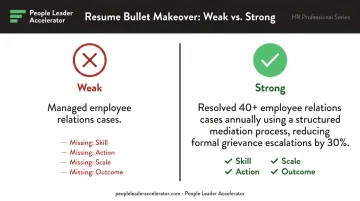
- Weak: "Managed employee relations cases"
- Strong: "Resolved 40+ employee relations cases annually using a structured mediation process, reducing formal grievance escalations by 30%"
The second version signals rigor, scale, and results — exactly what hiring managers and executives need to see.
Essential Hard HR Skills to Put on Your Resume
Hard HR skills are the technical, domain-specific capabilities that allow you to execute processes, analyze data, and keep the organization compliant. Many of these are screened by ATS before a human ever sees your resume, which makes precise, specific language critical.
HRIS Proficiency
HRIS platforms — Workday, SAP SuccessFactors, ADP, BambooHR — are the operational backbone of modern HR. Proficiency means more than logging in. It includes data entry accuracy, report generation, workflow configuration, and knowing how to pull the data a manager actually needs.
Always name the specific platforms you've used. "HRIS proficiency" as a standalone bullet gets filtered out. "Workday — reporting, onboarding workflows, and position management" survives ATS screening and means something to a hiring manager who uses the same system.
Recruitment and Talent Acquisition
Recruitment skills cover sourcing strategy, structured interview design, candidate evaluation, and offer negotiation — and remain relevant even for generalist HR roles. Recruitment today also includes employer branding, DE&I-conscious hiring practices, and ATS management.
If you've built a structured interview process, reduced time-to-fill, or improved offer acceptance rates, those outcomes belong in your experience section rather than a bare "recruitment" bullet.
People Analytics and Data Literacy
Research from SHRM found that 94% of business leaders said people analytics elevates the HR profession, and among HR executives already using it, 71% called it essential to HR strategy. At mid-level and above, data literacy has become a baseline expectation — not a differentiator.
Data literacy in HR means gathering, interpreting, and presenting workforce data — turnover rates, engagement scores, headcount trends — in ways that actually inform decisions. Even basic Excel proficiency and the ability to build a dashboard should be listed. Start there and build up.
Compliance and Employment Law Knowledge
Knowledge of FMLA, EEOC, ADA, FLSA, and applicable state regulations is non-negotiable in most HR roles. The stakes are documented: the EEOC secured nearly $700 million for discrimination victims in FY2024. Organizations hiring HR professionals want to know you understand the exposure.
Compliance knowledge signals two things: risk management ability and professional seriousness. List specific regulatory frameworks you've worked within, particularly if your target roles are in regulated industries or rapidly scaling companies.
Performance Management
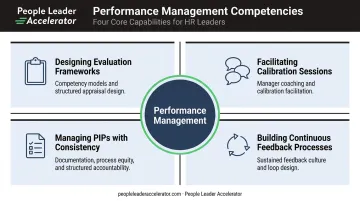
Performance management covers more ground than annual reviews. Core competencies to list include:
- Designing evaluation frameworks and competency models
- Facilitating calibration sessions and manager coaching
- Managing PIPs with appropriate documentation and consistency
- Building continuous feedback processes alongside (or instead of) annual cycles
Experience with both traditional and continuous feedback approaches is worth noting explicitly, as organizations are in different stages of that transition.
If you've redesigned a review process, trained managers on calibration, or built a competency framework from scratch, those are high-signal accomplishments worth featuring prominently.
Organizational and Project Management Skills
HR professionals regularly lead multi-stakeholder projects — system implementations, policy rollouts, culture initiatives — often without a dedicated project manager or formal methodology support.
Present this skill with scope and outcome. "Led the rollout of a new performance management system across 500 employees, delivering on time and within a 12-week timeline with 95% manager completion" is concrete. "Project management" as a standalone is not.
How to List HR Skills on Your Resume Effectively
Most candidates bury their skills or list them without context. Neither approach works. Use a three-section strategy instead:
- Dedicated skills section — for ATS keyword matching. List specific tools, platforms, and functional areas.
- Work experience section — for applied evidence. Show each skill in action with outcomes.
- Resume summary — for professional identity. Signal the level and orientation of your HR expertise in two to three sentences.
Turning Skills Into Results-Oriented Bullets
The format that works: [Skill] + [Action] + [Outcome]
- ❌ "Employee relations"
- ✅ "Resolved 40+ employee relations cases annually using a structured mediation process, reducing formal escalations by 30%"
Every bullet should answer the same question: so what? If it doesn't point to a result, it's not pulling its weight.
Matching the Job Description
Identify five to seven skills from the posting that align with your experience and lead with those. Use the exact language from the job description where it's accurate — hiring managers and ATS systems alike scan for their own terminology, and mirroring it directly increases your visibility.
Handling Soft Skills
Soft skills are nearly impossible to validate as standalone bullets. Listing "communication" or "emotional intelligence" without context signals nothing. Instead, weave these skills into your experience descriptions through behavioral examples — show them, don't just name them.
How to Keep Building HR Skills That Get You Noticed
The gap between having HR skills and being seen as a strategic HR leader often comes down to how deliberately those skills are developed and documented. Skills like people analytics, strategic workforce planning, and executive coaching are what separate operational HR professionals from those moving into senior leadership.
HRCI's SPHR certification framework reflects this directly: Leadership and Strategy accounts for 33% of the SPHR exam, the largest single domain. That weighting signals where senior HR credibility actually lives — in strategic capability, not administrative volume.
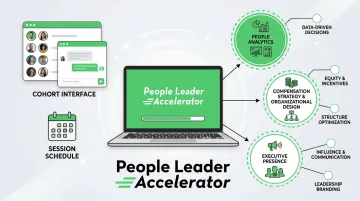
People Leader Accelerator offers cohort-based, practitioner-led development for HR professionals working toward that transition. Faculty have held SPHR, CECP, and executive coaching certifications, led people functions at organizations like Figma, and served as first VP of HR at multiple high-growth companies. The curriculum covers frameworks that translate directly to high-value resume skills:
- People analytics and data-driven decision-making
- Compensation strategy and leveling
- Organizational design
- People leadership and executive presence
One habit that pays off regardless of development path: maintain a skills development log. Each time you apply a new capability, document the context, what you did, and the outcome. When it's time to update your resume, you'll have specific, credible examples ready — rather than trying to reconstruct impact weeks later.
Frequently Asked Questions
What skills should I put on my resume for HR?
Lead with the skills most relevant to the role and seniority level. For most HR roles, that means a combination of soft skills (communication, coaching, emotional intelligence) and hard skills (HRIS proficiency, data literacy, compliance). Tailor the list to the specific job description rather than using a generic inventory.
What are the main functions of HR?
Core HR functions include recruitment and talent acquisition, onboarding, performance management, compensation and benefits, compliance, employee relations, and learning and development. Each function requires a different skill emphasis, which is why targeting your resume to the specific role — not just "HR" broadly — makes a real difference.
What is the difference between hard skills and soft skills in HR?
Hard skills are technical and domain-specific — HRIS platforms, data analysis, employment law. Soft skills are interpersonal and cognitive — communication, coaching, emotional intelligence. SHRM describes this as the what versus the how of HR practice.
How do I list HR skills on a resume if I'm new to the field?
Lean on transferable skills from previous roles — communication, organization, customer-facing experience. Highlight any relevant tools or coursework, and use internship or volunteer experience to demonstrate applied skills. Be specific about what you did, not just what you were exposed to.
Do HR certifications strengthen my resume skills section?
Yes — certifications like SHRM-CP, SPHR, or people analytics credentials validate specific skill sets and provide a credibility signal that self-reported skills alone can't match. List them in your certifications section and reference them in your summary where relevant.
What HR skills matter most for senior roles?
Strategic thinking, business acumen, people analytics, executive coaching, and change management are the skills most associated with HRBP, VP of HR, and CHRO-level roles. They represent a genuine shift from administrative execution — and they require deliberate development, not just years on the job.