

This guide covers everything you need to navigate an HR career from entry point to executive table: the roles available, what education and certifications employers actually look for, the skills that separate good HR professionals from great ones, how to advance strategically, and what the salary and job market look like right now.
Whether you're weighing HR as a career or already in the field and ready to move up, this is your practical roadmap.
Key Takeaways
- HR offers both generalist paths (spanning the full people function) and deep specialist tracks in recruiting, compensation, L&D, analytics, and organizational development
- A bachelor's degree is the standard entry point; certifications like SHRM-CP and SPHR differentiate candidates for management and senior roles
- The most valued HR professionals today combine people expertise with data literacy, strategic thinking, and business acumen
- HR managers earned a median annual wage of $140,030 in May 2024, with the field projected to grow faster than average through 2034
HR Career Paths: Roles and Specializations
The first fork in any HR career is the generalist-versus-specialist question. Understanding both options before committing to a direction will shape every decision that follows.
Generalist and HRBP Roles
HR generalists cover multiple HR functions — recruiting, employee relations, performance management, compliance, and policy — often within a single role. This is the dominant model in smaller organizations where one person needs to handle the full people function.
As organizations grow, the generalist role often evolves into the HR Business Partner (HRBP) model. Where a generalist handles operational breadth, an HRBP is specifically responsible for aligning HR activity with the needs and objectives of a designated business unit.
The distinction matters: HRBPs are expected to maintain business literacy, anticipate HR needs before they become problems, and act as consultants rather than administrators.
For professionals who want broad organizational impact and a direct line to business strategy, the HRBP path is especially compelling.
Specialist Roles
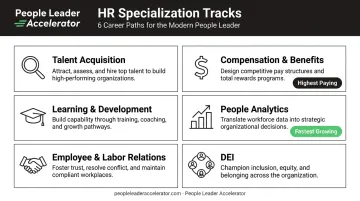
Larger organizations typically have dedicated teams for each HR domain. Common specializations include:
- Talent Acquisition / Recruiting — sourcing, assessing, and closing candidates; increasingly involves employer branding and workforce planning
- Compensation and Benefits — designing pay structures, equity programs, and total rewards strategies; one of the highest-paying HR niches
- Learning and Development (L&D) — building training programs, leadership development initiatives, and career pathing frameworks
- People Analytics — using workforce data to drive hiring, retention, and performance decisions
- Employee and Labor Relations — managing workplace conflict, investigations, and (in unionized environments) contract negotiations
- Diversity, Equity & Inclusion (DEI) — designing programs and policies that build more equitable workplaces
Leadership Roles
The leadership tier shifts the work from executing HR programs to owning the people strategy for the entire organization:
- HR Manager — leads a team, owns functional HR delivery
- Director of HR — sets departmental strategy, partners with senior leaders
- VP of HR — oversees the full people function, sits in executive leadership
- Chief People Officer (CPO) / CHRO — the top people role, accountable for culture, talent strategy, and workforce planning at the organizational level
McKinsey describes the modern CHRO as linking workforce and technology insights to business decisions — shaping culture and expanding how the organization thinks about talent.
Professionals in high-growth or startup environments often carry generalist and specialist responsibilities at once, especially early on. That breadth is demanding, but it can compress a career timeline significantly.
Education Requirements for an HR Career
Degrees That Open Doors
Most entry-level HR positions require a bachelor's degree. The BLS cites human resources, business, communications, and psychology as common fields — which reflects the reality that HR sits at the intersection of people dynamics and organizational operations. An HR-specific degree isn't mandatory; a business administration or organizational behavior background can be equally effective.
A master's degree (MBA, MS in HR, or Master of Labor Relations) becomes relevant when targeting director-level or above roles, or when specializing in areas like labor relations or executive compensation. It's not always required, but it can accelerate advancement and often opens doors to roles that prioritize strategic HR over operational execution.
Certifications Worth Pursuing
Formal degrees establish your foundation; certifications demonstrate how you apply it. For professionals targeting management or strategic roles, they've become close to expected. Here's how the major credentials map to career stage:
| Certification | Issuer | Career Stage | Key Requirement |
|---|---|---|---|
| SHRM-CP | SHRM | Early career | No degree or experience required |
| SHRM-SCP | SHRM | Senior / strategic | 3+ years of strategic HR duties |
| PHR | HRCI | Operational | 1–4 years of HR experience |
| SPHR | HRCI | Leadership | 4–7 years of HR experience |
| GPHR | HRCI | Global HR | 2–4 years of HR experience |
| CECP | WorldatWork | Compensation specialist | 3+ years exec comp experience recommended |
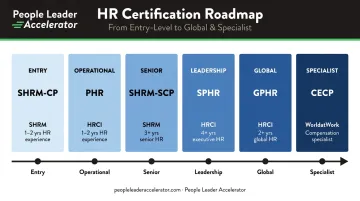
The SHRM-CP is particularly accessible — it requires no prior HR experience, making it a strong credential for career changers or recent graduates. The SPHR targets professionals who shape HR strategy and policy, while the CECP is the recognized standard for executive compensation specialists.
Credentials alone won't carry a career. Ongoing development fills the gaps that formal education typically skips:
- The SHRM Annual Conference draws thousands of practitioners each year and covers both emerging trends and core HR competencies
- Practitioner-led programs translate strategic HR frameworks into day-to-day application — something most degree programs don't cover
- Peer communities and alumni networks provide mentorship and real-world perspective that no certification can replicate
Essential Skills for a Successful HR Career
Interpersonal Foundations
Certain skills underpin every HR role regardless of specialization:
- Communication — written and verbal clarity, including the ability to tailor messages across audiences from frontline employees to the C-suite
- Active listening — genuinely understanding what someone needs before responding
- Discretion — handling sensitive information with professionalism
- Navigating difficult conversations — performance issues, terminations, complaints — these require both empathy and directness
These aren't soft skills in the dismissive sense. They're load-bearing competencies.
Strategic and Analytical Capabilities
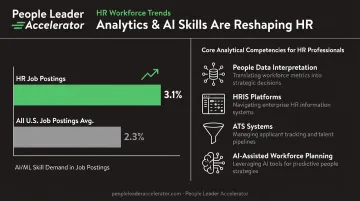
The modern HR professional is expected to work with data, not just people. According to a Gartner survey of 85 HR leaders, only 24% of HR functions are maximizing the business value from HR technology — which means professionals who can actually use data tools effectively are standing out.
Skills that matter here include:
- Interpreting people data: turnover rates, engagement scores, time-to-fill, compensation benchmarks
- Translating insights into recommendations leadership will act on
- Working confidently with HRIS platforms, ATS systems, and performance management tools
- Understanding where AI-assisted tools fit into hiring and workforce planning
SHRM's own research shows AI/ML skills appeared in 3.1% of new HR job postings in December 2025 — more than the 2.3% average across all U.S. postings. That number will only grow.
Business Acumen
This is the differentiator between HR professionals seen as operational support and those with a seat at the strategy table. Business acumen means understanding how the organization makes money and how people decisions connect to outcomes that leadership cares about:
- Revenue growth tied to hiring velocity and workforce planning
- Retention as a direct cost driver (replacement costs typically run 50–200% of annual salary)
- Team performance linked to manager effectiveness and compensation equity
You don't need to become a financial analyst. You need to speak the language of the business clearly enough that your recommendations land.
How to Advance Your HR Career Strategically
Advancement in HR rarely happens automatically. It requires deliberate action.
Expand Your Scope Proactively
Volunteer for cross-functional projects. Take on work that sits at the edge of HR's traditional boundaries — organizational design, workforce planning, M&A integration. Every time you solve a business problem through the people function, you build evidence of strategic contribution.
Build Mentorship in Both Directions
SHRM research found that 54% of HR executives identified coaching and mentoring as the primary skill-improvement area for people managers. That same dynamic applies to your own development.
- Find mentors outside HR — finance, operations, and general management leaders who can build your business literacy
- Find mentors within HR who are 2–3 levels ahead of where you want to be
- Mentor more junior HR professionals — it builds leadership presence and forces you to articulate what you actually know
Invest in Your Network
Join a local SHRM chapter and attend industry events. Build peer relationships with HR leaders at companies similar to yours — for benchmarking, for job opportunities, and for having someone to call when you're navigating something genuinely difficult.
Close the Operational-to-Strategic Gap
The most common barrier to advancement in HR isn't technical knowledge — it's the ability to translate HR expertise into business-aligned strategy. That's a specific skill set, and it doesn't develop automatically with tenure.
Structured programs built specifically for this transition can compress the timeline. People Leader Accelerator's 16-week cohort program is designed for exactly this gap, with faculty who have collectively held the top HR job 15 times across high-growth and startup environments. Faculty include Andrew Bartlow (25 years of HR and Talent experience, co-author of Scaling for Success), Carmela Krantz (first VP of HR at nine companies including six startups), and Marie Szuts (former people leader at Figma).
What separates the program is that participants work on their actual organizations each week, not generic case studies. That structure is what makes the strategic shift stick.
Embrace Emerging Areas
Developing skills in people analytics, AI-informed hiring, organizational design, and compensation strategy signals readiness for senior roles. At the director level and above, these are becoming core expectations, not optional specializations.
HR Career Salary and Job Outlook
What HR Professionals Earn
The BLS May 2024 wage data tells a clear story:
| Role | Median Annual Wage | Top 10% |
|---|---|---|
| HR Managers | $140,030 | $239,200+ |
| HR Specialists | $72,910 | — |
| Compensation & Benefits Managers | $140,360 | — |
Specialization pays. Compensation and benefits management matches HR manager-level pay at the median. HRIS and people analytics roles command a premium as well, though standardized BLS benchmarks for those titles aren't yet available.
Industry matters too. HR managers in professional, scientific, and technical services earned a median of $163,970 in May 2024 — roughly $24,000 above the overall median. Government and healthcare roles tend to track lower.
Job Market Projections
BLS projects HR manager employment to grow 5% from 2024 to 2034, faster than the average for all occupations. Key projections across HR roles:
- HR Managers: 5% growth, ~17,900 openings per year
- HR Specialists: 6% growth, ~81,800 openings per year
- Compensation, Benefits & Job Analysis Specialists: 5% growth, ~8,500 openings per year
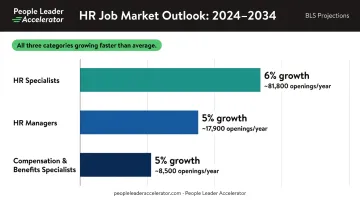
Demand is rising across all three categories as organizations navigate workforce complexity, regulatory change, and growing investment in employee experience. AI adoption is reshaping HR workflows, and professionals who build fluency with these tools — not just awareness of them — will have a clear edge.
Frequently Asked Questions
What kind of jobs can you do in HR?
HR careers range from generalist roles (handling the full people function) and HRBP positions to specialists in recruiting, compensation, L&D, employee relations, people analytics, and DEI. Leadership roles include HR Manager, Director of HR, VP of HR, and Chief People Officer — each progressively more focused on organizational strategy.
How do you start in HR with no experience?
Entry points include HR assistant or coordinator roles, internships, and volunteer work in talent acquisition or event coordination. A bachelor's degree in HR or a related field is the standard baseline; the SHRM-CP requires no prior experience and strengthens early-career candidacy considerably.
What field of HR pays the most?
Compensation and benefits management, HRIS and people analytics, and executive-level roles (VP of HR, CPO) command the highest salaries. The BLS reports a May 2024 median of $140,360 for compensation and benefits managers, with top earners in strategic and technical HR roles exceeding this significantly.
Do I need a degree to work in HR?
Most professional HR roles require at least a bachelor's degree, though the field of study can vary. Some entry-level coordinator or assistant roles are accessible without one, but advancement, particularly to manager and above, typically requires formal education or equivalent certification.
What certifications are most valuable for HR professionals?
SHRM-CP (early career), SHRM-SCP (senior/strategic), and SPHR (policy and strategy focus) are the most widely recognized credentials, each mapping to a distinct career stage. The CECP from WorldatWork is the standard for executive compensation specialists.
Is HR a good career for the future?
Yes. HR carries above-average growth projections through 2034, driven by workforce complexity and the strategic elevation of the people function. Professionals who pair analytical skills with business acumen are particularly well positioned for strong earning potential.