

That's the reality of HR today. New workplace terms emerge from TikTok and LinkedIn almost weekly, and staying current isn't just a vocabulary exercise — it's a diagnostic skill. The World Economic Forum documented how "quiet quitting" went viral on TikTok in 2022, and dozens of variants have followed since.
This guide organizes all 68 trending HR buzzwords into four thematic categories so you can quickly understand, reference, and — more importantly — act on what they signal.
Key Takeaways
- HR buzzwords name real workforce dynamics, not just social media noise — recognizing them early lets HR leaders act before problems become crises
- The 68 terms here fall into four clusters: Employee Experience & Culture, the Quiet/Loud Behavior Spectrum, Macro Workforce Trends, and Future of Work & Tech
- Terms like quiet quitting, resenteeism, and job hugging share a root cause: disengagement from unmet expectations around growth, recognition, and flexibility
- The "Great" series (Resignation → Regret → Betrayal → Gloom → People Shortage) is a connected macro narrative — not isolated events
- Knowing these terms is the starting point — translating them into strategy is what separates operational HR from genuine people leadership
What Are HR Buzzwords and Why Do They Matter?
HR buzzwords are popular terms — often originating on platforms like TikTok and LinkedIn — that give names to existing workplace behaviors, challenges, and dynamics. Most aren't invented out of thin air. They surface because enough people are experiencing the same thing that it earns a label.
Employees are already using these terms to describe their experiences — and that creates a real gap. An HR leader who doesn't recognize "quiet cracking" in an engagement survey or "breadcrumbing" in an exit interview may miss critical warning signs hiding in plain sight.
Three things to keep in mind as you read through this guide:
- Some terms have solid research behind them (Gallup quantifies quiet quitting directly); others are qualitative observations without authoritative prevalence studies.
- Many terms overlap — resenteeism, quiet cracking, and talent debt often describe symptoms of the same underlying issue.
- Instead of an alphabetical list, these 68 terms are grouped into four clusters to make them easier to absorb and apply.
Employee Experience, Well-Being & Culture Buzzwords
This cluster covers how employees feel about their work environment and their relationship with the organization. These buzzwords are often the "why" behind disengagement data — the explanations that numbers alone don't provide.
Defining the Core Terms
Employee Experience (EX) refers to the totality of how employees perceive every touchpoint with an employer, from recruiting through offboarding. Related terms expose where EX breaks down:
- Anti-Perks — benefits that actively harm culture (surveillance tools, rigid policies)
- Perk-cession — the rollback of perks like free lunches and unlimited PTO during cost-cutting cycles
- Office Peacocking — employers redesigning offices with premium amenities to lure employees back in-person, without fixing the underlying flexibility concerns
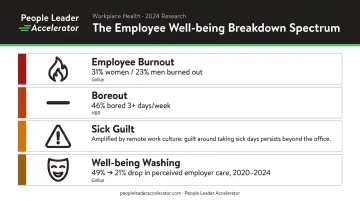
Well-being terms form a spectrum of workplace breakdown:
- Employee Burnout — chronic job stress manifesting in physical and mental exhaustion. Gallup's Q4 2025 data found 31% of U.S. women and 23% of U.S. men in full-time roles very often or always felt burned out.
- Boreout — disengagement caused by meaningless or insufficient work (a 2023 survey found 46% of U.S. workers reported boredom at least three days per week)
- Sick Guilt — feeling obligated to work while ill, exacerbated by remote work blurring sick-day norms
- Well-being Washing — projecting a wellness culture externally while neglecting it internally. HBR reported that employees strongly agreeing their organization cares about their well-being dropped from 49% in 2020 to 21% in 2024
Culture and psychological safety terms name dynamics employees often feel but can't easily describe:
- Toxic Workplace — an environment marked by manipulation, discrimination, and low trust. The APA found 19% of U.S. workers called their workplace toxic, with 22% reporting work-related mental health harm.
- Gaslighting — psychological manipulation that causes employees to doubt their own perceptions
- Empathy Gap — the organizational failure to understand employee perspectives, especially across management levels
Mindset and behavioral terms cover how individual employees adapt — or disengage:
- Monk Mode — eliminating distractions to achieve deep, focused work
- Quiet Ambition — prioritizing personal fulfillment over upward career mobility
- Body Doubling — a focus accountability technique (especially associated with ADHD) where working alongside someone improves task completion
- Emotional Paycheck — the non-financial value employees derive from flexibility, trust, and autonomy
- Sunday Scaries — weekend anxiety anticipating the upcoming workweek
When several of these terms surface together in employee feedback or culture surveys, the foundational employee experience needs structural attention — not a catered lunch.
The "Quiet/Loud" Spectrum: Engagement & Workplace Behavior Buzzwords
This is the most recognized cluster in modern HR vocabulary. It maps a full behavioral spectrum — from silent disengagement to open organizational disruption — with every shade in between.
In 2025, Gallup found that 64% of global employees were not engaged and 16% were actively disengaged — explicitly labeling these groups as quietly and loudly quitting, respectively. The terms below map that spectrum in detail.
The Quiet Side of the Spectrum
The foundational quiet terms:
- Quiet Quitting — doing only what the job requires, with no discretionary effort beyond the role's minimum
- Quiet Firing — management passively pushing employees toward resignation by withholding support, feedback, and opportunities
- Quiet Cutting — reassigning employees to less desirable roles as a way to encourage them to leave voluntarily
- Quiet Cracking — prolonged dissatisfaction gradually eroding engagement without a visible breaking point
Lesser-known variants that show "quiet" isn't always negative:
- Quiet Thriving — actively reframing work to find genuine engagement rather than withdrawing
- Quiet Management — a hands-off leadership style that gives employees meaningful autonomy
- Quiet Vacationing — working remotely from vacation destinations without disclosing location to employers (a precursor to the "hush trip")
The Visible and Performative Behaviors
Visibility-related terms:
- Bare Minimum Mondays — deliberately reducing workload at the start of the week to ease back in and reduce burnout risk
- Coffee Badging — showing up at the office just long enough to badge in, then leaving. Owl Labs found 44% of hybrid workers admitted to coffee badging in 2024
- Hybrid Hushing — managers quietly allowing their teams to ignore return-to-office mandates
Performative productivity terms:
- Productivity Theater — appearing busy through digital signals without meaningful output (a Visier survey found 43% of workers spent more than 10 hours weekly on tasks designed only to look productive)
- Fauxductivity — the illusion of busyness without results
- Resenteeism — staying in a job out of financial obligation while harboring deep resentment; a portmanteau of "resentment" and "presenteeism"
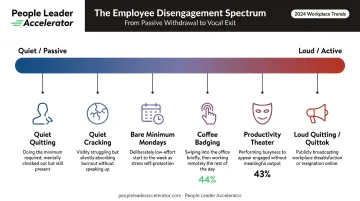
The loud end of the spectrum:
- Loud Quitting — openly expressing dissatisfaction in ways that actively harm the organization
- Quittok — posting resignation stories on TikTok, often going viral
- Job Hugging — clinging to a current role out of fear amid economic uncertainty
- Job Cuffing — committing more visibly to a current role during downturns for perceived job security
- Social Loafing — exerting reduced effort in group settings, assuming others will compensate
Macro Workforce Trends: Hiring, Retention & Career Shift Buzzwords
The labor market shifts of the past five years didn't happen in isolation — they unfolded in sequence. Most of these terms trace how worker sentiment moved from mass departure to disengagement to cautious stabilization, and HR leaders who understand that arc can anticipate what comes next.
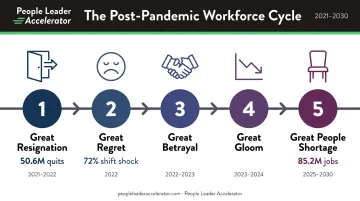
The "Great" Series — A Sequential Workforce Story
Each term marks a distinct phase in the post-pandemic labor cycle:
- The Great Resignation — mass voluntary departures beginning in 2021. BLS data shows 50.6 million quits in 2022, compared to 47.7 million in 2021
- The Great Regret — remorse among those who left when new roles didn't match expectations (a Muse survey found 72% of respondents experienced "shift shock" after starting a new job)
- The Great Betrayal — workers concluding employer loyalty is an illusion, accelerating interest in freelance and fractional work
- The Great Gloom — declining employee happiness and engagement even after the resignation wave subsided
- The Great People Shortage — the projected global talent deficit ahead. Korn Ferry projected 85.2 million unfilled jobs and nearly $8.5 trillion in unrealized annual revenue by 2030 across 20 major economies (based on 2018 model projections, not current observed vacancies)
Stabilization terms that followed:
- The Big Stay — employees choosing to remain in current roles amid a tighter job market
- The Great Flattening — elimination of middle management layers to streamline organizations. Amazon asked each business unit to increase its individual-contributor-to-manager ratio by at least 15%; Microsoft cut roughly 6,000 roles specifically to reduce management layers
- Threat Rigidity — organizations clinging to past practices under pressure, resisting adaptive change even when it's necessary
Hiring, Career Mobility & Workforce Behavior Terms
These terms describe how candidates and employees are actually behaving — and what that means for hiring and retention strategies:
- Ghost Jobs — postings companies don't intend to fill. Greenhouse data cited by SHRM found about 20% of listings had no hiring activity in a given quarter
- Rage-Applying — mass-applying to jobs out of frustration with a current role
- Industry Hopping — moving between sectors rather than climbing within one
- Quick Quitting — leaving a job after less than a year
- White-Fonting — hiding ATS-targeted keywords in white text on resumes to game applicant tracking systems
- Boomerang Employees — former employees who return. HBR found more than one-quarter of new hires were returning employees
- Unretirement — retirees re-entering the workforce due to economic pressure or boredom
- Labor Hoarding — retaining employees during downturns to avoid costly future rehiring
- Talent Debt — the productivity and engagement cost of retaining disengaged employees long-term
- Glass Cliff — appointing women to leadership during organizational crises, setting them up for failure in unstable conditions (established in foundational FTSE 100 research by Ryan and Haslam)
- Rolling Recession — sector-by-sector economic contraction rather than a broad simultaneous downturn
Several newer terms reflect how workers — especially younger ones — are redefining career ambition altogether:
- Lazy Girl Jobs — flexible, low-pressure, remote-friendly roles that reframe what career "success" looks like (coined on TikTok in 2023)
- Micro-Retirement — an extended unpaid career break taken before traditional retirement age
- Conscious Unbossing — actively opting out of managerial promotions, particularly among younger workers
- Proximity Bias — favoring in-office employees over remote workers in decisions about assignments, promotions, and visibility
The Future of Work: HR Tech, Flexibility & New Workforce Concepts
These terms are reshaping how HR leaders think about technology governance, workforce flexibility, and the evolving identities of the people they manage. Know them before they appear in your next leadership meeting.
AI and Tech Terms
- Shadow AI: Unauthorized use of AI tools without IT or organizational approval, exposing companies to data security and compliance risks. Microsoft found 78% of AI users brought their own tools to work; IBM found only 22% of U.S. office-worker AI users relied exclusively on employer-provided tools.
- App Sprawl: The proliferation of disconnected workplace tools that generate friction rather than efficiency — a growing IT governance headache HR leaders now inherit.
- People Analytics: Using workforce data to drive strategic HR decisions. Among adopters, 71% of HR executives called it essential and 82% used it for retention decisions — yet only 9% currently applied AI-driven analytics.
- Tech Shame: The discomfort employees feel when judged for technical difficulties, disproportionately affecting older workers and those new to digital-first environments.
Flexible and Nomadic Work Terms
- Digital Nomad: Employees who work remotely while traveling globally. MBO Partners counted 18.5 million U.S. digital nomads in 2025 — a number HR policies increasingly need to address.
- Hush Trips: Working remotely from a vacation destination without informing employers, raising compliance and tax nexus concerns for HR teams.
- Workfluencer: An employee who builds a social media following by sharing workplace content — raising questions about confidentiality, brand risk, and off-duty conduct policies.
- Fractional Work: Senior expertise delivered on a part-time or retainer basis, allowing organizations to access CHRO- or VP-level capability without a full-time hire.
- Infinite Workday: The erosion of 9-to-5 boundaries caused by remote work and always-on digital connectivity, contributing to burnout and declining work-life separation.
Generational and Social Terms
- The Gen Z Stare: A disengaged, deadpan response observed in Gen Z workers during customer-facing or professional interactions. No formal measurement study exists, but the pattern is widely reported by managers and has sparked debate about engagement styles across generations.
- LinkedIn Envy: Career anxiety triggered by scrolling peers' professional highlights — a real engagement and retention signal worth monitoring in younger workforces.
- Polymath: Someone with deep expertise across multiple disciplines. Increasingly valued in hiring and cross-functional role design, where narrow specialization alone rarely meets organizational needs.
- Skills Gap: The growing mismatch between employer needs and available candidate capabilities. The WEF projects 39% of workers' core skills will change by 2030, with 63% of employers citing skills gaps as a top transformation barrier.
Beyond the Buzzwords: What They Mean for Strategic HR Leaders
Buzzwords aren't just vocabulary. They're a diagnostic tool.
When employees, managers, or media start using a new term, it typically means a workplace dynamic has become widespread enough to earn a name. HR leaders who recognize these patterns early can act proactively rather than reactively — before the behavior shows up in turnover data six months later.
A practical pattern-recognition framework: cluster emerging buzzwords by the underlying issue they reveal, then map them to the HR levers you control.
| Underlying issue | Related buzzwords | HR lever |
|---|---|---|
| Disengagement without departure | Quiet cracking, resenteeism, talent debt | Growth paths, recognition programs |
| Structural culture failure | Toxic workplace, well-being washing, empathy gap | Culture design, manager development |
| Compensation and security anxiety | Job hugging, job cuffing, great gloom | Compensation benchmarking, transparency |
| Flexibility expectations | Coffee badging, hybrid hushing, proximity bias | Return-to-office policy design |
| Technology governance | Shadow AI, app sprawl, infinite workday | AI policy, digital tool governance |
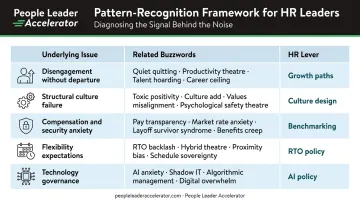
"Quiet cracking," "resenteeism," and "talent debt" often point to the same root cause: employees trapped in roles without meaningful growth or recognition. Addressing one in isolation rarely solves the problem.
Staying current with HR buzzwords is part of developing the strategic fluency that separates operational HR from genuine people leadership. That fluency requires more than vocabulary — it takes structured frameworks for culture design, people analytics, and compensation benchmarking. People Leader Accelerator's programs are built specifically for HR leaders working to close that gap.
Frequently Asked Questions
What are common HR buzzwords?
The most widely recognized HR buzzwords include quiet quitting, quiet firing, the Great Resignation, employee experience (EX), and ghost jobs. New terms emerge regularly from social media platforms (particularly TikTok and LinkedIn), often gaining mainstream HR attention within weeks of going viral.
What are the 7 C's of HR?
The 7 C's is a traditional HR framework covering Competence, Commitment, Culture, Compensation, Compliance, Coordination, and Communication. Unlike trending buzzwords, it's a structured model for evaluating overall HR effectiveness and organizational health.
What are the 5 R's of HR?
The 5 R's (typically Recruitment, Retention, Rewards, Retraining, and Retirement) represent core HR pillars. Several trending buzzwords — quiet quitting, talent debt, and the great people shortage — directly challenge how well organizations are executing on each of these pillars.
What is the difference between quiet quitting and quiet firing?
Quiet quitting is employee-driven: doing only what the role requires with no additional discretionary effort. Quiet firing is management-driven: passively pushing an employee toward resignation by withholding support, development opportunities, and meaningful feedback.
What is the newest HR buzzword right now?
The most recent entries here — job hugging, conscious unbossing, hybrid hushing, and the Gen Z stare — emerged in 2024–2025. They reflect current anxieties around job security, generational workplace dynamics, and ongoing tension over return-to-office mandates.