
Introduction
Employees today expect the same seamless, on-demand experience from HR that they get from their banking app or favorite retail platform. The reality inside most organizations tells a different story. According to Sapient Insights' 2024 Annual HR Systems Survey, 15% of organizations had no standard HR-systems experience and 12% reported a disjointed or fragmented one — meaning more than a quarter of organizations are failing to deliver even a consistent baseline.
That gap is getting harder to ignore. Remote work, AI adoption, and shifting workforce demographics are accelerating pressure on HR service delivery to change. This article covers:
- What HR service delivery (HRSD) actually is
- The main delivery models in use today
- The core benefits of getting it right
- How the function is evolving in ways that matter for HR leaders now
Key Takeaways
- HRSD is the combination of people, processes, and technology used to deliver HR services across the full employee lifecycle.
- The tiered service delivery model (Tier 0–3) is the dominant modern framework, organizing support from self-service through strategic HR leadership.
- AI, automation, and self-service are compressing what was previously Tier 1 work, reshaping how HR teams are structured.
- For HR leaders in high-growth organizations, getting HRSD right early determines whether the function scales smoothly or becomes a source of compounding friction.
What Is HR Service Delivery?
HR service delivery is the operating system behind how employees get help from HR. It's the combination of people, processes, and technology an organization uses to deliver HR services across the full employment lifecycle — from onboarding and benefits enrollment to payroll queries, employee relations, and offboarding.
Traditional vs. Modern HRSD
Traditional HRSD meant walking down the hall to ask an HR generalist, filling out paper forms, or waiting days for a response. That model worked when workforces were centralized and expectations were low — but distributed teams and consumer-grade digital experiences have changed both conditions permanently.
Modern employees expect instant, digital, self-directed access to HR — the same way they'd check a bank balance or reschedule a delivery. When HR can't deliver that, it doesn't just create frustration; it erodes confidence in the organization itself.
How HRSD Differs from HRIS and HR Operations
These terms get conflated constantly. Here's how they actually differ:
- HRIS (Human Resources Information System) is the technology platform that stores and manages employee data — think Workday, SAP SuccessFactors, or UKG Pro.
- HR operations refers broadly to the day-to-day running of the HR department.
- HR service delivery is the structured framework and channels through which HR services reach employees — it sits within HR operations and depends on the HRIS, but it's neither of those things.
How HRSD Performance Gets Measured
Four metrics tend to define whether HRSD is working:
| Metric | What It Measures |
|---|---|
| First-contact resolution rate | Share of inquiries resolved without escalation or repeat contact |
| Case resolution time | How quickly requests move from submission to closure |
| Employee satisfaction with HR | How employees rate their HR service interactions |
| HR cost per employee served | Efficiency of delivery relative to workforce size |
According to Hackett Group's 2023 benchmarking, Digital World Class HR functions operated at 33% lower total HR cost and served 66% more employees per HR FTE than peer organizations — though this reflects whole-function performance, not HRSD in isolation.
Common HR Service Delivery Models
No single model fits every organization. The right structure depends on workforce size, geographic distribution, and how mature the HR function is. Here's how the main models compare.
Traditional Model
HR generalists serve a local employee population, handling the full range of HR tasks for their assigned group. It's personal and accessible, but it doesn't scale. Bottlenecks form quickly, consistency suffers across locations, and the model relies heavily on individual HR rep knowledge rather than documented processes — particularly for distributed or remote workforces.
Shared Services Model
HR generalists and specialists consolidate into a central function, dividing work by type rather than by employee population. This improves consistency, reduces duplication, and lowers per-transaction costs. It's the default structure for mid-to-large organizations with hybrid workforces that need standardized service across multiple sites or regions.
Self-Service Model
Employees handle routine needs themselves — checking payslips, requesting time off, finding policy documents — through portals, chatbots, or knowledge bases. This reduces HR's administrative load significantly and meets employee expectations for immediacy. The limitation: self-service works best for simple, well-defined requests. Complex or sensitive situations still require human judgment.
Tiered Service Delivery Model
This is the most comprehensive modern framework, drawing from Dave Ulrich's 1997 work on HR operating models. It organizes support into four tiers:
| Tier | Who Handles It | Typical Scope |
|---|---|---|
| Tier 0 | Employee self-service | Knowledge searches, simple transactions, FAQs |
| Tier 1 | HR generalists / shared services | Inquiry intake, routine administration, case management |
| Tier 2 | HR specialists | Complex questions, policy interpretation, functional expertise |
| Tier 3 | HR business partners / leadership | Sensitive issues, exceptions, strategic decisions |
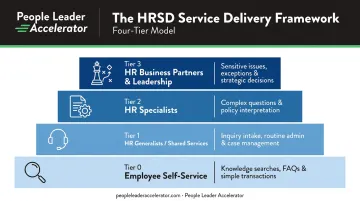
A ScottMadden/APQC study found that 70% of participating HR shared-services organizations used a tiered staffing model. The tiered approach works because it routes each request to the appropriate level, keeping strategic HR capacity focused on high-value work rather than password resets. Understanding these models sets the stage for how technology and employee expectations are now pushing each one to evolve.
Key Benefits of Effective HR Service Delivery
Getting HRSD right produces three categories of organizational benefit.
1. Cost Efficiency
Automation and process standardization reduce administrative duplication. When employees can resolve routine queries through self-service and cases route automatically to the right tier, HR handles more volume with fewer resources. Hackett's data shows the efficiency differential is substantial for organizations that invest in this infrastructure.
2. Better Employee Experience
Speed, consistency, and personalization all improve when HRSD is structured properly. Employees get answers faster, requests don't fall through the cracks, and interactions feel less like navigating a bureaucracy. Given that HR touchpoints span the entire employment lifecycle — first day to last — the cumulative effect on employee trust is significant.
3. Data and Analytics
A well-structured HRSD platform generates real-time visibility into service quality: where cases are backing up, which issues repeat most often, how satisfaction scores trend by department or location. That data is how HR shifts from reactive firefighting to proactive intervention.
From Administrative to Strategic
The case for investing in HRSD infrastructure is also a workforce planning argument. McKinsey's 2018 analysis estimated that 56% of typical hire-to-retire tasks had automation potential with then-current technology — and that figure has only grown with AI advances.
Every reclaimed hour is an hour HR can redirect to higher-value work:
- Workforce planning and headcount modeling
- Talent development and succession pipelines
- Organizational design and restructuring support
The scalability case is especially direct for high-growth organizations. A tiered, technology-enabled HRSD model can absorb a doubling of headcount without a proportional increase in HR FTEs. Without it, HR teams at scaling companies end up buried in transactions precisely when the organization needs them thinking strategically.
How HR Service Delivery Is Evolving
Several forces are reshaping HRSD simultaneously — and they're mutually reinforcing.
The Distributed Workforce Imperative
Employees no longer work 9–5 in a single office. Gallup's current hybrid work data shows that among U.S. employees in remote-capable roles, 52% are hybrid and 26% are exclusively remote. HR services can't be office-hours-only when your workforce spans time zones and work schedules.
That means HR must be accessible anytime, on any device — a baseline requirement, not a differentiator.
The Consumerization Pressure
Employees benchmark their workplace technology against the apps they use in everyday life. When your bank's app resolves a dispute in minutes and your HR portal takes three days to process a leave request, the gap is obvious. Most organizations haven't closed it — Sapient Insights data shows 27% of organizations still operate with no standard or fragmented HR experience.
AI and Intelligent Automation
This is where the most structural change is happening. A 2024 Gartner survey of 179 HR leaders found that 38% were piloting, planning, or had already implemented generative AI in HR — up from 19% just eight months prior. Among the top use cases: employee-facing HRSD chatbots (43%) and HR administrative task automation (42%).
In practice, AI is compressing what was previously Tier 1 work into Tier 0:
- Chatbots handle real-time FAQ resolution without human intervention
- Automated case routing reduces manual triage at the front end
- Emerging agentic AI can complete multi-step HR workflows end-to-end
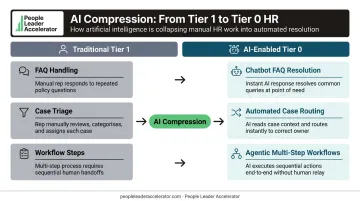
Tier 1 teams aren't disappearing — their work is shifting toward higher-complexity cases that require human judgment.
From Reactive to Proactive Delivery
Traditional HRSD responded to what employees asked. Modern HRSD anticipates what they'll need. Platforms now deliver real-time data that flags flight risks, identifies onboarding friction points, and triggers personalized outreach before employees have to ask. The shift from customer-service metrics to predictive indicators is one Gartner explicitly identifies as a strategic priority for HR shared-services leaders.
Personalization at Scale
Employees increasingly expect HR interactions tailored to their role, location, tenure, and career stage — not generic policy documents. Modern HRSD platforms use employee data to deliver relevant content, route cases contextually, and adapt communications to individual circumstances. Doing this consistently across thousands of employees requires two things: solid data architecture and deliberate process design.
What This Means for HR Leaders in High-Growth Organizations
The evolution of HRSD isn't primarily a technology procurement decision. It's a strategic architecture question, and one HR leaders need to own.
Service Architecture Is a Strategic Choice
The "What-Who-How" framework gives HR leaders a structured way to make service architecture decisions explicit — rather than letting them accumulate as informal practice. Three questions drive it:
- What services are you delivering, and which ones should be automated vs. handled by a person?
- Who delivers each service — a shared service center, an HRBP, a manager, or an employee self-serving?
- How are services accessed — through a portal, a ticket system, direct contact, or some combination?
This requires the same strategic thinking as organizational design or talent strategy.
The Capability Gap Is Real
As HRSD becomes more data-driven and structurally complex, HR professionals need fluency in process design, people analytics, and change management — not just traditional HR knowledge. McKinsey's 2025 HR Monitor survey of 1,925 HR professionals found that 35% identified problem-solving and 30% identified data analytics and AI as top-five future skill priorities. These aren't fringe capabilities — they're quickly becoming core to the job.
The High-Growth Stakes
For HR leaders at startups, high-growth tech companies, and PE-backed businesses, the timing of HRSD decisions matters enormously. Service model choices made at 50 employees tend to calcify. What works informally at that stage often creates serious friction at 200 or 500 employees — when the organization needs HR operating strategically, not catching up administratively.
This is precisely the territory that People Leader Accelerator is built for. The program is designed by faculty including Andrew Bartlow (co-author of Scaling for Success: People Priorities for High Growth Organizations) and Marie Szuts (former people leader at Figma).
It equips HR leaders with the strategic frameworks to build and scale effective people operations — including the operating model decisions that determine how HRSD performs at scale.
Frequently Asked Questions
What is HR service delivery?
HR service delivery is the structured combination of processes, people, and technology an organization uses to provide HR services to employees across the full employment lifecycle — from onboarding and benefits to payroll and offboarding. It defines how HR help reaches employees, through which channels, and at what speed.
What is the role of an HR service delivery associate?
An HR service delivery associate typically works within the Tier 1 layer of a shared services or tiered HRSD model. They handle general employee inquiries, process routine HR requests, and escalate complex or sensitive cases to specialists or HR business partners when needed.
What is UKG HR service delivery?
UKG HR Service Delivery refers to the HRSD features within UKG Pro, including employee self-service through People Assist, automated workflows, case management, and reporting dashboards. It's one example of a broader category of HRSD software platforms available to HR teams.
What is the difference between HR service delivery and HR operations?
HR operations refers to the day-to-day functioning of the HR department. HR service delivery is the specific framework and channels through which HR services are structured and delivered to employees. HRSD is one component of HR operations, not a synonym for it.
How does HR service delivery impact employee experience?
HRSD shapes nearly every HR interaction an employee has. Poor delivery creates friction and erodes trust; effective HRSD builds employee confidence and reduces the administrative drag that frustrates employees and HR teams alike.