
Introduction
Most HR teams in high-growth organizations don't fail because of bad intentions — they fail because they're rebuilding from scratch every time. A new hire wave hits, and suddenly everyone's improvising: managers waiting on laptops, IT unaware a start date changed, payroll missing a final check detail. Each gap costs time. Some create compliance exposure.
According to APQC's cross-industry benchmark, the median HR team spends only 40% of its combined time on strategic work — the rest gets consumed by administrative coordination that structured workflows could largely eliminate.
Structured workflows are the fix. This guide covers what HR workflows are, five ready-to-adapt templates for the processes that matter most, a five-step framework for building your own, and the three mistakes that break even well-designed systems.
Key Takeaways
- HR workflows are structured sequences with defined triggers, owners, and approvals — not just task lists
- Five workflows deliver the most impact first: onboarding, recruiting, performance reviews, leave approvals, and offboarding
- Most workflows fail at the handoff between departments, not inside a single system
- Ownership clarity — not tool sophistication — is the single most critical design variable
What Are HR Workflows?
An HR workflow is a structured, repeatable sequence of tasks that moves a specific HR process from trigger to completion — defining who does what, in what order, and with what approvals along the way.
Logic is what drives it. A workflow starts when an event occurs and automatically assigns or sequences what happens next — that's what separates it from a checklist.
Workflow vs. Process vs. Checklist
These three terms get used interchangeably, but they mean different things:
| Term | Definition | Example |
|---|---|---|
| HR Process | The overarching concept | "We have an onboarding process" |
| HR Workflow | Operational implementation with triggers, owners, deadlines | "Signed offer triggers IT provisioning within 48 hours" |
| Checklist | Static task list with no logic or accountability | "Here's what to do before a new hire starts" |
A checklist tells you what to do. A workflow tells you when, who, and what happens next.
Core Components of an Effective HR Workflow
Every reliable HR workflow contains five elements:
- Trigger — the event that starts the workflow (e.g., signed offer letter, resignation notice)
- Actions — the sequential tasks to be completed
- Owners — the specific person or role responsible for each step
- Approvals — decision gates where sign-off is required before the workflow proceeds
- Notifications — automated or manual updates keeping stakeholders informed
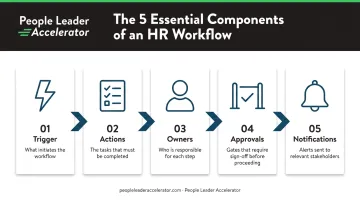
Getting these five elements right is what turns an informal process into a workflow you can actually hand off, audit, and scale.
The Strategic Case for HR Workflows in High-Growth Organizations
Informal processes that work fine at 20 employees become compliance liabilities at 200. That's the core scaling tension HR leaders face.
Inconsistent onboarding creates unequal employee experiences. Undocumented performance reviews create legal exposure during terminations — and manager frustration compounds when no one can explain why the same process produces different results each time.
In startup and PE-backed environments specifically, HR leaders who bring structured workflows shift their credibility from administrator to strategic partner. That distinction matters during board reviews and headcount justification conversations.
The organizational benefits compound fast:
- Faster cycle times with less back-and-forth between departments
- Fewer skipped steps and downstream errors
- Clear accountability for every action
- Compliance documentation that holds up under audit
- Faster ramp time for new HR team members who can follow documented processes from day one
McKinsey estimates two-thirds of current HR tasks can be automated — but you can't automate what you haven't documented. Well-designed workflows generate the process data HR leaders need to build the business case for technology, headcount, or structural investment.
5 Essential HR Workflow Examples with Step-by-Step Templates
The five workflows below represent the highest-frequency, highest-risk HR processes in most organizations. Each template is a starting point — adapt the steps to fit your tools, team size, and structure.
Employee Onboarding Workflow
Goal: Ensure every new hire has access, equipment, documentation, and context before day one — without relying on memory or manual coordination.
Trigger: Signed offer letter
Core steps:
- HR enters employee into HRIS and notifies IT and Facilities
- IT provisions hardware and system access (SLA: 5 business days before start)
- Facilities prepares workspace and access credentials
- Manager creates 30-60-90 day plan
- HR conducts orientation and collects signed policy acknowledgments
- New hire completes required training modules
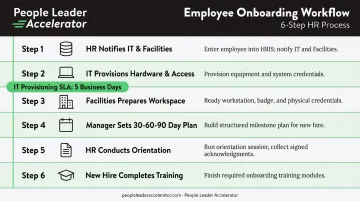
Most common failure point: IT access not ready on day one — usually because no one defined when the IT notification should fire.
Template design priorities: Specify which step triggers IT notification, who owns the 30-60-90 plan, and what the equipment provisioning SLA is. This workflow spans HR, IT, Facilities, and the hiring manager — every handoff is a potential gap.
Brandon Hall research found that mature onboarding practices make organizations 103% more likely to improve retention and engagement. The workflow is the mechanism that makes "mature" repeatable.
Recruiting and Hiring Workflow
Trigger: Approved job requisition submitted by hiring manager
Core steps:
- HR reviews requisition and posts to selected platforms
- Applications screened against defined qualifications
- HR shortlists and schedules interviews
- Interview panel submits structured feedback
- HR coordinates background and reference checks
- Offer drafted, approved, and sent
- Accepted offer automatically triggers onboarding workflow
Most common failure point: Feedback submission. Panels delay, which delays decisions. Adding a 48-hour post-interview feedback deadline as a workflow rule measurably reduces time-to-hire.
SHRM's 2025 benchmarking data shows screening and interviewing each average 8-9 days. Structured templates and deadline rules are the fastest lever for compressing that timeline.
Template design priorities: Document where your ATS handles steps automatically versus where manual action is required. Map the exact handoff point between recruiting and onboarding — many organizations leave this handoff undocumented.
Performance Review Workflow
Trigger: HR calendar trigger at the start of each review cycle
Core steps:
- HR notifies managers of upcoming cycle with firm deadlines
- Employees complete self-assessments
- Managers evaluate performance using standardized criteria
- HR audits for rating consistency ← most commonly skipped step
- Managers conduct review conversations
- Completed reviews and development actions stored in HRIS
Most common failure point: Skipping the consistency audit in step 4. Without it, ratings drift across managers, creating legal exposure during termination decisions.
Template design priorities: Build automated reminders with hard deadlines at every step. Define what happens when a manager misses a deadline — typically escalation to an HR Business Partner. The documentation generated by a well-run review workflow is what protects the organization when termination decisions get challenged.
Leave Request and Approval Workflow
Trigger: Employee submits leave request via HRIS or self-service portal
Core steps:
- System routes request to direct manager
- Manager approves or denies based on team capacity
- HR updates leave balance
- Payroll notified of any unpaid leave
- Team calendar updated
Most common failure point: Leave balances updated manually after the fact — creating payroll discrepancies and employee disputes about accrued time.
Template design priorities: This is one of the easiest workflows to fully automate once approval rules are documented. For teams new to workflow design, leave approvals are an ideal first automation project: high volume, simple logic, and immediate time savings once the rules are configured.
Offboarding Workflow
Trigger: Manager notifies HR of resignation or termination
Core steps:
- HR confirms final day and activates exit checklist
- IT revokes system access and collects company equipment ← non-negotiable deadline: last day or before
- Payroll prepares final payment and benefits continuation information
- HR schedules exit interview
- Manager initiates knowledge transfer or replacement recruiting
- HR archives employee record
Most common — and most costly — failure: Missing step 2. NIST's personnel-termination controls explicitly require organizations to disable system access on or before the employee's last day, revoke credentials, and retrieve security-related property. In tech-enabled environments, delayed revocation creates real security exposure.
Template design priority: IT revocation must happen on or before the employee's last day, not after. Build this as a hard-deadline automated trigger so it cannot be overlooked or postponed.
How to Build an HR Workflow From Scratch
Step 1 — Start with your most broken process
Don't try to document every HR process at once. Pick the one generating the most complaints, errors, or escalations. Set a measurable goal: reduce onboarding cycle time by 20%, achieve 95% performance review completion. You need a baseline to prove the improvement worked.
Step 2 — Map how it actually works today
Document current reality, not the theoretical process. Capture:
- Every action and who performs it
- What triggers the workflow
- Which systems and documents are involved
- Where handoffs occur between departments
- Where approvals are required
- Where delays and workarounds consistently appear
This step surfaces the real problem. IT receiving equipment requests with 24 hours notice isn't an IT failure — it's a trigger-timing failure that no one ever defined.
Step 3 — Assign ownership using RACI
Map each step to a role using RACI:
- Responsible — who does the actual work
- Accountable — who owns the outcome and answers for it
- Consulted — who must provide input before the step completes
- Informed — who gets notified after the fact
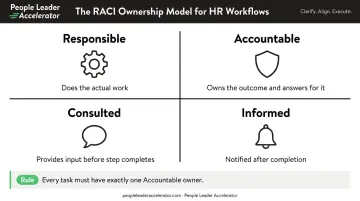
McKinsey's 2023 organizational research found 40% of leaders attributed inefficiency to unclear roles. The RACI model exists specifically to prevent the most common workflow failure: two people each assuming the other owns a step.
Every task must have exactly one accountable owner — not a shared department, not "HR."
Step 4 — Validate with the people who live it
Before formalizing the workflow, walk through the draft with actual stakeholders — managers, IT, payroll, the HR team members who run this process daily. Ask:
- Where do delays consistently happen?
- What information is always missing when work arrives at your step?
- Which steps feel unnecessary or duplicative?
Workflows that look correct on paper often miss friction that only practitioners can see.
Step 5 — Pilot, measure, and iterate
Test the redesigned workflow with one team or business unit before scaling organization-wide, tracking cycle time, error rate, completion rate, and stakeholder satisfaction. Treat the template as a living document. Workflows that don't evolve become the informal processes you were trying to replace.
People Leader Accelerator's programs give HR leaders the process design tools, audit frameworks, and templates to build and sustain workflows like these — and connect the results to executive-level business cases as their organizations scale.
Common HR Workflow Mistakes to Avoid
Mistake 1 — Too many approval layers
Workflows with three or more approval steps for routine decisions create delays that defeat the purpose of standardization. Audit your approval chains and ask one question for each gate: does this approval change the outcome or protect the organization? If the answer is no, it can likely be removed or delegated.
McKinsey data shows that 61% of respondents in organizations with 1-3 reporting layers reported quick decisions — compared to 38% in organizations with seven or more layers. Approval bloat in workflows follows the same logic.
Mistake 2 — Unclear or shared ownership
Tasks assigned to a role or department rather than a specific person almost always produce delays or dropped steps. The most dangerous version: two departments each believe the other owns a step. IT thinks HR confirms the equipment list. HR thinks IT already knows.
The RACI model from Step 3 exists to close exactly this gap. Shared ownership is usually an assumption — not an agreement.
Mistake 3 — Building without measuring
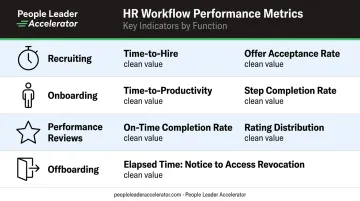
A workflow without defined KPIs cannot be improved. Before redesigning any workflow, capture your baseline metrics. The right measures vary by workflow:
- Recruiting: time-to-hire and offer acceptance rate
- Onboarding: time-to-productivity, plus completion rate by step
- Performance reviews: on-time completion rate, rating distribution
- Offboarding: elapsed time from notice to access revocation
Build tracking into the workflow design from the start — not as an afterthought once the process is already live.
Frequently Asked Questions
What are the 7 HR processes?
The seven core HR processes are: recruitment and hiring, onboarding, performance management, learning and development, compensation and benefits, employee relations, and offboarding. Each should be structured as a formal workflow with defined triggers, owners, and steps.
What are the 5 steps of workflow?
The five universal workflow steps are: trigger (what starts it), action (the task performed), owner (who does it), approval (the decision gate), and completion/notification (confirming the step is done and alerting the next owner). These apply to HR workflows of any size or complexity.
What are examples of workflows?
Common HR workflow examples include:
- Onboarding — signed offer to day-one readiness
- Recruiting — job requisition to accepted offer
- Leave approvals — employee request to calendar update
- Performance reviews — cycle launch to completed documentation
- Offboarding — resignation notice to access revocation and record archiving
What is the difference between an HR process and an HR workflow?
An HR process is the overarching concept, such as "hiring" or "onboarding." An HR workflow is the operational implementation with specific steps, triggers, owners, and deadlines. One process can contain multiple workflows — a standard external hire versus an expedited internal transfer, for example.
What HR workflows should small or scaling teams prioritize first?
Start with onboarding and offboarding. Both are high-frequency, span multiple departments, and carry the most compliance and security risk when they go wrong. Leave approvals are typically the easiest first automation project because the approval logic is simple and the ROI on time saved is immediate.
How do you measure if an HR workflow is working?
Track four metrics: cycle time, completion rate, error or rework rate, and stakeholder satisfaction. Capture these baselines before redesigning. Without them, you can confirm something changed but not whether it actually improved.