

Still, if you're sitting outside the profession looking in, the job postings can feel discouraging. "3-5 years of HR experience required" shows up constantly, which creates an obvious problem when your experience just happens to be in a different field.
This guide cuts through that. You'll learn how to identify the HR skills you already have, which entry points fit your background, and how to position your non-HR career as a genuine asset rather than a gap to apologize for.
Key Takeaways
- Professionals from finance, education, operations, tech, and marketing bring transferable skills HR departments actively need
- Certifications like SHRM-CP and aPHR open entry-level HR doors without a degree or prior HR experience
- Volunteering for HR-adjacent work in your current role is one of the fastest ways to build a credible track record
- Strategic HR positions typically require 5+ years of experience, so targeting specialist or coordinator roles first is the realistic path
- Framing your non-HR experience in HR terms is what separates candidates who get interviews from those who don't
Why HR Is a Smart Career Move Right Now
HR has changed fundamentally. For decades, it was primarily administrative — processing paperwork, managing compliance, running benefits enrollment. That version of HR still exists, but it's no longer the whole story.
Today, only 18% of CHROs report that their HR strategy is seamlessly aligned with organizational goals, according to SHRM's 2025 research across 212 chief HR officers. That gap represents real demand for HR professionals who understand how businesses operate, not just HR processes.
The numbers back up the opportunity:
- HR specialists: 6% projected growth (2024–34), 81,800 annual job openings, $72,910 median salary
- Training and development specialists: 11% projected growth (fastest among core HR roles), 43,900 annual openings, $63,490 median salary
- Compensation specialists: 5% projected growth, $77,020 median salary
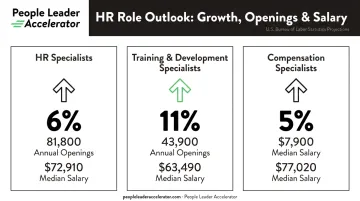
These are entry and mid-level roles. HR managers — who earn a $140,030 median salary — typically require five or more years of related experience, making that the advancement target rather than the entry point.
The profession increasingly needs people who've been on the receiving end of HR decisions. Someone who's managed a budget, led a team through change, or built a training program from scratch brings operational context that a career HR generalist may not have.
Which Backgrounds Transition Well Into HR
No single background is disqualifying, but some map more naturally to specific HR functions. The most common and direct transitions include:
| Previous Background | Natural HR Entry Point |
|---|---|
| Education / training | L&D, onboarding, organizational development |
| Finance / accounting | Compensation, benefits, workforce planning |
| Operations / project management | HR program management, HRIS |
| Marketing / communications | Employer branding, internal communications |
| Customer service / hospitality | Employee relations, culture programs |
| Psychology / counseling | OD, employee wellbeing, engagement |
| Legal | Employee relations, compliance |
| Data / technology | People analytics, HRIS |
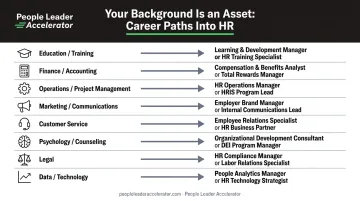
An HR degree is not a prerequisite. SHRM describes professionals entering HR from administrative work, business development, and finance — the field has always absorbed people with varied starting points. What matters more than your degree title is whether you can demonstrate HR-relevant competencies and domain knowledge.
Entry points vary based on what you bring. Finance professionals tend to move into compensation or workforce planning, where their analytical skills have immediate application. Former educators often land in L&D or onboarding — facilitation and curriculum design translate almost directly. If your background is in operations or project management, HR program management and HRIS implementation are natural fits.
Knowing your strongest entry point lets you target roles precisely rather than scatter applications across functions you're not positioned for yet.
Identify the Transferable Skills You Already Have
The SHRM Body of Applied Skills and Knowledge — the framework underpinning SHRM certification — identifies nine behavioral competencies for HR professionals. Several of them are skills you likely developed before you ever thought about HR as a career.
Communication and Facilitation
Every HR function depends on communication — explaining policies, coaching managers, facilitating difficult conversations, running training sessions. If any of these describe your background, you've been building this competency for years:
- Teaching or training in any formal or informal setting
- Managing a team or leading cross-functional projects
- Customer-facing roles requiring de-escalation or persuasion
- Presenting to senior stakeholders or executive audiences
Conflict Resolution and Relationship Management
SHRM explicitly lists Relationship Management as a core HR competency, defined as managing conflict while supporting the organization. If you've navigated interpersonal dynamics under pressure — on a sales floor, in a classroom, inside an operations center — you already have a foundation here. The HR context shifts, but the skill itself doesn't.
Project and Program Management
HR runs on projects: benefits rollouts, onboarding redesigns, DEI initiatives, performance cycle administration. If you've managed timelines, budgets, and stakeholder expectations, you already understand how this work gets done. The HR vocabulary is different; the discipline isn't.
Business Acumen and Data Literacy
This is where career changers often hold a real edge. SHRM's BASK framework defines Business Acumen as understanding operations, the external environment, and how to connect HR decisions to business outcomes — knowledge that finance, sales, and operations professionals accumulate naturally.
The data side is equally relevant. More HR job postings now list AI and analytics skills as requirements, and career changers from quantitative backgrounds bring a head start in people analytics — an area HR executives increasingly treat as central to workforce strategy.
Practical Steps to Transition Into HR
Step 1 — Audit Your Experience and Choose an Entry Point
Before you apply anywhere, get specific about where you're entering. Three main paths exist:
- HR specialist roles — broad operational HR work, the most common entry path
- Functional specialist roles — recruiting, L&D, compensation, benefits; often hire for domain expertise
- HR coordinator or generalist roles — operational support roles that build foundational exposure
Generalist roles require a broader HR knowledge base. Specialist roles let you lead with what you already know. Most career changers find traction faster through the specialist path.
Step 2 — Get Certified
Two credentials are specifically accessible to candidates without prior HR experience:
- SHRM-CP — No HR title, degree, or prior HR experience required. Exam fee: $350–$499 depending on membership and timing.
- aPHR (HRCI) — No HR experience required; requires only a high school diploma. Exam fee: $300 plus a $100 application fee.
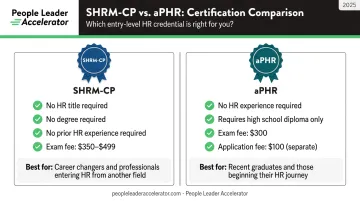
The PHR requires professional-level HR experience to sit for the exam, so it's not the right starting credential for most career changers.
Certification does two things: it builds foundational knowledge, and it signals to hiring managers that you're serious about the transition — not just exploring it.
Step 3 — Volunteer for HR-Adjacent Work Now
You don't need to leave your current job to start building an HR track record. Options include:
- Leading onboarding improvements for your team or department
- Running or founding an Employee Resource Group (ERG)
- Serving as an HR liaison on a cross-functional project
- Helping develop a culture initiative or employee survey process
Even informal involvement in these areas creates legitimate resume content — and it gives you stories to tell in interviews.
Step 4 — Build Your Network Intentionally
Most HR roles, especially at smaller organizations, fill through relationships before they ever get posted. Prioritize:
- Joining a local SHRM chapter and attending events
- Engaging in HR communities on LinkedIn
- Attending HR conferences or smaller HR meetups
You're not just looking for job leads — you're learning how HR practitioners talk about their work, what problems they're solving, and where your background might fit.
Step 5 — Invest in Structured Development
Certifications build your knowledge base. But if you're targeting a manager-level or HRBP role rather than an entry-level position, knowledge alone won't close the gap — you also need judgment, and that requires a different kind of learning environment.
Structured programs like People Leader Accelerator are designed for exactly that. The format combines peer cohort learning, practitioner-led curriculum, and ongoing community — the kind of environment where you can stress-test your thinking against people doing real HR work. What you get includes:
- Peer cohort learning with professionals navigating similar transitions
- Practitioner-led instruction grounded in real organizational challenges
- Community access that extends well beyond the program itself
One participant described the experience as "a full rebuild of my perspective, emotions, and tool belt," with gains in both professional confidence and practical capability. That outcome is harder to replicate through solo certification study.
Step 6 — Get Official Experience Through Any Available Channel
Your resume ultimately needs to show an actual HR role. Options:
- A lateral move into an HR coordinator position
- A short-term internship (yes, even if you're mid-career)
- A formal internal rotation or "tour of duty" in your company's HR function
Even a brief stint creates the entry on your resume that unlocks subsequent opportunities. Most hiring managers weight recent, relevant experience heavily. A six-month HR coordinator role can open more doors than five years of non-HR work, however impressive that background is.
How to Brand Yourself as a Career Changer in HR
Lead With Your Transition Story
Your resume and LinkedIn profile need to answer one question clearly: why HR, and why now? Don't bury the answer.
Open your resume with a professional summary that frames your career arc toward HR. Structure the rest of your resume to lead with relevance, not chronology:
- Open with a summary connecting your previous domain to HR
- List certifications and HR-adjacent project work before your job history
- Skip strict reverse-chronological order if prior titles don't signal HR experience
You're not hiding anything — you're organizing information to serve the reader.
Position Your Background as Specialization
A former finance professional applying for a compensation analyst role isn't a generalist lacking experience — they're a specialist with domain depth. A former teacher moving into L&D isn't starting from zero. They're bringing instructional design experience and facilitation skills that many career HR practitioners lack.
Name your previous background directly in cover letters and interviews. The framing that works: my experience in [field] is exactly why I'm well-suited for this HR role — not despite it, because of it.
Learn to Speak HR
Before interviews, internalize the vocabulary:
- HRIS, headcount planning, span of control
- Engagement scores, eNPS, exit interview trends
- OKRs, competency frameworks, succession planning
- Workforce planning, org design, total rewards
What matters is using these terms accurately and naturally in conversation. That signals you're already thinking like an HR practitioner — not someone who just discovered the vocabulary.
Frequently Asked Questions
Is HR a good career change?
HR is a meaningful and growing field, with over 81,800 annual job openings for HR specialists alone. Career changers with real business experience are often better positioned for strategic roles than lifelong HR professionals — they know firsthand what it's like to be a manager, an employee, or a leader navigating difficult people decisions.
How do I make a career change to HR?
Start by auditing your transferable skills and identifying which HR specialty fits your background. Get an accessible certification (SHRM-CP or aPHR), volunteer for HR-adjacent work in your current role, and reframe your resume to lead with your HR relevance rather than your previous job titles.
Do I need an HR degree to transition into HR?
No. Neither SHRM-CP nor aPHR require an HR-specific degree, and the aPHR requires only a high school diploma. Many HR professionals entered from unrelated fields. Demonstrated competencies, certifications, and relevant project experience carry more weight than your undergraduate major.
What are the best HR certifications for career changers?
The SHRM-CP and HRCI's aPHR are the strongest starting points — both are accessible without prior HR experience. The aPHR is slightly more entry-level; the SHRM-CP covers a broader range of HR knowledge. The right choice depends on your current background and the type of role you're targeting.
How long does it take to transition into an HR career?
The timeline varies widely based on your starting background, the roles you're targeting, and how quickly you build credentials and relevant experience. Most people see meaningful progress within 6–18 months of focused effort, though some transitions take longer.
How do I get back into HR after a career break?
Start by refreshing your HR knowledge through current certifications or coursework, since standards and technology shift quickly. Then update your resume to reflect skills developed during your break — informal coaching, program management, and volunteer leadership all count. Reconnect with your network before you actively need it.