
The consequences show up fast: inconsistent hiring decisions, new hires who disengage within weeks, performance conversations that feel arbitrary, and compliance gaps that become expensive problems.
This guide covers everything HR professionals need to know: a clear definition of HR processes, the core processes across the full employee lifecycle, and practical guidance on how to manage and improve them — especially in high-growth environments where the stakes are highest.
Key Takeaways
- HR processes are standardized workflows managing every stage of the employee lifecycle, from hiring to offboarding
- The seven core processes span workforce planning, recruitment, onboarding, training, performance management, compensation, and employee relations
- Gallup's 2024 research links top-quartile employee engagement to 23% higher profitability across 183,806 business units
- Documented processes lower compliance risk, preserve institutional knowledge, and reveal where automation can take hold
- High-growth organizations need scalable processes built ahead of demand, before hiring volume or complexity forces the issue
What Are HR Processes and Why Do They Matter?
HR processes are the standardized workflows and procedures that guide how an organization manages its people at every stage of the employee lifecycle — from the moment a position opens to the day an employee leaves. They create consistency, reduce errors, and set clear expectations for both HR teams and employees.
The Business Case for Structured HR Processes
Without defined processes, HR operates on instinct and improvisation — which stops scaling the moment headcount grows past a single team.
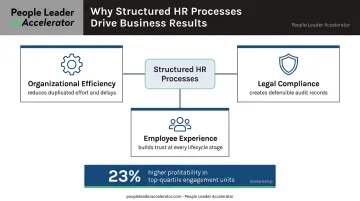
Well-designed HR processes deliver three direct business outcomes:
- Organizational efficiency — consistent workflows reduce duplicated effort and decision-making delays
- Legal compliance — documented procedures create defensible records during audits or disputes
- Employee experience — predictable, fair processes build trust at every lifecycle stage
The engagement data backs this up. Gallup's research across 3.3 million employees found that top-quartile engagement units outperformed bottom-quartile units by 23% in profitability and 18% in sales productivity. While engagement is multi-causal, structured HR processes are a significant driver of the consistent management practices that sustain it.
HR Processes vs. HR Systems: An Important Distinction
These terms get conflated constantly, but the difference matters.
| Dimension | HR Processes | HR Systems (HRIS/HRMS) |
|---|---|---|
| What they are | Structured workflows and decision logic | Software platforms that store and automate data |
| Example | How hiring decisions are made and documented | The ATS that tracks applicants |
| Sequence | Come first | Extend what's already designed |
Strong processes come first. The right technology extends their reach — but it can't compensate for workflows that were never properly designed.
The Core HR Processes: A Complete Lifecycle Overview
HR processes follow the employee lifecycle. Each stage flows into the next, and mastering each one is what separates reactive HR departments from strategic ones. Here are the seven core processes every HR function must manage.
Workforce Planning
Workforce planning is the foundation everything else builds on. HR analyzes current capabilities, forecasts future talent needs based on business goals, and builds a roadmap for hiring, development, and succession.
Key tasks include:
- Workforce analysis — understanding current skill sets, gaps, and capacity
- Talent forecasting — projecting future headcount needs by role and function
- Succession planning — identifying and developing candidates for critical roles
The risk of short planning horizons is real. CIPD's 2024 research found 69% of UK HR professionals reported increased competition for qualified talent — yet 31% planned no further than six months ahead. That gap creates constant reactive hiring and unnecessary cost.
Practical tip: Tie workforce planning reviews to quarterly business reviews, not annual budget cycles. Business goals shift faster than annual plans can accommodate.
Recruitment and Selection
Recruitment is the process of attracting, screening, and selecting the right candidates for open roles. The key steps:
- Craft accurate, role-specific job descriptions
- Post through diverse channels to reach varied candidate pools
- Apply structured screening criteria consistently across candidates
- Conduct structured interviews — SIOP research reports structured interviews achieve a mean operational validity of r=.42 (meaning they predict job performance more reliably than most other common selection methods)
- Use an applicant tracking system (ATS) to manage candidate data and maintain compliance
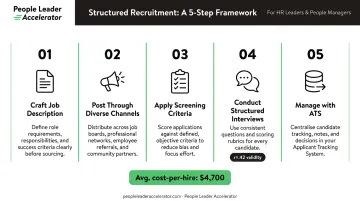
SHRM reports average cost-per-hire of nearly $4,700. That figure climbs significantly for senior roles — and doesn't account for lost productivity when positions remain unfilled. Consistency and fairness in selection criteria are non-negotiable for both quality outcomes and legal defensibility.
Onboarding
Onboarding integrates new hires into the organization. It spans orientation, role-specific training, equipment and systems access, manager check-ins, and culture immersion — typically running from day one through the end of the first year.
The decision window is narrow. BambooHR's 2023 research found 70% of new hires decided whether a job was a good fit within the first month — including 29% within the first week. First impressions formed during onboarding are rarely revised.
Effective onboarding programs typically include:
- Pre-boarding communications before day one
- Structured orientation covering culture, expectations, and team context
- A 30-60-90 day plan outlining role milestones and success metrics
- Regular manager check-ins at defined intervals
- Feedback mechanisms to catch early disengagement
CIPD's 2024 survey found 41% of organizations experienced new-hire resignations within 12 weeks. The mechanics of onboarding — clarity on expectations, early manager contact, and a defined 30-60-90 day plan — are what make the difference between a new hire who stays and one who starts job-hunting before their 90-day mark.
Training and Development
Training builds the skills employees need now. Development prepares them for what comes next. HR's responsibilities span both:
- Identifying skills gaps through performance data, manager input, and role analysis
- Designing or sourcing programs that address priority gaps
- Measuring training effectiveness through completion rates, performance changes, and manager feedback
ATD's 2025 State of the Industry Report found organizations averaged 13.7 formal learning hours and $1,054 direct expenditure per employee in 2024. Best-in-class learning organizations, per McKinsey, provide approximately 75 hours per employee annually and show higher promotion and retention levels.
With remote and hybrid work now standard, most organizations blend in-person and digital delivery — matching format to content type and learner context rather than defaulting to one mode.
Performance Management
The data on feedback frequency is striking. Gallup's research of 13,490 full-time U.S. employees found 80% of those receiving meaningful feedback in the preceding week were fully engaged — and daily feedback was associated with 3.6x greater motivation than annual feedback alone.
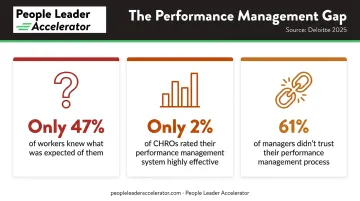
Those are significant gains. Yet most organizations haven't redesigned their processes to capture them. Deloitte's 2025 survey of nearly 10,000 leaders found:
- Only 47% of workers knew what was expected of them
- Only 2% of CHROs said their performance management system was highly effective
- 61% of managers couldn't say they trusted their performance management process
Common approaches include annual or biannual reviews, 360-degree feedback, and continuous check-in models. The most effective programs combine all three — using structured reviews for documentation while relying on regular feedback loops for real-time course correction.
Compensation and Benefits
Compensation and benefits management covers all elements of employee pay: salary benchmarking, payroll, health and retirement benefits, bonuses, and non-monetary perks. HR must benchmark compensation against market standards regularly to stay competitive.
The influence on employee decisions is significant. Gallup's research found 64% of employees rated a significant increase in income or benefits as very important when considering a new job. Pew Research found 63% of U.S. workers who quit in 2021 cited low pay as a factor.
Key process components:
- Regular market benchmarking against comparable roles and geographies
- Defined salary bands and pay equity reviews
- Total rewards communication — ensuring employees understand the full value of their package
- Annual review and adjustment cycles aligned to business performance
Base salary is still the primary driver — but the Gallup and Pew data make clear that flexibility, health benefits, and visible career paths now factor heavily into whether employees stay or leave.
Employee Relations and Compliance
When conflict goes unmanaged, the costs compound fast. Acas estimated workplace conflict costs UK organizations £28.5 billion annually — more than £1,000 per employee. In the U.S., the EEOC received 88,531 new discrimination charges in FY2024, securing nearly $700 million for over 21,000 victims.
Employee relations — covering conflict resolution, policy communication, workplace culture, and employee wellbeing — is where HR serves as both mediator and advocate. Getting it right keeps those numbers off the books.
Compliance is a distinct but interrelated layer. HR must ensure the organization adheres to:
- Applicable labor laws and employment regulations
- Tax obligations and reporting requirements
- Data privacy requirements (GDPR for UK/EU, state-level equivalents in the U.S.)
- Health and safety standards
For organizations operating across multiple states or jurisdictions, compliance complexity multiplies. Processes that work in one location may require significant adaptation in another.
How to Map and Document HR Processes
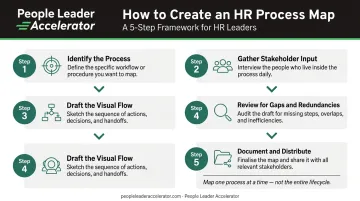
HR process mapping means visualizing the steps, roles, and decision points within each HR function using tools like flowcharts or swimlane diagrams. A clear process map creates a shared reference that improves cross-team coordination and makes inefficiencies visible.
Steps to Create an HR Process Map
- Identify the process — select one process to map at a time; don't attempt the entire lifecycle at once
- Gather stakeholder input — interview the people who actually execute the process; frontline input catches gaps that managers often miss
- Draft the visual flow — map each step, decision point, and handoff between roles or systems
- Review for gaps and redundancies — flag steps that add no value, pinpoint where errors tend to cluster, and identify handoffs with unclear ownership
- Document and distribute — store the final version somewhere the full team can access and update it
Why Documentation Pays Off
Process documentation delivers concrete operational value across the HR function:
- Provides defensible evidence of consistent practice during compliance audits
- Preserves institutional knowledge when HR staff turn over
- Helps new HR hires ramp faster than verbal knowledge transfer ever could
- Creates the foundation needed before any process can be automated
Best Practices for Managing HR Processes Effectively
Align Processes to Business Goals
Every core HR process should trace back to a specific business objective — whether that's workforce growth, retention improvement, or culture evolution. HR leaders should review processes against current strategic priorities at least annually. Setting them once and assuming they stay relevant is how HR gets caught flat-footed during organizational shifts.
Build Feedback Loops
Employees and managers are often the first to notice when a process creates friction. Build structured feedback mechanisms into key processes:
- Post-onboarding surveys at 30, 60, and 90 days
- Stay interviews to understand what's working before someone decides to leave
- Manager pulse checks on process usability
Act on the patterns. Feedback that isn't used quickly stops being provided.
Standardize Without Rigidity
Standardization is essential for consistency, but processes should accommodate legitimate variation. A global onboarding framework can have a consistent structure while allowing local adjustments for different legal requirements or cultural norms. The clearest way to manage this: define what must be consistent (the core steps) and what can flex (the delivery method or timeline).
Measure What Matters
Define specific KPIs for each HR process and track them consistently:
| Process | Example KPIs |
|---|---|
| Recruitment | Time-to-hire, offer acceptance rate |
| Onboarding | 90-day retention, time-to-productivity |
| Training & Development | Completion rate, skill assessment scores |
| Performance Management | Goal completion rate, review completion rate |
| Employee Relations | Conflict resolution time, EEOC complaint volume |
People analytics tools surface patterns that manual tracking misses. PLA's People Analytics guide covers how to identify which metrics drive the most value for your organization and how to build a dashboard that informs real decisions, not just reports data nobody acts on.
Scaling HR Processes in High-Growth Organizations
The processes that work for a 50-person company often collapse at 200 or 500 employees. In high-growth environments, HR leaders must design scalable processes ahead of demand — building structure before the chaos arrives, not after.
Common Scaling Failures
- Onboarding processes that worked when HR was personally involved in every new hire become bottlenecks at high volume
- Performance management that relied on managers "just knowing" their teams breaks down when span of control widens
- Compliance processes designed for one state become inadequate as the company expands geographically
Where to Start
Not all processes need to be formalized simultaneously. Prioritize based on business risk and impact:
- Recruitment and selection: Bad hires at scale are expensive and difficult to reverse
- Onboarding: Early disengagement compounds quickly when hiring volume is high
- Performance management: Inconsistent practices across a growing manager population create equity and retention problems
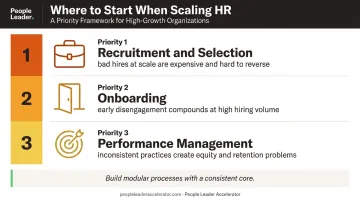
Build modular processes — ones with a consistent core that can be adapted for different teams, locations, or roles without being rebuilt from scratch each time.
Building on Proven Frameworks
People Leader Accelerator's programs draw directly from Scaling for Success: People Priorities for High Growth Organizations, co-authored by faculty member Andrew Bartlow — a resource built specifically for HR leaders in high-growth contexts, not adapted from generic management theory.
The curriculum covers how to build, manage, and evolve HR processes as organizations scale, taught by faculty who have led people functions at companies like Figma and served as the first VP of HR at multiple startups.
Frequently Asked Questions
What are the steps in the HR process?
Most HR processes follow the employee lifecycle sequence: workforce planning → recruitment and selection → onboarding → training and development → performance management → compensation and benefits → employee relations and offboarding.
What is the difference between HR processes and HR systems?
HR processes are the structured workflows that define how people operations are carried out (for example, how new hires are onboarded). HR systems — HRIS and HRMS platforms — store data and automate those workflows. Build strong processes first; the technology supports and scales them from there.
What is end-to-end HR process management?
End-to-end HR process management means HR takes ownership of designing, coordinating, and optimizing every step of a process from start to finish — ensuring nothing falls through the cracks as a workflow crosses teams, departments, or systems.
How can HR processes improve employee retention?
Well-designed HR processes create consistent, fair experiences at every lifecycle stage. Structured onboarding accelerates belonging, regular performance feedback supports growth, and competitive compensation signals the organization's investment in its people.
How do you measure the effectiveness of HR processes?
Define KPIs for each process — time-to-hire for recruitment, 90-day retention for onboarding, training completion rates for L&D — and track them over time. Comparing results before and after process changes shows what's working and where to improve.