
Introduction
HR leaders face a real tension right now. Organizations expect CHROs and CPOs to operate as true strategic partners — sitting at the executive table, shaping workforce strategy, influencing board decisions. At the same time, the daily operational demands of running an HR function have never been heavier.
The result? Most HR leaders end up doing neither job well.
Research from Gartner puts numbers to this squeeze: HR Business Partners spend nearly 19 hours per week handling employee issues and over 16 hours on daily operations — leaving just nine hours for strategic work. That's less than a quarter of the working week spent on what the business actually needs most from senior HR.
Organizations are responding with a distinct structural solution: the HR Chief Operating Officer. Rather than asking one person to lead both the strategy and the machine that executes it, they're separating the two — and it's reshaping how senior HR teams are built.
Key Takeaways
- The HR COO owns operational execution within HR — separate from the CHRO's strategic mandate
- When HRBPs spend just 9 hours per week on strategy, it signals a broken operating model — not a people problem
- Core scope includes HR service delivery, technology governance, process design, and change program coordination
- The HR COO is a force multiplier for the CHRO, not a replacement
- This role delivers the most value in large, complex, or rapidly scaling organizations
What Is an HR Chief Operating Officer?
The HR COO is a senior leadership role inside the HR function — responsible for the operational infrastructure that enables HR to deliver consistently at scale. The remit typically covers:
- HR service design and execution
- System implementation and governance
- Process standardization and compliance oversight
- Budget management
- Coordination of large-scale HR programs
Gartner published a formal HR Chief Operating Officer Job Description Template in January 2024 — a sign that the role has moved from informal experiment to recognized leadership construct. The foundational definition comes from Deloitte's Robin Lissak and Jason Geller, who describe the HR COO as the leader focused on how HR services are designed, developed, implemented, and delivered — with stated accountability for efficiency, effectiveness, cost, compliance, the HR budget, and HR technology.
How It Differs from VP HR Operations
The title difference matters. A VP of HR Operations or HR Director typically manages a team and a defined scope of services. The HR COO holds broader organizational authority — overseeing the full HR operating system across shared services, centers of excellence, and business-facing HR teams. In practice, the role appears most frequently in organizations large enough to run a shared services model, maintain multiple HRIS instances, or coordinate HR delivery across divisions and geographies.
Where the HR COO Sits
The HR COO reports to the CHRO or CPO — not to the company-wide COO or CFO. The role is scoped entirely to the HR function's internal operations, not the broader enterprise operating model. Real-world examples confirm the structure:
- HSBC's HR COO (Lynsey Unsworth) oversees HR financial plans, forecasting, controls, risk governance, and service performance
- M&G plc's HR COO (Pete O'Rourke) sits on the HR Leadership Team, reporting directly to the Chief People Officer
- Intuit's COO for People and Places (Christine Martino) managed cross-functional people strategy execution across a 300+ person organization with a $300M budget
Why the HR COO Role Is Emerging Now
Several forces have converged to make this role more necessary than it was five years ago.
The HRBP Capacity Problem
When HR Business Partners spend the majority of their week on operational and transactional work, the strategic support business units are asking for doesn't happen. This isn't a competency failure — it's a structural one. Without a dedicated operational layer managing the delivery infrastructure, HRBPs absorb the operational burden by default.
Technology Complexity Has Outgrown Generalist Expertise
A 2024 Gartner survey found that 38% of HR leaders were already piloting, planning, or implementing generative AI — up from just 19% in mid-2023. Yet in a separate study, only 24% of HR employees said their function was getting maximum value from HR technology.
That gap between adoption and actual value extraction is a governance problem. Someone needs to own the HRIS ecosystem, manage vendor relationships, drive implementation quality, and ensure data integrity — work that requires dedicated operational leadership, not periodic attention from a strategically focused CHRO.
Organizational Complexity Is Accelerating
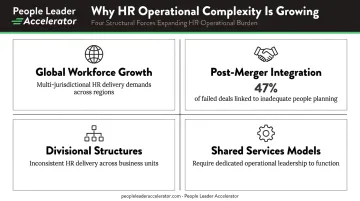
Technology governance is only part of the picture. Several structural trends are also expanding the operational burden HR must carry:
- Growth in global workforces requiring multi-jurisdictional HR delivery
- Post-merger integration, where Mercer research identifies inadequate people planning as a factor in 47% of failed deals
- Divisional structures where HR must deliver consistently across multiple business units with different needs
- Shared services models that require dedicated operational leadership to function well
The Post-Pandemic Baseline Has Shifted
Each of those structural pressures intensified after 2020. Hybrid work models, workforce policy volatility, and accelerated digital transformation have added permanent operational complexity to HR functions. Organizations that absorbed this complexity by overloading CHROs and HRBPs are now recognizing that the fix needs to be structural, not personal.
Key Responsibilities of an HR COO
Operational Infrastructure and Service Delivery
The HR COO owns the "how" of HR delivery — ensuring that payroll, benefits administration, onboarding, compliance, and employee services are delivered consistently, efficiently, and at the right cost level across all business units.
A key principle here is fit for purpose: the goal is not to build gold-plated systems that exceed what the business needs, but to match service quality to what each unit actually requires. Over-engineering frustrates stakeholders and burns budget. Under-delivering damages credibility. The HR COO's job is to find and hold that balance.
Core services under this remit include:
- Payroll and benefits administration
- Employee onboarding programs
- Compliance and policy management
- Shared services and HR help desk operations
- Cross-business unit service consistency
HR Technology and Process Optimization
HR COO ownership of the HRIS ecosystem spans:
- Vendor evaluation and selection
- System implementation and configuration
- Data governance and integrity standards
- Ongoing optimization and user adoption
- Integration across HR technology tools (payroll, ATS, performance, analytics)
Alongside technology, the HR COO drives process standardization across the HR function. Consistent processes give HR Business Partners a stable, uniform operational foundation — which means they can engage business units with a confident, unified voice rather than working around fragmented or inconsistent HR delivery.
Change Program Coordination
HR functions routinely run multiple improvement programs simultaneously — shared services redesigns, technology implementations, policy updates, talent process overhauls. Without coordination, these initiatives collide, exhaust stakeholders, and fragment the perception of HR effectiveness.
The HR COO manages the overall change portfolio across three core dimensions:
- Sequencing: prioritizing initiatives so the function doesn't pursue five things at once
- Resource conflict resolution: ensuring programs don't compete for the same people and budget
- Change absorption: pacing transformation so the organization can keep up
This work is less visible than strategy, yet it's what keeps HR credible while transformation is underway.
HR COO vs. CHRO and Other HR Leadership Roles
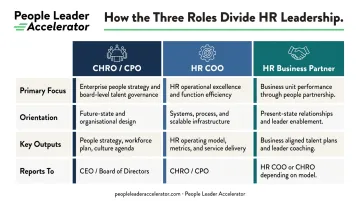
The clearest way to frame the distinction is this: the CHRO focuses on the what — HR strategy, workforce planning, culture, organizational design, and board-level people priorities. The HR COO focuses on the how — executing that strategy reliably, efficiently, and at scale across the whole HR function.
| Dimension | CHRO / CPO | HR COO | HR Business Partner |
|---|---|---|---|
| Primary focus | Enterprise people strategy | HR operational execution | Business unit support |
| Orientation | External (board, CEO, business) | Internal (HR function itself) | External (business units) |
| Key outputs | Strategic direction, culture, org design | Service quality, process standards, tech governance | Business-aligned people solutions |
| Reports to | CEO | CHRO / CPO | CHRO or business leader |
Current CHRO postings still frequently list operational skills as requirements. Deloitte's 2025 analysis found that 54% of CHRO job postings requested business-operations skills, and the number of unique skills expected of CHROs has grown 23% over five years. The HR COO doesn't eliminate operational demands from the CHRO role entirely — but absorbing the heaviest operational responsibilities creates real capacity for the CHRO to prioritize board engagement and organizational strategy.
That freed-up capacity also reshapes how the rest of the HR function operates — particularly for HR Business Partners. Where the HR COO is internally focused on making the HR function run well, the HR BP is externally focused on business unit needs. A strong HR COO gives HR BPs better tools, cleaner processes, and consistent service standards — so they spend less time troubleshooting HR operations and more time solving the business problems they're actually hired to address.
Signs Your Organization Is Ready for an HR COO
No research has established a reliable headcount threshold for creating this role. What matters more is organizational complexity and the nature of the operational burden.
Organizations most likely to benefit:
- Large enterprises with divisional, multi-country, or matrix structures
- Organizations post-merger or mid-integration, where HR delivery needs to be unified across legacy systems
- High-growth companies scaling rapidly, where operational infrastructure hasn't kept pace with headcount
- Any organization where the CHRO is consistently being pulled into operational firefighting
Concrete signals to watch for:
- HR service delivery is inconsistent across business units
- HRBPs report that the majority of their time goes to transactional work
- The HR function is running multiple disconnected improvement programs simultaneously
- The CHRO doesn't have enough bandwidth to participate meaningfully in executive strategy conversations
- HR technology implementations keep stalling or underdelivering
Below a certain scale, a dedicated COO-level HR role isn't justified. Operational leadership can be embedded within an HR Director or Senior HR Operations Manager. Once the organization spans multiple divisions, geographies, or large shared services operations, a dedicated position with real authority is the more sustainable answer.
Skills and Competencies That Define a Successful HR COO
The HR COO requires a different leadership archetype from the typical CHRO or HR Business Partner. Where those roles lean toward relationship-building and strategic influence, the HR COO is execution-oriented, systems-thinking, and comfortable managing complexity at scale.
Core competencies:
- Runs large, multi-workstream HR programs with governance structures and clear accountability
- Navigates HRIS ecosystems, vendor management, data governance, and system integration
- Maps, standardizes, and optimizes HR processes at scale — frameworks like Six Sigma apply directly here
- Builds business cases, manages HR budgets, and makes cost-versus-quality trade-offs that hold up under scrutiny
- Coordinates across HR centers of excellence, shared services, and business-facing teams without direct authority over all of them
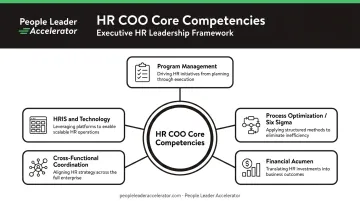
These competencies rarely develop through a standard HR career path. Progressing through HRBP roles, COE specialisms, or generalist management doesn't reliably build the operational and systems fluency this role demands.
HR professionals who aspire to senior operational leadership often need to deliberately build capabilities their career history hasn't required. People Leader Accelerator — led by faculty with Six Sigma certification, 25+ years of practitioner experience, and backgrounds in high-growth tech and private equity — gives HR leaders the operational and strategic frameworks to close that gap.
Frequently Asked Questions
Does the HR chief report to the COO or the CFO?
The CHRO or CPO typically reports directly to the CEO. In some organizations, they may report to the COO instead. The HR COO — a role inside the HR function — reports to the CHRO or CPO, not to the company-wide COO or CFO.
What is the average salary for a COO?
COO compensation varies significantly by company size, industry, and geography. For current benchmarks, consult resources like the Bureau of Labor Statistics, LinkedIn Salary, or Glassdoor, which provide regularly updated figures by industry and location.
What is the average salary for an HR chief?
Equilar reported $2.8M median total compensation for top HR executives in large public companies in 2025. For broader benchmarks across company sizes, consult SHRM, Radford (Aon), or Mercer — all of which publish updated compensation data for senior HR roles.
What is the difference between an HR COO and a CHRO?
The CHRO sets HR strategy and represents the people function at the executive and board level. The HR COO manages the operational execution of that strategy — service delivery, technology governance, process design, and change coordination. The roles are complementary, not interchangeable.
What size company typically needs an HR COO?
The role is most common in large enterprises with divisional or international structures, or in high-growth organizations scaling rapidly. Smaller organizations typically embed this responsibility within a senior HR operations leader rather than a distinct C-suite position.
What skills are most important for an HR COO?
Operational program management, HR technology expertise, process optimization (Six Sigma frameworks are particularly relevant), financial acumen, and the ability to coordinate across HR centers of excellence and business-facing teams are the core requirements.