
An HR mission statement closes that gap. It's a concise declaration of what your HR function does, how it operates, and why it matters — a compass for daily decisions and long-term strategy alike.
This article covers what an HR mission statement actually is (and how it differs from a company mission or vision), 10 examples drawn from real companies and illustrative scenarios, what separates strong statements from generic ones, and a five-step process for writing your own.
Key Takeaways
- An HR mission statement defines your people function's purpose, values, and direction — distinct from the broader company mission
- Strong statements are concise (1–3 sentences), jargon-free, and specific enough to reflect your culture
- Real-world examples reveal tone, structure, and focus — use them as reference, not templates
- Writing your own requires stakeholder input, honest self-assessment, and periodic revisiting as the organization grows
What Is an HR Mission Statement?
According to AIHR's definition, an HR mission statement is a "short, clear summary of an organization's human resources department's purpose and aspirations." It describes what the department is doing now — not where it hopes to be someday.
That present-tense focus is what separates a mission from a vision.
Mission vs. Vision
- Mission: Current purpose and practice — what HR does today and why
- Vision: The future state HR is working toward — the aspirational destination
Conflating them produces statements that sound inspiring without actually guiding decisions. An HR mission should be practical enough to inform a hiring policy or a performance review process.
HR Mission vs. Company Mission
These serve different audiences and different purposes:
| Statement Type | Focus | Audience |
|---|---|---|
| Company mission | The organization's purpose and value to customers | Customers, investors, public |
| HR mission | How the people function supports employees and organizational success | Employees, candidates, HR team |
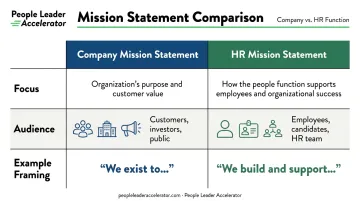
The two should align — but they're not interchangeable. Your company might exist "to accelerate the world's transition to sustainable energy." Your HR function exists to build the team and culture that makes that possible.
10 HR Mission Statement Examples
None of the companies below have published a document explicitly labeled "HR mission statement." What they have published are people philosophies, culture principles, and people-team operating beliefs — the building blocks from which an HR mission is derived. As you read through each example, pay attention to three things: how specific the language is, who the intended audience appears to be, and whether the statement could belong to any company or only to that one.
Google's People Operations philosophy, documented through Google re:Work, centers on: "Make work better." The broader framing: "When you put employees first, build trust and respect, and let data inform HR decisions, you can create a successful environment for your teams."
What works: Three words carry enormous weight. "Make work better" is directional without being prescriptive — it applies across hiring, development, and culture. The data-informed qualifier signals a commitment to evidence over gut instinct, which differentiates Google's approach from feel-good HR rhetoric.
Microsoft
Microsoft HR describes its role as: "An important driver of organizational culture at Microsoft, helping our employees thrive in a growth mindset culture with a focus on being customer-centered, diverse and inclusive, and unified as One Microsoft."
What works: It positions HR as a culture driver, not a support function. The explicit reference to growth mindset connects directly to the company's identity under Satya Nadella. HR's mission and the broader business mission are visibly aligned.
Adobe
Adobe's people philosophy centers on Adobe for All: "Our belief in creating a company culture where all employees are empowered to make an impact. When people are respected and included, they are more creative, innovative and successful."
What works: The cause-and-effect structure is smart — inclusion leads to creativity leads to business results. It's not just an aspiration; it's an argument. That logical chain makes the statement more credible than a standalone commitment to "diversity and belonging."
Patagonia
Patagonia's people principle: "We aspire to be a company where people from all backgrounds, identities and experiences have the power to contribute and lead."
What works: Patagonia's HR identity is inseparable from its environmental mission. Their 2022 ownership transfer explicitly framed employees as central to protecting that mission.
For HR leaders in purpose-driven organizations, the takeaway is direct: your people statement should reflect what the company actually stands for — not just HR's functional role.
Netflix
Netflix's people philosophy, from their Culture Memo: "Our goal is to inspire and empower more than manage because employees have more impact when they're free to make decisions about their own work."
Their talent density framing: "We aim only to have high performers at Netflix — people who are great at what they do, and even better at working together."
What works: Netflix makes explicit trade-offs. This isn't a statement for every organization — it's unapologetically selective. The directness attracts the right candidates and repels the wrong ones. That's exactly what a well-crafted HR identity should do.
Salesforce
Salesforce's Ohana-rooted people philosophy: "At Salesforce, equality is a core and longstanding value. We are committed to creating equal opportunities for everyone, ensuring equal pay for equal work, and supporting the dignity of every person." Their Ohana concept prioritizes "collaboration, inclusivity, and the well-being of every individual."
What works: The Ohana (family) concept gives Salesforce's HR identity a cultural anchor specific to the company. "Dignity" is a stronger word than "respect" — it implies a higher standard of care. The commitment to equal pay adds operational specificity most HR statements avoid.
HubSpot
HubSpot's Culture Code — which "guides how we build, hire, and lead" — centers on transparency and autonomy: "They have complete autonomy and we trust them to drive results regardless of their work-life fit or schedule."
What works: HubSpot's people principles read like a contract between company and employee — specific enough to make hiring decisions against, credible enough to test in practice. The tone is direct, warm, and anti-bureaucratic. Candidates know what they're walking into before they apply.
High-Growth Tech Startup (Illustrative Example)
"To attract, develop, and retain exceptional people who are empowered to build the company we all want to work for."
What works: Brevity, employee-centricity, and growth orientation in a single sentence. The phrase "we all want to work for" positions employees as co-creators of the culture — not just recipients of HR programs. Well-suited for Series A–C environments where the culture is still being defined.
Purpose-Driven Enterprise HR Department (Illustrative Example)
"To build an inclusive, high-performance organization by partnering with business leaders to develop talent, uphold our values, and create an environment where every employee can do their best work."
What works: "Partnering with business leaders" signals strategic intent, not administrative support. The breadth of scope — talent development, values, environment — reflects an enterprise HR function with multiple stakeholders. Appropriate for organizations where HR touches every business unit.
People Operations Team at a PE-Backed Company (Illustrative Example)
"To build people systems and a culture that accelerate business performance, attract top talent, and ensure every hire contributes to our mission from day one."
What works: This one doesn't soft-pedal accountability. "Accelerate business performance" and "every hire contributes from day one" reflect the urgency of PE-backed environments, where headcount decisions are tied directly to return on investment. HR leaders seeking board-level credibility need language that treats headcount as a business lever, not a cost line.
What Makes a Great HR Mission Statement?
The gap between a generic HR statement and an effective one comes down to specificity and honesty.
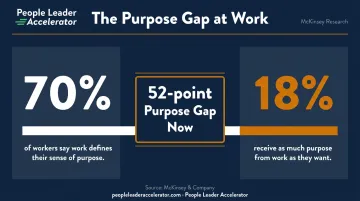
McKinsey's research on organizational purpose found that among 1,021 US workers surveyed, 70% said work defines their sense of purpose — but only 18% received as much purpose from work as they wanted. That gap isn't closed by posting a mission statement. A well-crafted, operationally embedded one, however, creates the conditions for it to narrow. That's what the qualities below are designed to produce.
Qualities of a Strong Statement
- Fits in 1–3 sentences — if you can't recall it, you won't use it
- Avoids jargon like "synergies," "ecosystems," or "holistic approaches"
- Reflects how your HR team actually makes decisions, not how it aspires to sound
- Reads as distinctly yours, not interchangeable with any other organization
- Frames HR as a business driver, not an administrative layer
What to Avoid
- "We value our people" — This applies to every HR department everywhere. It says nothing.
- Naming every HR function (recruiting, compliance, L&D, benefits...) results in a job description, not a mission
- Aspirational language that doesn't match actual HR behavior — HBR notes that vague, grandiose statements erode trust rather than build engagement
The test: could your statement appear on a competitor's careers page without anyone noticing? If yes, revise.
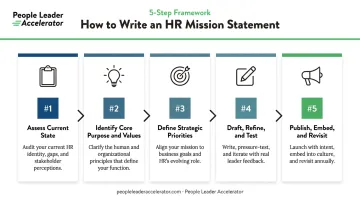
How to Write Your HR Mission Statement in 5 Steps
Step 1: Assess Your Current State
Before writing anything, audit where HR actually stands. What does your team do day-to-day? How do employees describe HR when you're not in the room? How do senior leaders perceive the function's value?
This honest baseline prevents the most common failure mode: a statement that describes the HR department you wish you had, not the one that exists. Aspirational language without operational backing erodes credibility fast.
Step 2: Identify Your Core Purpose and Values
Run a stakeholder workshop with HR team members, two or three senior leaders, and representatives from other departments. Three questions worth anchoring the conversation around:
- Why does HR exist here beyond compliance?
- What would be lost if the HR function disappeared?
- What values actually guide how we treat people — not what we say, but what we do?
Aim to align on 3–5 foundational principles before drafting anything. For HR leaders who want a structured framework for this work, our free Connecting HR to the Business guide addresses how to reframe HR's core purpose, separating transactional outputs from genuine strategic contribution. Our Strategic People Planning Resource Package includes a "Role of a Strategic HR Leader" matrix that's particularly useful for this step.
Step 3: Define Your Strategic Priorities
Connect HR's purpose to what the business actually needs over the next 12–24 months. Where does HR have the highest leverage on business outcomes — talent acquisition velocity, culture cohesion through rapid scaling, leadership bench strength, organizational design?
The statement doesn't need to name all of these — it should reflect where HR's energy is concentrated, not just describe HR's existence.
Step 4: Draft, Refine, and Test
Write 2–3 versions at different lengths:
- One sentence
- Two sentences
- A short paragraph (3–4 sentences)
Then test them with a small cross-functional group. Ask: after reading this, do you understand what HR stands for here? Does it feel authentic or generic? Would this help you make a decision about how to handle a people issue?
Revise based on what confuses or falls flat. The short version usually wins — brevity forces clarity.
Step 5: Publish, Embed, and Revisit
Once finalized, the statement earns its value through consistent placement:
- Employee handbook
- Careers page and job postings
- New hire onboarding materials
- Internal HR communications and team pages
Set a calendar reminder to review it annually, or sooner when something significant changes: a new CEO, an acquisition, a major headcount shift, or a deliberate culture reset. The statement shouldn't be permanent. It should be current.
Frequently Asked Questions
What is the mission of HR?
HR's mission is to attract, develop, and retain talent while building a work environment that supports both employee wellbeing and organizational performance. The way that mission gets expressed varies based on company size, culture, and strategic priorities.
What is a good HR mission statement?
A good HR mission statement is clear, concise (1–3 sentences), free of jargon, and authentically reflects the organization's values and strategic direction. It should be distinctive enough that it couldn't be lifted from another company's handbook without anyone noticing.
How long should an HR mission statement be?
Most effective HR mission statements are 1–3 sentences. If the team can't recite it from memory, it won't guide day-to-day behavior — keep it short enough to stick.
What is the difference between an HR mission statement and a company mission statement?
A company mission statement speaks to the entire organization's purpose and its relationship with customers or stakeholders. An HR mission statement narrows focus to the people function, defining how HR supports employees and enables the broader company mission.
How often should you review and update your HR mission statement?
Plan for an annual review tied to strategic planning cycles. Trigger an earlier review when something significant changes: rapid growth, a merger, a leadership transition, or a major shift in company culture or direction.