An HR organizational chart is designed to solve exactly that problem. But results vary widely. A chart built for a 50-person startup looks nothing like one designed for a 2,000-person enterprise — and structure type, functional scope, and whether the chart is actually kept current all determine how much strategic value it delivers.
This article covers what an HR org chart is, which roles and functions to include, the most common structure types, and a step-by-step process for building one that scales.
TL;DR
- An HR org chart is a visual diagram of the HR department's internal structure — showing roles, reporting lines, and functional ownership.
- The right structure depends on your organization's size, complexity, and growth stage; no single model fits all.
- Core HR functions must be assigned to specific roles before the chart can be built.
- Common structures include functional, hierarchical, HRBP, matrix, and flat models — choose based on your team's needs.
- An HR org chart is only as useful as it is current — update it as roles and structures evolve.
What Is an HR Organizational Chart and Why Does It Matter?
An HR organizational chart is a visual diagram that maps the HR department's internal structure — individual roles, reporting relationships, and functional ownership. It clarifies not just who does what, but how HR is organized to support the broader business.
The practical benefits are real:
- Role clarity — employees and managers know exactly who to go to for recruiting, benefits, or employee relations questions
- Gap identification — leaders can see where functions are under-resourced or where ownership is unclear
- Onboarding support — new HR team members orient faster when structure is visible
- Strategic planning input — a current chart supports headcount planning and organizational design decisions
When connected to actual workforce data, an HR org chart becomes more than a reference poster: it functions as a planning tool that helps HR leaders make the case for headcount, restructuring, or new capability investments.
CIPD research found that 84% of HR functions had restructured, were restructuring, or planned to restructure in the prior two years. That rate of change makes a documented, current org chart more valuable — not less.
Key HR Functions and Roles Every HR Org Chart Should Include
Core Functions to Map
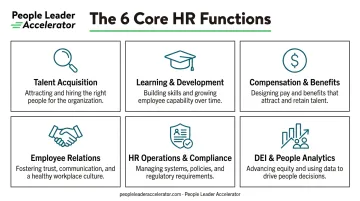
Before building any chart, the organization must decide which HR functions it needs to own internally. SHRM's Body of Applied Skills and Knowledge identifies 14 HR knowledge domains — but for most organizations, the practical starting point is six core functions:
- Talent Acquisition — recruiting, sourcing, and employer branding
- Learning & Development — training programs, leadership development, and career pathing
- Compensation & Benefits — total rewards design, pay equity, and benefits administration
- Employee Relations — performance management, conflict resolution, and policy enforcement
- HR Operations & Compliance — HRIS administration, employment law, and workforce data
- DEI and People Analytics — typically added once headcount exceeds 500, but worth accounting for in your structure early
Not every function needs a dedicated team or specialist from day one. According to SHRM's 2025 benchmarking data, 46% of organizations manage all HR functions internally, while among those that outsource, the most common areas are HR technology (24%), recruiting (22%), and L&D (19%).
Key Leadership Roles
The roles that anchor an HR org chart depend on company size, but the core hierarchy typically includes:
- CHRO or VP of HR — strategic oversight, executive team representation
- HR Director — policy, operations, day-to-day team leadership
- HR Business Partner (HRBP) — embedded advisory support to specific business units
- Recruiting Director — talent pipeline ownership and TA team leadership
Whether those roles are generalists or specialists depends on where you are in the growth curve. Generalists handle multiple HR domains — recruiting, compensation, benefits, training — making them the practical backbone of lean teams. As headcount grows, specialist roles emerge and the chart gains depth.
The HR-to-Employee Ratio
How many HR roles does your chart need to account for? SHRM's 2025 CHRO Benchmarking Brief reports a median of 1.98 HR staff per 100 employees across U.S. organizations — though this varies significantly by industry (professional services firms reported 2.78 per 100). This isn't a universal prescription; industry, outsourcing decisions, and HR technology all affect the actual number.
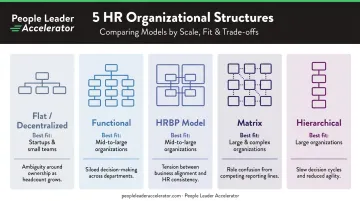
Types of HR Organizational Structures
Functional Structure
The most common model. HR professionals are grouped by specialty — a recruiting team, a comp and benefits team, an L&D team — each with its own lead. Works well in mid-to-large organizations that benefit from deep role specialization. Functional silos are the main risk, making cross-HR coordination harder than it needs to be.
Hierarchical Structure
A top-down chain of command from CHRO or VP of HR down through directors, managers, and individual contributors. Provides clear accountability and decision-making authority. Too many approval layers, though, slow HR's responsiveness when the business needs a fast answer.
HR Business Partner (HRBP) Model
HRBPs are HR professionals embedded within specific business units, acting as strategic advisors while drawing on a centralized HR function for specialist support. McKinsey's 2025 research found that more than three-quarters of HR functions still organize around the classic Ulrich model — which is the foundation the HRBP structure is built on. It aligns HR closely with operational needs, but requires clear role boundaries to prevent HRBPs from getting pulled into transactional work rather than strategic advisory work.
Matrix Structure
HR employees report to both a functional HR leader and a business-unit leader. Suits large, complex organizations that need cross-functional flexibility. Unclear dual-reporting lines are the central risk: without explicit ownership, accountability gaps form and erode team effectiveness over time.
Flat or Decentralized Structure
Common in startups and early-stage companies, where one or two HR professionals cover all functions with minimal management layers. Enables fast decisions without approval chains — but what works at 40 people becomes a bottleneck at 150 if the structure doesn't evolve with headcount.
How to Create Your HR Organizational Chart: A Step-by-Step Guide
Step 1: Define Your Core HR Functions
Identify which HR functions your organization needs to own internally versus outsource. This step determines the scope of the chart — you can only map roles and reporting lines once you know what work needs to be done. Payroll is commonly outsourced in smaller businesses; recruiting and L&D are the next most frequent candidates.
Step 2: Collect HR Staff Details
Gather the following for each HR team member:
- Full name and current job title
- Primary function or area of ownership
- Reporting manager
- Whether the role is filled or open
This step often surfaces problems: unclear ownership, overlapping responsibilities, or gaps between what the org chart says and what people actually do. Resolve those before moving on.
Step 3: Choose the Right Structure Type
Match your structure to your organization's current size, complexity, and growth trajectory (see the structure types above). Most organizations start with a functional or flat structure and evolve toward a hybrid or HRBP model as they grow. Choose a structure that reflects how work actually gets done, not one that simply looks tidy on paper.
Step 4: Build and Visualize the Chart
Practical options by maturity level:
| Tool Type | Best For | Trade-offs |
|---|---|---|
| Spreadsheet (Excel, Google Sheets) | Early-stage, small teams | Limited visual flexibility |
| Design tools (Lucidchart, Visio) | Mid-size, dynamic layouts | Requires manual updates |
| HRIS auto-generated charts | Larger organizations | Requires accurate HRIS data |
Whatever tool you choose, prioritize one that allows easy edits, because roles will change.
Step 5: Make It Accessible and Establish an Update Cadence
Publish the chart somewhere employees can actually find it — the company intranet, onboarding materials, or the employee handbook. Accessibility matters, but so does keeping it current:
- Assign ownership — one named HR team member is responsible for keeping the chart current
- Set a review cadence — quarterly reviews at minimum, plus updates triggered by any significant role change
- Don't treat it as a finished artifact — the chart should reflect reality, not a past state
How Your HR Structure Should Evolve by Company Size
Small Businesses and Startups (Under 100 Employees)
HR is typically one person: an HR Manager or Director handling everything from recruiting to compliance. The org chart is simple — one leader at the top, possibly one coordinator below, with payroll often outsourced.
The priority at this stage isn't specialization. It's role clarity and enough structure to scale without friction.
Carmela Krantz, a core faculty member at People Leader Accelerator who has served as the first VP of HR at nine companies including six startups, knows this challenge well. Building HR from scratch in an early-stage company means creating structure before the company outgrows the absence of it.
Mid-Sized Companies (100–999 Employees)
As headcount climbs, HR begins to specialize. Dedicated roles emerge for recruiting, employee relations, and comp and benefits. A mid-size HR structure typically looks like this:
- VP of HR or HR Director at the top
- Recruiting Manager leading a small TA team
- Compensation and Benefits Manager owning total rewards
- HR Generalists supporting multiple business units
- HR Coordinator handling administrative and operational tasks
Large Enterprises (1,000+ Employees)
HR structures become complex, with distinct functions operating semi-independently under centralized leadership. At this scale, the structure commonly includes:
- CHRO with strategic ownership
- Multiple VPs or Directors over distinct functions
- HR Business Partners aligned to individual business units
- Centers of Excellence (COEs) for L&D, DEI, People Analytics, and HRIS
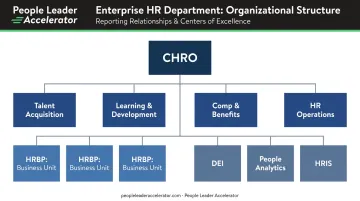
At this scale, the org chart evolves from a reference tool into a strategic input for workforce planning, governance design, and finance alignment. Without clear dual-reporting lines and defined cross-functional coordination, decisions stall and accountability gaps emerge — both costly problems for a CHRO trying to operate as a true business partner.
Common Mistakes When Building an HR Org Chart
1. No room for growth built in
A chart that accurately reflects your current headcount but can't accommodate growth will require a full overhaul every time the company hires significantly. Build in a view of planned or open roles, and choose a structure type that can evolve.
2. Dual-reporting lines left ungoverned
Matrix and HRBP structures create real value — but only when dual-reporting arrangements are explicitly governed. Every role on the chart should have a clearly defined primary manager for performance reviews, budget decisions, and escalation paths. Ambiguity here creates accountability gaps that erode trust.
3. Building it once and walking away
This is the most common failure. A chart built once and never updated stops reflecting reality within months. It erodes employee confidence, creates confusion about who to contact, and limits the chart's value as a planning tool.
Assign ownership and build chart reviews into the HR team's operating calendar. Treat it as a responsive, ongoing practice — not a once-a-year checkbox.
Frequently Asked Questions
What is the organizational structure of HR?
HR departments are typically organized around core functions — recruiting, L&D, comp and benefits, employee relations, and HR operations — with a leadership hierarchy running from CHRO or VP of HR down through directors, managers, generalists, and specialists. The specific structure depends on company size, industry, and whether any functions are outsourced.
What are the main roles in an HR department?
HR roles fall into three tiers: leadership (CHRO, VP of HR, HR Directors), mid-level (HR Business Partners, Recruiting Managers, Compensation and Benefits Managers), and operational (HR Generalists, Recruiters, HR Coordinators, and Specialists). Which roles exist depends on team size and organizational complexity.
How many HR employees do you need per 100 employees?
According to SHRM's 2025 CHRO Benchmarking Brief, the current U.S. median is 1.98 HR staff per 100 employees — though this varies by industry, outsourcing decisions, and HR technology adoption.
What is the difference between a functional and matrix HR structure?
A functional structure groups HR professionals by specialty (recruiting, compensation, etc.), each reporting to their functional lead. A matrix structure adds a second reporting line to a business-unit leader — improving operational alignment but introducing dual-reporting complexity that requires clear governance to manage.
When should you update or restructure your HR org chart?
Update the chart whenever a significant role change occurs — new hire, departure, promotion, or reorg — and review it formally at least quarterly. A structural overhaul is warranted when the company enters a new growth stage, completes a merger or acquisition, or shifts its HR operating model.
What should a small business HR org chart look like?
A simple, flat structure: an HR Manager or HR Director at the top, one or two specialists or coordinators reporting to them, and functions like payroll often outsourced. At this stage, clarity and flexibility matter more than specialization. The goal is a structure that can grow without breaking.
Conclusion
A well-designed HR organizational chart does more than show reporting lines. It creates role clarity, surfaces structural gaps, supports workforce planning, and gives HR leaders the foundation to operate strategically rather than reactively. The right structure varies by company size, growth stage, and operational complexity — but clear ownership, defined reporting lines, and regular updates apply regardless of your organization's size or stage.
HR and people leaders looking to build the strategic frameworks behind high-performing functions — especially in high-growth environments — can find practitioner-led programs at People Leader Accelerator. Faculty include HR leaders who have built people functions from scratch at startups and scale-ups, and co-authored Scaling for Success: People Priorities for High Growth Organizations.