That requirement is real. But what counts as qualifying experience is far broader than most career changers realize. Hiring managers at SHRM have documented that people regularly enter HR from administrative, finance, and operations roles after gradually taking on HR-related duties. The work was already there. The framing wasn't.
This guide covers what actually counts as HR experience, which transferable skills matter most, how to build a credible HR profile without a formal title, and which entry-level roles give career changers the best shot at landing their first position.
Key Takeaways
- HR spans 7 core activity areas — and experience in any of them counts, regardless of your job title
- Skills like conflict resolution, data analysis, and process management map directly to HR competencies
- Volunteering for HR-adjacent work, structured learning, and community networking are the fastest credibility-builders
- Resume framing matters as much as experience — HR language changes how recruiters read the same work history
- HR coordinator and recruiting coordinator roles are the most accessible entry points for career changers
What Actually Counts as HR Experience
"HR experience" doesn't mean you had HR in your title. Work involving hiring support, onboarding coordination, conflict resolution, compliance tracking, benefits administration, training facilitation, or employee engagement all counts — as long as you frame it correctly.
The 7 Core HR Activity Areas
These seven areas consolidate the functional domains recognized across major HR frameworks, including SHRM's Body of Applied Skills and Knowledge. Audit your own background against each:
| HR Activity Area | What It Covers | Non-HR Example |
|---|---|---|
| Recruitment & Staffing | Sourcing, interviewing, offer management | Scheduling interviews for your manager |
| Compensation & Benefits | Pay structures, benefits administration | Coordinating open enrollment paperwork |
| Training & Development | Learning programs, onboarding, facilitation | Running new hire orientation for your team |
| Employee Relations | Conflict resolution, performance management | Mediating a team dispute or coaching a peer |
| Compliance & Administration | Records management, policy documentation | Maintaining employee files per company policy |
| Workforce Planning | Headcount forecasting, org design | Supporting a reorg or helping hire for gaps |
| HR Technology & Systems | HRIS, reporting, data management | Running reports in an HR or ops system |
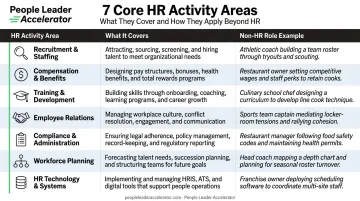
Most people coming from adjacent roles have touched at least two or three of these areas without realizing it qualifies. The next step is translating that work into language hiring managers recognize.
What Hiring Managers Count as Valid Experience
SHRM notes that people commonly move into HR from administrative, business development, and finance roles where they gradually assumed HR duties. Some hiring managers still screen by title first — which means the translation work falls entirely on you.
The difference framing makes is real. Consider these two ways to describe the same task:
- ❌ "Kept employee files organized"
- ✅ "Maintained confidential personnel records in compliance with company policy and applicable privacy requirements"
Same work. Very different signal. Review your past job descriptions and rewrite every duty that maps to one of the seven activity areas above using HR-aligned language. That reframe is what turns invisible experience into a credible HR background.
The Transferable Skills HR Hiring Managers Value Most
Hiring managers screening career-changers aren't just looking for HR titles — they're looking for proof that you can handle people problems, work with data, and operate with discretion. The good news: most of those skills are already on your resume. You just need to know how to frame them.
People-First Skills That Translate Directly
These soft skills appear in almost every HR job description — and they're routinely developed outside HR roles:
- Active listening and empathy — essential for employee relations, conflict resolution, and investigations; developed in customer service, teaching, counseling, or management.
- Discretion and confidentiality — HR handles sensitive information daily; administrative, legal, and healthcare support roles build exactly this kind of judgment.
- Clear written and verbal communication — from policy writing to difficult conversations, this skill transfers directly from any client-facing, documentation-heavy, or leadership role.
Analytical and Operational Skills That Give You an Edge
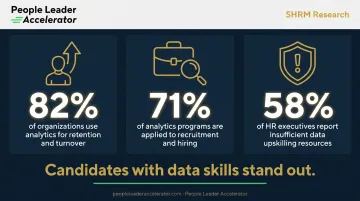
Data literacy is increasingly what separates candidates in HR hiring. SHRM research surveying 2,149 HR professionals found that among organizations using people analytics, 82% applied it to retention and turnover and 71% to recruitment and hiring. Yet 58% of HR executives reported insufficient resources to upskill their teams in data skills — which means candidates who arrive with this capability stand out.
That skills gap extends to the broader operational side of HR. These capabilities are consistently sought in coordinator and people operations roles:
- Project management and process documentation
- Compliance tracking and records administration
- Familiarity with HRIS or operations systems
- Reporting, metric interpretation, and spreadsheet fluency
Candidates from finance, operations, or tech backgrounds have a natural edge here. Name them explicitly in your application — a vague bullet about "cross-functional collaboration" won't do the work for you.
How to Build Credible HR Experience Without a Formal Title
Think of this as a 6–18 month runway. The goal is to produce verifiable HR work — deliverables, projects, and outcomes — before you ever have an HR title.
Volunteer for HR-Adjacent Work Now
If you're currently employed, this is the most practical path. Volunteer for:
- Culture or employee engagement initiatives
- New hire onboarding coordination
- Training facilitation or lunch-and-learn logistics
- Employee survey design or analysis
- Serving as an HR liaison for your team
SHRM specifically recommends becoming a department HR liaison for engagement or well-being work, creating a culture handbook, or proposing a temporary "tour of duty" in HR. These produce named deliverables and references — exactly what resume screeners are looking for.
For those in small businesses: consider proactively taking on de facto HR duties like policy documentation, interview coordination, or onboarding checklists. Document every outcome clearly, even if the work is unofficial.
Pursue Structured Learning and Credentials
Certifications signal commitment and fill knowledge gaps when you can't point to an HR title. Here's what's accessible depending on where you are:
- SHRM-CP — Requires no degree, no HR title, and no prior HR experience. It's the most accessible credential for true career changers and validates operational HR knowledge. SHRM's own research found certified HR professionals report salaries 14–15% higher than non-certified peers.
- PHR / SHRM-SCP / SPHR — These require one or more years of HR experience and are better targets after you've landed your first role.
Beyond credentials, structured programs offer something certifications alone don't: applied frameworks and peer learning alongside working practitioners. People Leader Accelerator, for example, pairs strategic HR curriculum with faculty who have held senior people roles at companies like Figma and across private equity-backed organizations. For career changers targeting people operations or HR business partner roles, that kind of direct exposure to how experienced HR leaders think and operate can close the gap faster than self-study alone.
Engage With the HR Professional Community
Building visibility in HR before you apply matters. Concrete steps:
- Join a local SHRM chapter and attend chapter events
- Follow HR practitioners on LinkedIn and comment meaningfully on their posts
- Participate in HR-focused online communities and forums
- Attend HR webinars and virtual conferences — even free ones count
- Look for mentorship opportunities through SHRM's career transition groups
Community engagement creates social proof of your commitment and builds the relationships that lead to referrals.
How to Position Your Background Effectively
Reformat Your Resume Around HR Outcomes
The standard chronological resume works against career changers. Instead:
- Open with a professional summary that frames an HR-focused story — not a list of past titles
- Add a "Relevant HR Skills and Experience" section that pulls HR-adjacent duties from all past roles, regardless of title
- Rewrite bullet points using HR competency language
Before/after examples:
| Generic Language | HR-Framed Language |
|---|---|
| "Handled employee complaints" | "Investigated and resolved employee relations concerns in alignment with company policy" |
| "Organized onboarding paperwork" | "Coordinated new hire onboarding documentation and process compliance for 15+ hires annually" |
| "Ran team meetings" | "Facilitated cross-functional team communications and tracked action items to support organizational effectiveness" |
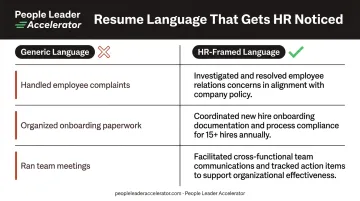
The underlying work is identical — HR framing is what gets you past the first screen.
Once your resume reflects that framing, your LinkedIn profile needs to match it.
Optimize Your LinkedIn Profile
Your LinkedIn profile needs to signal HR intent before you apply anywhere:
- Headline: Include your HR target explicitly — for example, "Aspiring HR Professional | Background in Operations & Employee Relations"
- About section: Use HR-relevant keywords drawn directly from job postings you're targeting
- Activity: Comment on posts from HR practitioners, share relevant industry content, and follow HR thought leaders
Recruiters search LinkedIn by keyword. An admin-generalist profile won't surface for HR roles — even when you're genuinely qualified.
Entry-Level HR Roles to Target as Your Starting Point
These are the most accessible first roles for career changers without a formal HR title:
| Role | Why It's Accessible | Key Skills Needed |
|---|---|---|
| HR Coordinator | Broadest exposure; often open to strong operational backgrounds | Organization, communication, HRIS basics |
| Recruiting Coordinator | Logistics-heavy; maps directly to admin and ops experience | Scheduling, attention to detail, candidate communication |
| People Operations Associate | Common at tech startups; values systems and process skills | Process orientation, data fluency, adaptability |
| HR Administrative Assistant | Lowest barrier to entry; builds foundational knowledge fast | Administrative accuracy, confidentiality, systems |
| Talent Acquisition Sourcer | Research-focused; no prior HR title often required | Boolean search, LinkedIn, communication |
Where to look: Prioritize smaller, generalist HR teams at startups, scaleups, and SMBs, where coordinators handle broad responsibilities rather than narrow specialties. The market supports this move: according to the BLS, HR specialists earn a median of $72,910, with 81,800 average annual openings and 6% projected growth through 2034. Career changers who position themselves well have real runway here.
Practical job search tips:
- Target postings that include "or equivalent experience" in requirements
- Research the HR team on LinkedIn before applying and personalize your outreach
- Focus on mission-driven organizations and growth-stage companies known for developing internal talent
Frequently Asked Questions
What does HR actually cover day-to-day?
The seven core areas are recruitment and staffing, compensation and benefits, training and development, employee relations, compliance and administration, workforce planning, and HR technology. Understanding these helps career changers identify where their existing experience already overlaps with formal HR functions.
What is considered HR experience?
Any work involving hiring support, onboarding, conflict resolution, training facilitation, compliance tracking, benefits administration, or employee-facing communication qualifies — even if your role had a non-HR title. The key is translating those duties into HR-aligned language.
What skills do you need for HR?
Modern HR requires both interpersonal skills (communication, empathy, discretion, conflict resolution) and analytical or operational skills (data literacy, process management, HRIS familiarity). Strong candidates typically demonstrate both, not just one.
Can I get into HR without a degree?
BLS job-requirement data shows that 40% of HR specialist positions require only a high school diploma. Certifications like SHRM-CP, relevant work experience, and strong framing of transferable skills often matter more than a specific degree — especially at startups and smaller companies.
What is the best entry-level HR job for someone with no experience?
HR coordinator and recruiting coordinator are the most accessible starting points. Both offer broad exposure to HR functions and are frequently found at growth-stage companies willing to hire candidates with strong operational or administrative backgrounds.
How long does it take to break into HR from another field?
Timing varies based on existing experience, credentials pursued, and networking effort. The most realistic range for someone actively building credentials and targeting accessible roles is 6–18 months. Candidates who volunteer for internal HR projects and earn a SHRM-CP tend to move faster.