Introduction
You've likely seen the footage. At a Coldplay concert in July 2025, a jumbotron camera caught Astronomer CEO Andy Byron and Chief People Officer Kristin Cabot in an embrace that neither appeared to expect the world to see. Within hours, the clip had generated millions of views, corporate memes, and genuine shock. Byron resigned on July 19; Cabot followed on July 24.
The internet moved fast to make it a scandal. The more durable conversation — the one that matters for every organization watching — is structural: when the CEO-HR relationship lacks clear boundaries and accountability, the consequences extend far beyond two individuals.
They ripple into morale, organizational credibility, and a company's ability to hold anyone to consistent standards.
This guide covers what a healthy CEO-HR partnership actually looks like, what happens when it breaks down, and how HR leaders can build the kind of strategic alignment that drives results.
Key Takeaways
- The CEO-HR relationship is one of the most strategically consequential in any organization — and how well it functions shapes the entire leadership team's effectiveness.
- HR's most valuable contribution isn't administrative efficiency — it's aligning people priorities with business goals.
- Strong partnerships depend on psychological safety, clear role definition, shared metrics, and regular structured dialogue.
- The most common failure modes — HR staying too operational, CEOs undervaluing the function, and weak governance — are all preventable.
- HR leaders who want a genuine seat at the CEO's table must speak the language of business outcomes, not just people programs.
Why the CEO-HR Relationship Shapes Organizational Outcomes
The Structural Reality Is Uniquely Complex
The CHRO or Chief People Officer holds a position unlike any other in the C-suite: their primary mandate covers the health of the entire organization — people, culture, performance, and capability. That scope creates a relationship with the CEO that is inherently more complex than, say, the CEO-CFO dynamic.
What makes it structurally tense: HR must sometimes advise, investigate, or set policy regarding the very leaders who control HR's budget, headcount, and organizational scope. That includes the CEO. No other executive function operates with that dual accountability baked in.
Without proactive governance, that tension quietly erodes HR's ability to function as an independent check — which is precisely what the organization needs it to be.
Alignment Gaps Are Common, Even When Both Parties Agree on HR's Role
A SHRM/Chief Executive survey of 243 CEOs and 406 CHROs found that 84% of both groups viewed the CHRO as a strategic adviser. But that shared belief in HR's role didn't translate to shared priorities. The priority gaps were stark:
- Talent availability and recruiting: cited by 56% of CEOs vs. 29% of CHROs
- DEI priorities: cited by 62% of CHROs vs. just 30% of CEOs
- Strategic adviser role: agreed upon by 84% of both — yet the agendas diverged sharply below that surface agreement
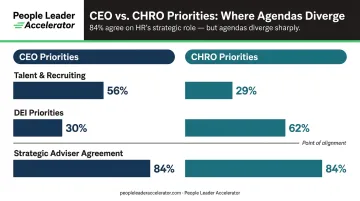
Agreement on HR's strategic importance doesn't automatically produce alignment on what that means in practice. The agenda must be built explicitly — not assumed.
The Astronomer Case as a Governance Lesson
Strip away the personal dimension entirely, and what the Astronomer situation illustrates is a governance failure. Kristin Cabot herself described her role at the time of her appointment as "people strategy versus traditional human resources — the real magic happens when you align the people strategy with the business strategy."
That's exactly the right framing for a modern CPO. The irony is that the incident exposed a gap between that strategic mandate and the structural accountability the role requires.
When the CEO-HR relationship lacks defined boundaries, it doesn't just create personal risk — it compromises HR's ability to enforce standards organization-wide.
In high-growth companies especially, this dynamic determines whether culture and talent can scale alongside the business. It's the core challenge that programs like People Leader Accelerator are specifically built to address.
The Strategic vs. Operational HR Divide: Where Most Companies Get It Wrong
What "Strategic HR" Actually Means for a CEO
The modern expectation for HR is sharply different from its traditional reputation as a payroll-and-compliance function. Today's standard is HR that translates business strategy into organizational design, talent planning, culture architecture, and leadership effectiveness.
That older perception still persists in more organizations than most CHROs would like to admit.
The distinction matters because CEOs and HR leaders often misread each other's expectations. CEOs may assume HR is primarily there to execute. HR leaders may assume their strategic value is already recognized. Both assumptions tend to be wrong.
What HR should own operationally:
- Policy development and compliance
- HR processes, systems, and administration
- Employee relations and day-to-day people operations
What should be a joint CEO-HR priority:
- Succession planning and leadership pipeline
- Culture design and organizational values in practice
- Organizational structure decisions
- Executive team effectiveness
How these responsibilities are allocated determines whether the CEO treats HR as a strategic partner or a back-office function — and that allocation is almost always set by the CEO, not HR.
How CEOs Inadvertently Keep HR Operational
Many CEOs create the dynamic they later complain about. By excluding HR from strategic planning cycles, board reporting, or business model discussions, they signal — without saying it — that HR is an execution function. HR then behaves accordingly, and the cycle reinforces itself.
The market is correcting for this. Deloitte's analysis of 748 CHRO job postings found that in 2024:
- 64% of postings requested business management capability
- 54% requested business operations experience
- 49% requested business strategy background
- Demand for finance backgrounds had grown 34% over the study period
Organizations are hiring for strategic capability, not just HR expertise.
The Promotion Trap in Fast-Growth Companies
One pattern shows up repeatedly in high-growth environments: strong HR operators get promoted into CHRO or CPO roles without the strategic and business-partnering skills those roles demand. They've built excellent HR functions. They haven't necessarily learned to think like business leaders.
Russell Reynolds reports that 60% of Q1 2026 CHRO appointments were first-time CHROs — up from 54% the prior year. More new leaders are entering the role than ever, which amplifies the stakes of whether they're equipped to operate at CEO level from day one.
The operational-to-strategic transition is learnable — but it requires deliberate development, structured exposure to business decision-making, and often, external support. A title change alone rarely closes the gap.
What a High-Functioning CEO-HR Partnership Actually Looks Like
The Foundational Elements
Four conditions define effective CEO-HR relationships:
- Mutual trust — built through demonstrated competence, confidentiality, and follow-through
- Clearly defined roles — both parties know what each owns and where accountability is shared
- Psychological safety — HR can challenge the CEO constructively without political consequence
- Shared accountability — people outcomes are measured jointly, not siloed in an HR dashboard
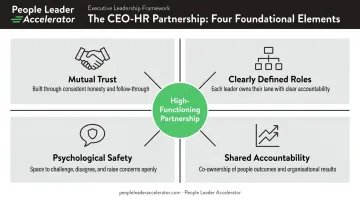
Each element depends on the others. Trust without role clarity creates blurred boundaries. Shared accountability without psychological safety produces filtered intelligence — HR tells the CEO what they want to hear.
Operating Cadence: Structure Over Ad Hoc
The most common structural gap in CEO-HR relationships isn't the absence of trust — it's the absence of rhythm. Effective partnerships operate on a consistent cadence, not just in reaction to problems.
Spencer Stuart recommends that a new CHRO explicitly agree with the CEO on expectations, success criteria, and the content and cadence of one-on-ones. In large organizations, at least annual — and often twice-annual — enterprise talent reviews are standard practice.
A practical baseline framework:
| Cadence | Purpose |
|---|---|
| Weekly 1:1 | Organizational pulse, emerging issues, strategic alignment |
| Quarterly talent review | Pipeline health, performance trends, succession gaps |
| Annual people strategy session | Aligning people priorities to business planning cycle |
The cadence matters because trust is built in consistent interactions, not crisis management.
The Reporting Structure Question
Direct CEO reporting gives HR the most strategic access and influence. The CHRO sits in the room where business decisions are made and can integrate people considerations in real time rather than receiving information second-hand.
The counterweight: direct reporting requires stronger governance, not less. The more access HR has to the CEO, the more critical it is that both roles maintain clear professional boundaries. The Astronomer situation is the case study for what happens when that governance fails — regardless of the specific facts, the organizational damage was real and immediate.
Metrics That Build Credibility
Activity metrics — headcount, time-to-fill, training completion rates — rarely move CEOs. Business outcome metrics do. HR leaders who make that translation earn a seat at strategy discussions, not just operational ones.
Three metrics that translate directly:
- Revenue per employee — links workforce investment to business productivity
- Retention of key talent in critical roles — surfaces whether the people who create disproportionate value are staying
- Succession coverage rate — quantifies leadership pipeline health against business risk
Most CHROs already know these metrics exist. The ones who use them consistently — and tie them explicitly to quarterly business reviews — are the ones CEOs treat as strategic partners rather than functional managers.
Common Failure Modes in the CEO-HR Relationship
The Reactive Cycle
The most common structural failure looks like this: CEOs don't include HR in strategic decisions because they don't see HR as a strategic asset. HR leaders, excluded from those decisions, default to operational execution. That execution reinforces the CEO's perception. The cycle repeats.
Breaking it requires HR to act differently before being invited to. That means bringing business-linked data to conversations proactively, not waiting to be asked.
The Governance Failure
The Activision Blizzard case offers a documented example of what weak escalation controls cost. The SEC found that Activision Blizzard lacked controls to collect and analyze employee workplace misconduct complaints for disclosure purposes from 2018 through 2021, resulting in a $35 million civil penalty.
The governance failure wasn't just about process — it was about the absence of clear accountability structures that would have required HR to escalate, regardless of who was involved. When HR governance doesn't apply to all levels — including the C-suite — it doesn't apply at all.
The Communication Gap
CEOs who treat HR as an executor miss the organizational intelligence HR is positioned to provide. HR leaders who don't proactively share what they're seeing create an information gap that eventually produces decisions misaligned with people realities.
HR should be surfacing signals like:
- Talent risks — flight risk patterns, succession gaps, critical role vacancies
- Engagement trends — early warning indicators before attrition spikes
- Culture signals — team-level friction, manager effectiveness data
- Workforce capacity — whether headcount and skills align with growth plans
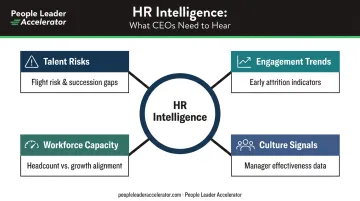
The fix is structural: HR brings insights before being asked, framed in the language CEOs actually track — revenue risk, cost exposure, execution capacity. People data lands when it connects to a metric the CEO already owns.
How HR Leaders Build Strategic Credibility with the CEO
Start with Business Fluency
The most effective HR leaders learn the business deeply — understanding the P&L, competitive pressures, growth levers, and the trade-offs the CEO is navigating. That depth shifts the CEO's perception of HR from support function to strategic partner.
SHRM advises CHROs to read financial statements, understand value drivers, and translate people proposals into revenue, cost, risk, and productivity terms. That's the language of credibility.
Bring Intelligence, Don't Wait for Requests
The HR leaders who earn the most strategic trust are the ones who walk into CEO conversations with insights the CEO didn't know to ask for — talent pipeline gaps, compensation benchmarking against market, succession coverage risks, early-stage culture signals from engagement data.
Korn Ferry's survey of 750 senior HR leaders found 61% of CHROs said their CEO frequently relied on them for strategic advice. The two areas where that reliance was highest: culture and change management, and leadership succession. Both require HR to surface information the CEO doesn't have direct visibility into.
Invest in the Skill Set
Strategic HR leadership is learnable. The gap between operational excellence and executive-level business partnership is a capability difference — and capabilities can be developed.
People Leader Accelerator is built for this transition. The program's faculty bring real-world depth that's hard to find in traditional HR development:
- Led people operations at high-growth tech companies, including Figma
- Served as first VP of HR at nine organizations across start-ups and scale-ups
- Co-authored Scaling for Success: People Priorities for High Growth Organizations
The curriculum equips HR professionals with business fluency, strategic frameworks, and the executive confidence to operate as genuine partners at the CEO level — covering the governance structures and strategic mandate that define senior HR leadership.
Frequently Asked Questions
Should HR report directly to the CEO?
Direct CEO reporting gives HR the most strategic access and influence. It enables real-time people input on business decisions rather than filtered, delayed input. That access requires strong governance structures and clear professional boundaries to function without the risks the Astronomer case illustrated.
What is the difference between a CHRO and a Chief People Officer?
The titles are largely interchangeable in practice. CPO tends to appear more often in tech and growth-stage companies and emphasizes a people-first, culture-forward philosophy. CHRO is the more traditional designation. Both represent the senior-most HR executive and serve as the CEO's primary people strategy partner.
How often should a CEO meet with the HR leader?
At minimum, a weekly 1:1 to maintain organizational alignment and address emerging issues. Structured quarterly talent reviews and an annual people strategy alignment session — tied to the business planning cycle — complete an effective meeting rhythm.
What are the most important qualities of a high-performing CHRO or CPO?
Business acumen, strategic thinking, executive courage (the ability to challenge the CEO constructively), and the ability to translate people data into business outcomes. Increasingly, job postings for these roles list business management, operations, and strategy as explicit requirements — not just HR expertise.
Can a CEO and HR leader have a personal relationship at work?
Most organizations prohibit romantic or personal relationships between a CEO and their direct reports, including HR leaders. The reason is structural: such relationships compromise HR's ability to enforce standards impartially and create conflicts of interest that undermine the function's credibility across the entire organization.
How can HR leaders gain more influence with the CEO?
Speak in business outcomes, not HR metrics. Bring organizational intelligence proactively rather than waiting to be asked. Credibility builds through demonstrated impact on what the business actually tracks — retention of key talent, succession coverage, and revenue per employee.