This wasn't a contrarian pundit taking shots at HR from the outside. It was the head of the organization that certifies, trains, and advocates for HR professionals globally — telling its own constituency that business as usual is not going to cut it.
If that warning registers as noise, HR professionals are proving the point.
This article unpacks what the SHRM CEO actually said, what it reveals about the real state of HR's relevance, and what the leaders who are thriving are doing differently.
Key Takeaways
- The SHRM CEO's warning reflects a genuine and widening gap between what HR currently delivers and what organizations now need.
- HR has become reactive and process-focused at a moment when businesses need it to be predictive and strategy-driven.
- AI now gives executives direct access to workforce data that once flowed through HR — cutting the function out of decisions it used to own.
- The HR professionals ahead of this curve are building business acumen, data fluency, and organizational design capability — not doubling down on compliance expertise.
- The CHRO-to-CEO pathway is real: Leena Nair went directly from CHRO at Unilever to global CEO of Chanel.
What the SHRM CEO Actually Said — and Why It Matters
At the SHRM26 annual conference in Orlando on June 18, 2026, CEO Johnny C. Taylor Jr. delivered a keynote titled "Take Back HR." As reported by HR Dive, Taylor told the audience that HR had "lost the plot" on the future of work, needed a "revolution" to direct how work gets performed by humans and AI, and faced "extinction" if it failed to establish genuine business value. He called for HR to become "decisive, analytical, business-first, solution-oriented."
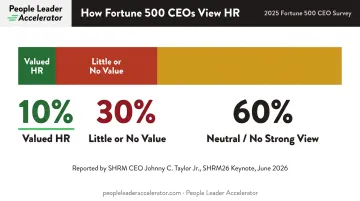
He also reported that at a 2025 meeting with 92 Fortune 500 CEOs, only 10% said they valued HR — and 30% said HR had little or no value. These were speaker-reported figures from Taylor's keynote, not a published SHRM survey, but the signal is hard to ignore.
What gives the warning its weight is who delivered it. This is the organization that created the SHRM-CP and SHRM-SCP credentials. It runs the largest annual HR conference in the world. When it turns the microphone on itself and calls the profession's direction into question, that's a structural diagnosis from the institution that defines the field.
"Lost the plot" has a specific meaning here. It doesn't mean HR has forgotten how to do HR. It means HR has been so focused on managing processes that it missed the larger shift happening around it:
- AI transforming workforce models at every organizational level
- Skills-based talent strategies displacing traditional job-based hierarchies
- Growing CEO expectation that HR shapes organizational direction, not just administers it
The "extinction" framing doesn't predict that HR departments disappear. It predicts that strategic people decisions migrate to finance, operations, and AI systems — while HR manages the paperwork. That's the actual risk Taylor is naming.
The Signs That HR Has "Lost the Plot"
The Process Trap
HR's identity has long been built around processes: performance review cycles, compliance audits, benefits administration, headcount management. These are necessary functions. But they became the definition of HR's value — and that's where the problem starts.
When HR's success metrics are "did the cycle run on time" and "are we compliant," the function optimizes for execution rather than impact. The business is asking fundamentally different questions:
- Which talent risks will hit revenue this quarter?
- Which teams are burning out before they can ship?
- What does our workforce need to look like in 18 months?
Processes don't answer those questions.
SHRM's own 2025 research illustrates the perception gap. In its State of the Workplace report, the gap between how HR sees itself and how everyone else sees it is stark:
| Metric | HR Executives | Workers |
|---|---|---|
| Strategy effectiveness | 70% | 41% |
| Employee experience | 56% | 42% |
The further you get from HR's own assessment, the worse the numbers look.
The Future-of-Work Blind Spot
Taylor's critique targets HR's slow response to AI, hybrid work models, and skills-based talent management. The data supports the concern.
According to Gartner, 88% of HR leaders say their organizations have not realized significant business value from AI tools — despite widespread investment. HR is acquiring tools without the analytical foundation to deploy them against real business problems — and that's a strategy failure, not a technology one.
The Engagement and Turnover Evidence
The most visible sign that HR has "lost the plot" is that even with massive investment in recruitment and retention programs, the needle hasn't moved.
- Gallup reports global employee engagement fell to 21% in 2024, down from 23% the year prior.
- BLS data shows 3.2 million voluntary quits in December 2024 alone — a 2.0% quit rate that represents years of continued labor market churn.
These aren't numbers HR can explain away with macroeconomic headwinds. Years of sustained investment in engagement programs haven't moved engagement or retention in any meaningful direction — which raises the harder question: if the programs aren't working, is HR solving the right problem?
What's Driving the Extinction Threat: AI, Automation, and the Shifting Power Dynamic
AI Is Already Here
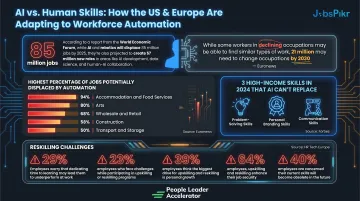
Many core HR functions are being automated now — not in some hypothetical future. Resume screening, onboarding documentation, benefits queries, compliance tracking, scheduling: these have workable AI solutions today.
McKinsey's analysis of generative AI in HR identifies significant use cases in knowledge management, performance feedback, and workforce planning. It describes AI giving new workers access to institutional knowledge that can move them 80–90% of the way to full proficiency — collapsing timelines that HR has traditionally managed through structured onboarding programs.
The World Economic Forum's Future of Jobs Report 2025 projects that structural change will affect 22% of current jobs by 2030, with 40% of surveyed employers expecting workforce reductions where AI can automate tasks. The HR functions most exposed to this disruption are the same ones that currently define most HR roles.
The Analytics Disintermediation Problem
As people analytics tools become more sophisticated, CEOs, CFOs, and COOs are gaining direct access to workforce data that previously flowed exclusively through HR.
When a CFO can pull attrition risk models directly from a workforce intelligence platform, HR's traditional role as the keeper and interpreter of people data disappears. Unless HR can add interpretive and strategic value that raw data cannot — turning data into decisions, not just dashboards — it gets cut out of the conversation entirely.
The Outsourcing Pressure
That same disintermediation logic is accelerating a parallel pressure. Organizations, particularly in PE-backed and high-growth environments, are actively questioning whether transactional HR functions should be outsourced entirely, leaving a lean strategic HR team in-house.
Deloitte's 2024 Global Outsourcing Survey found that 80% of global executives planned to maintain or increase third-party outsourcing investment, with 83% already using AI within outsourced services. For mid-level HR practitioners who haven't built strategic credentials, this is the pressure that matters most. The transactional work they do today may not exist in its current form within five years.
What "Staying Relevant" Actually Looks Like for HR Leaders
The New HR Value Proposition
The HR leaders who are thriving operate as organizational diagnosticians — identifying talent risks before they hit revenue, quantifying disengagement before it becomes attrition, and connecting workforce investment to measurable business outcomes.
The capabilities that make this possible:
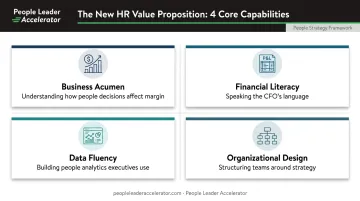
- Business acumen — understanding how the company makes money and where people decisions affect margin
- Financial literacy — reading a P&L, speaking the CFO's language, modeling ROI on people programs
- Data fluency — building and interpreting people analytics dashboards that executives actually use
- Organizational design — structuring teams and roles around strategy, not legacy precedent
From Generalist to Strategic Advisor
Staying relevant doesn't mean abandoning HR expertise — it means applying it differently. The HR leaders who secure long-term influence function as trusted advisors to the CEO and board, not administrators serving the organization.
This shift requires a fundamentally different development path. People Leader Accelerator's 16-week core program is designed for exactly this transition, focusing on three core skills:
- Connecting people decisions to business outcomes executives care about
- Influencing CEOs and boards without formal authority
- Making high-stakes calls on organizational design and talent strategy
Participants work on their actual organizations each week, not generic case studies. The Mastermind component adds ongoing peer accountability through structured monthly decision forums with 8–12 senior HR leaders of comparable scope.
That curriculum aligns directly with external benchmarks. The SHRM Body of Applied Skills and Knowledge (BASK) identifies Business Acumen, Consultation, and Analytical Aptitude as core competencies for strategic HR. These aren't soft skills to acquire — they're the admission criteria for being taken seriously in the strategic conversation.
Proactive Career Investment
Aon's Chief People Officer Lisa Stevens told Fortune that her role shifted from 80% operational to 60% or more strategic work between 2019 and 2024. That shift didn't happen by default — it happened because she changed how she operated.
The HR professionals making this transition are treating their own development with the same rigor they apply to developing others. That means actively building skills in people analytics, organizational design, executive coaching, and workforce strategy — not waiting for the organization to push them into it.
The CHRO-to-CEO Pathway: Evidence That HR CAN Lead
The extinction warning is real, but it exists alongside a compelling counternarrative: HR expertise, applied strategically, is exactly what modern organizations want at the top.
The Leena Nair Case
Leena Nair's career trajectory is the clearest example. She joined Unilever as a summer intern in 1992, moved to its London headquarters in 2012, and finished her Unilever tenure as CHRO. In 2021, Chanel appointed her as global CEO — a direct CHRO-to-CEO transition at a company where the CEO role had never come from an HR background.
Mary Barra's path at GM is more accurately described as cross-functional: she held a senior HR role in 2009 before moving through global manufacturing, product development, and supply chain before becoming CEO in 2014. Her trajectory shows that HR experience can be a strategic foundation. Nair's shows it can be the whole case.
What These Leaders Have in Common
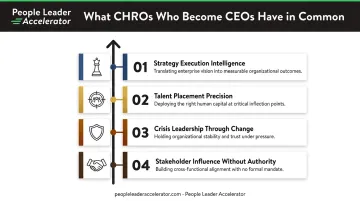
The CHROs who reach CEO weren't the best HR administrators. They were the ones who used HR as a foundation to develop:
- Deep understanding of how organizations execute strategy
- The ability to identify and place the right people in critical roles
- Crisis leadership built through repeated organizational change
- Stakeholder influence developed through years of advising without authority
Korn Ferry's 2025 CHRO survey, covering 756 HR leaders across 50+ countries, describes CHROs as working closely with CEOs on business strategy and organizational transformation — not just managing compliance. For CHROs already operating at that level, the data confirms what they know. For those who aren't, it marks the gap.
The Org Chart Question
The CEO holds organizational authority over the CHRO. That's the chart. But the extinction risk isn't about org chart position — it's about relevance and influence. The CHROs at risk are those who see their role as supporting the organization. Those who aren't at risk are busy shaping it.
Frequently Asked Questions
What is the CEO of HR called?
The top HR executive is typically titled Chief Human Resources Officer (CHRO) or Chief People Officer (CPO). Today, the role extends well beyond compliance origins. Modern CHROs are expected to serve as strategic workforce advisors to the CEO and board.
Who is higher, HR or CEO?
The CEO holds the highest executive authority, and the CHRO typically reports to the CEO. In high-performing organizations, the CHRO functions as a strategic peer in the executive conversation. Increasingly, former CHROs are also being elevated to the CEO role itself.
Can an HR professional become a CEO?
Yes. Leena Nair moved directly from CHRO at Unilever to global CEO of Chanel. Mary Barra held a senior HR role at GM before ultimately becoming CEO. The pathway typically requires developing business acumen and operational experience that extends beyond core HR functions.
What does it mean for HR to have "lost the plot" on the future of work?
It means HR has been so focused on process management and compliance that it underinvested in preparing for AI-driven transformation, skills-based workforce models, and the evolving expectations of both employees and senior leadership. The plot it lost is the strategic one.
How can HR leaders protect their relevance in an AI-driven workplace?
HR leaders need to shift from transactional work to strategic advisory: building data literacy, financial fluency, and the ability to connect people decisions to measurable business outcomes. Those who position HR as a driver of organizational performance, rather than an administrative cost center, are the ones who stay in the room.