

If you're an HR professional wondering whether this is a smart pivot, or someone from an IT background curious about HR tech roles, the confusion is understandable. Job postings use "HRIS analyst," "HR systems analyst," and "HR technology analyst" interchangeably, and the required skill mix isn't obvious from either side of the HR-IT divide.
This article covers what the role actually involves, the skills and credentials that matter, current salary data, and the most practical paths into the field.
Key Takeaways
- The HR systems analyst (also called HRIS analyst) manages, configures, and optimizes an organization's HR technology stack, sitting at the intersection of HR and IT.
- Core responsibilities include system administration, data management, integrations, user support, and process improvement.
- Both HR-to-tech and tech-to-HR career paths work; neither background alone is sufficient.
- US salaries range from roughly $60,500 (entry-level) to $88,200+ (senior-level), per Salary.com data.
- Vendor-specific certifications (Workday Pro, SAP SuccessFactors, Oracle HCM) carry the most weight in hiring, alongside the HRIP credential.
What Is an HR Systems Analyst?
An HR systems analyst—most often titled HRIS analyst in job postings—is the professional responsible for managing and optimizing a company's human resources information system (HRIS). That's the centralized platform housing employee records, payroll data, time-off balances, benefits elections, performance reviews, and more.
The role is fundamentally about translation. When an HR team says "we need automated onboarding workflows," the HRIS analyst converts that business need into system configurations, workflow rules, and integrations—typically without writing custom code. This dual literacy—understanding both HR processes and technical systems—is what distinguishes the role from a pure HR generalist or a pure IT professional.
Common Titles and Platforms
The titles "HR systems analyst," "HRIS analyst," and "HR technology analyst" all refer to the same functional role. SHRM formally recognizes "Human Resource System Analyst" as a distinct job description in its library. Platforms these analysts typically manage include:
- Workday and SAP SuccessFactors (dominant in mid-to-large enterprises)
- Oracle HCM Cloud (common in complex, global organizations)
- UKG and ADP (strong in mid-market and hourly workforce environments)
- BambooHR (popular in smaller, growing companies)
Organizational Context
In smaller companies, one person handles all HRIS responsibilities. In larger enterprises, the role sits within an HR operations or HR technology team, often with multiple analysts covering different modules or functional areas.
SHRM reports 23% year-over-year growth in demand for HR technology skills—a clear sign that organizations are investing in this function, not just filling a gap.
Key Responsibilities of an HR Systems Analyst
Day-to-day work spans several distinct areas. The balance across them shifts depending on company size, industry, and how mature the HRIS environment is.
System Administration and Configuration
This is the core of the role. Responsibilities include:
- Managing system settings, security roles, and user access
- Configuring workflows to reflect current HR policies (for example, updating PTO accrual rules when policy changes)
- Testing configuration changes before they go live
- Maintaining system documentation
Deep platform knowledge is non-negotiable here. Surface-level familiarity isn't enough when a broken workflow affects payroll for 2,000 employees.
Data Management and Reporting
HRIS analysts own data quality across the system. In practice, this means:
- Running regular audits to catch inconsistencies and duplicates
- Managing data imports and exports between systems
- Building reports and dashboards that HR leadership uses for headcount planning, turnover analysis, compensation reviews, and compliance reporting
This is where the role starts generating real strategic value—when an HR leader can make a hiring decision because the data is clean and the report is accurate.
System Integrations and Upgrades
HRIS platforms rarely operate alone. Analysts manage connections between the HRIS and adjacent systems like payroll processors, benefits platforms, applicant tracking systems (ATS), learning management systems (LMS), and time-tracking tools.
They also coordinate and test vendor-released updates before deploying to production—a process that can involve significant QA work on complex environments.
User Support and Process Improvement
HRIS analysts serve as the internal subject matter expert for the platform. Core support responsibilities include:
- Troubleshooting issues escalated by HR team members or managers
- Writing documentation and how-to guides
- Training users when new features roll out
Strong analysts go further. They proactively identify manual processes worth automating, build self-service portals, and surface underused platform capabilities—turning a support function into a driver of operational efficiency.
Skills and Qualifications for an HR Systems Analyst
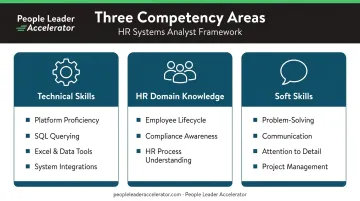
This role requires three distinct competency areas. All three matter equally — gaps in any one of them surface quickly once you're in the seat.
Technical Skills
- Proficiency in at least one major HRIS platform (Workday, SAP SuccessFactors, Oracle HCM, ADP, UKG, or BambooHR)
- SQL for custom reporting and database queries
- Advanced Excel skills (pivot tables, VLOOKUP, data modeling)
- Data visualization and report-building tools
- Working knowledge of system integrations (APIs, file-based integrations, middleware)
- Familiarity with data privacy and security principles
HR Domain Knowledge
Analysts need to understand how HR processes actually work to configure systems that support them effectively. That means:
- Knowledge of the full employee lifecycle: hiring, onboarding, payroll, benefits, performance management, offboarding
- Familiarity with compliance requirements that affect system configuration (FLSA, ACA reporting, state leave laws)
- Understanding of how different HR functions interact with the HRIS daily
Soft Skills
- Problem-solving — diagnosing system issues from vague user-reported symptoms
- Clear communication — translating technical constraints for non-technical HR colleagues
- Attention to detail — data integrity depends on precision at every step
- Project management — coordinating implementations and upgrades across multiple stakeholders
- Stakeholder management — balancing competing requests from HR teams with finite system resources
Education and Certifications
Most postings require a bachelor's degree in HR, information systems, business administration, or a related field. Beyond that, certifications carry significant weight.
| Certification | Type | What It Signals |
|---|---|---|
| Workday Pro | Vendor-specific | Deep Workday platform expertise |
| SAP SuccessFactors | Vendor-specific | SAP HCM configuration proficiency |
| Oracle Cloud HCM | Vendor-specific | Oracle Fusion HCM knowledge |
| UKG Certification | Vendor-specific | UKG platform administration |
| HRIP (IHRIM) | General HRIS | Broad HR technology practitioner knowledge |
| SHRM-CP / PHR | General HR | HR process and compliance credibility |
The HRIP certification from IHRIM is the most recognized general-purpose HRIS credential. It requires five years of practical HR technology experience, making it an experienced-practitioner credential rather than an entry-level one.
HR Systems Analyst Salary and Career Outlook
Salary by Experience Level
Salary.com's 2025 national data breaks down HRIS analyst compensation by level:
| Level | Experience | 2025 Median Salary |
|---|---|---|
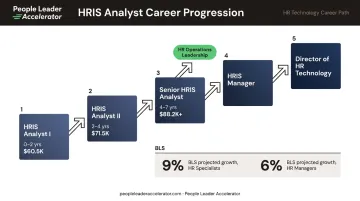
| HRIS Analyst I | 0–2 years | $60,541 |
| HRIS Analyst II | 2–4 years | $71,464 |
| HRIS Analyst III / Senior | 4–7 years | $88,232 |
Geographic location moves these numbers meaningfully—major metro areas like New York, San Francisco, and Seattle carry premiums above national medians. Platform specialization matters too: Workday-certified analysts consistently command higher compensation than generalists, making certification a worthwhile investment once you're established in the role.
Career Trajectory
The most common progression:
HRIS Analyst → Senior HRIS Analyst → HRIS Manager → Director of HR Technology
Alternatively, analysts who build strong business acumen often pivot toward broader HR operations leadership, where their systems knowledge supports strategic decisions around headcount planning, compensation structure, and workforce analytics.
That career path also comes with strong job stability. Every organization with a meaningful employee population needs some level of HRIS support. The continued migration to cloud-based platforms is generating more implementation projects, integration work, and upgrade cycles—demand is growing, not shrinking. The BLS projects 9% growth for Computer Systems Analysts and 6% for HR Specialists through 2034, and the HRIS analyst role sits squarely at the intersection of both.
How to Become an HR Systems Analyst
Two entry paths dominate, and both are legitimate.
Path 1: HR Professional Building Technical Skills
Start as an HR coordinator, HR assistant, or benefits administrator. You already understand HR processes — now layer in platform training. Pursue vendor-specific learning (SAP's free Learning Journeys, Workday's on-demand training programs) and seek out HRIS projects within your current role. Even volunteering to own a module migration or run a data audit builds hands-on experience that reads well on a resume.
Path 2: IT or Business Analyst Building HR Knowledge
You have the technical foundation — now develop HR domain knowledge. Start with a general HR credential (SHRM-CP or PHR) to build process literacy, then pursue vendor-specific platform training. Find opportunities to work on HR system implementations or support projects within your current organization.
Building Your Portfolio
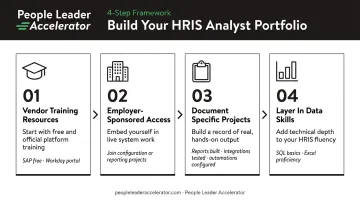
Regardless of entry path, hands-on experience with actual platforms is non-negotiable. Here's how to get it:
- Start with vendor training resources — SAP's Learning Journeys are free; Workday offers on-demand basics through its learning portal
- Pursue employer-sponsored access — if your current employer uses a major HRIS, ask to get involved in configuration projects or reporting work
- Document specific projects — reports you built, integrations you tested, automations you configured
- Layer in data skills — SQL basics and Excel proficiency differentiate candidates at the same credential level
Adding Strategic Depth
Technical skills get you into the role. Knowing what to do with the data is what advances your career.
Programs like People Leader Accelerator offer frameworks specifically in people analytics and data-driven HR decision-making. Their People Analytics Full Guide ($500) is a 75-page resource covering how to identify metrics that drive business value, structure dashboards, and translate analytics findings for executive audiences. It bridges the gap between pulling data from a system and using it to influence decisions.
Free resources — including an HR dashboard sample and cost-of-turnover calculator — are also available from PLA for analysts building their analytics toolkit.
HR Systems Analyst vs. Related HR Roles
These three roles get conflated often — and the differences shape how you position yourself on a career path.
| Role | Core Focus | Relationship to HRIS Analyst |
|---|---|---|
| HR Data Analyst | Interprets workforce data — turnover models, compensation benchmarking, predictive headcount planning | Analyst manages the systems that produce the data; Data Analyst interprets it |
| HR Systems Administrator | Routine maintenance — password resets, basic access changes, simple configuration updates | Administrator handles day-to-day upkeep; Analyst owns integration management, process improvement, and system implementations |
| HRIS Manager | Team oversight, vendor relationships, HR technology roadmap, platform strategy | The next step up from analyst — requires the same technical foundation plus leadership and budget accountability |
In smaller organizations, the analyst and data analyst functions often sit with one person. The administrator role, by contrast, is typically a stepping stone into the analyst level — not a parallel track.
Frequently Asked Questions
What does an HR systems analyst do?
An HR systems analyst manages and optimizes the company's HRIS platform—configuring workflows, maintaining data integrity, building reports, managing integrations with adjacent systems, and serving as the internal expert for HR technology. The role spans both technical system work and HR process knowledge.
How much do HR analysts earn?
In the US, HRIS analyst salaries range from roughly $60,500 at the entry level to $88,200+ at the senior level, per 2025 Salary.com data. Experience level, geographic location, company size, and platform specialization (particularly Workday and SAP SuccessFactors) all influence where someone falls in that range.
What is the difference between an HR systems analyst and an HR analyst?
An HR systems analyst focuses on managing and configuring HR software platforms. An HR data analyst focuses on interpreting workforce data to produce business insights. Both use the HRIS regularly, but in fundamentally different ways—one builds and maintains the system, the other analyzes what it produces.
Do you need a technical degree to become an HR systems analyst?
Not necessarily. Many successful HRIS analysts come from HR backgrounds and build technical skills through certifications and on-the-job platform experience. The reverse path—IT professionals learning HR domain knowledge—is equally common. The requirement is competency in both areas, not a specific degree path.
What certifications are most valuable for an HR systems analyst?
Vendor-specific certifications carry the highest market value—Workday Pro, SAP SuccessFactors, and Oracle Cloud HCM all signal platform expertise employers actively seek. For broader HRIS credibility, the HRIP from IHRIM leads the field, while SHRM-CP or PHR strengthens your HR process knowledge.
Is HR systems analyst a good career choice?
Yes. Strong job stability, competitive compensation, and a clear progression path make it a solid long-term choice. The continued migration to cloud-based HRIS platforms sustains demand for professionals who can implement and optimize these systems. Its position at the HR-IT intersection also makes it resistant to outsourcing and automation.