According to SHRM, 56% of organizations have no succession plan at all. The remaining majority operate reactively, filling critical vacancies with whoever is available rather than whoever was prepared. In high-growth environments — where roles multiply and evolve faster than tenure — that gap becomes a recurring leadership crisis.
This guide covers what succession planning actually is, how the process works across four practical stages, and the best practices that separate programs that produce real bench strength from those that exist only on paper.
Key Takeaways
- Succession planning is the ongoing process of identifying critical roles and developing internal talent to fill them before vacancies occur
- Effective programs follow four stages: assess organizational needs, evaluate talent, develop successors, and execute the transition
- Any role whose vacancy would disrupt business continuity qualifies — not just C-suite positions
- Most programs fail by identifying successors but skipping active development
- Integrating succession planning with performance management and talent development multiplies retention and readiness outcomes
What Is HR Succession Planning?
Succession planning is the proactive, ongoing process of identifying critical organizational roles, assessing internal talent against those roles, and developing individuals so they're prepared to step in when needed. The operative word is proactive — succession planning happens before vacancies occur, not in response to them.
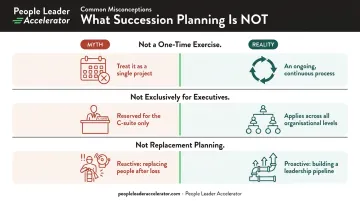
Three things it is not:
- Not a one-time org chart exercise. A succession plan created once and filed away is effectively worthless. The organization changes; the plan must too.
- Not exclusively for executives. Any role that would cause operational or strategic disruption if left unfilled qualifies as a critical role — including technical leads, key account managers, and specialized individual contributors.
- Not replacement planning. Replacement planning is reactive: someone leaves, you find a substitute. Succession planning is forward-looking: you build the bench before you need it.
Two Approaches Worth Knowing
Effective succession programs typically combine two models:
- Position-focused: Identifying and developing successors for specific critical roles
- Talent-pool-focused: Building a broader bench of high-potential employees who can flex into multiple roles as needs evolve
Position-focused planning without a broader pipeline leaves the organization exposed when top candidates leave. A talent pool without role alignment produces development that doesn't close the right gaps. The strongest programs use both — and the sections below explain how to put that into practice.
Why Succession Planning Matters
The business risk is real and documented. A 2025 Gartner survey of 227 supply-chain leaders found that 54% said leadership turnover had moderately to completely disrupted their function's ability to operate over the prior three years. Leadership vacancies, in other words, don't just slow teams down — they break them.
The costs extend beyond disruption. Unplanned leadership vacancies trigger:
- Knowledge loss when the outgoing leader holds undocumented institutional knowledge
- Team instability as direct reports lose direction and momentum
- Erosion of stakeholder confidence in boards, investors, and clients
- Recruiting costs and extended time-to-productivity for external hires
The Retention Dimension
Succession planning also directly affects whether high-potential employees stay. MIT Sloan's analysis of 34 million employee profiles found that lateral career opportunities were 12 times more predictive of retention than promotions alone. DDI's research similarly reports that high-potential employees are 3.7 times more likely to leave without visible development opportunities.
Employees who can see a path forward stay longer. When succession planning is communicated well, it builds that visibility directly into the employee experience.
For high-growth organizations, that retention signal carries added weight. When roles multiply faster than tenure accumulates, a continuously updated leadership pipeline is what separates companies that scale cleanly from those that cycle through external hires and absorb repeat onboarding costs.

How HR Succession Planning Works
Succession planning is a continuous cycle — four interdependent stages that feed into one another rather than a linear sequence completed once per year. Here's how each stage works in practice.
Stage 1: Assess Organizational Needs and Identify Critical Roles
Not every role belongs in a succession plan. The first question is which roles, if vacated or poorly filled, would damage business continuity, competitive position, or team performance.
HR works with senior leaders to define role criticality using criteria such as:
- Decision-making authority — span and strategic weight of decisions the role controls
- Difficulty of replacement — how long it would take to find and develop an equivalent externally
- Specialized knowledge held — unique institutional or technical knowledge concentrated in the role
- Proximity to revenue or operations — direct connection to core business functions
Best practice is to limit the scope intentionally. Trying to succession-plan every role dilutes the effort. Focus on the top tier of positions where vacancies would cause the most damage.
Stage 2: Evaluate Talent and Identify Potential Successors
With critical roles defined, the work shifts to assessing who in the organization has the potential and track record to fill them.
Common evaluation methods include:
- 9-box grid assessments — mapping employees on performance vs. potential axes to identify high-potential candidates; People Leader Accelerator offers a free 9-box template for this purpose
- Structured performance reviews — using documented review data rather than informal manager impressions
- 360-degree feedback — gathering input from peers, direct reports, and managers for a fuller picture
- Leadership competency evaluations — assessing candidates against the specific competencies required for the target role
Using multiple data sources matters. SHRM and Gallup both flag that potential ratings based on manager intuition alone frequently embed unconscious bias, producing succession lists that reflect familiarity rather than actual readiness.
Document successors at two readiness levels: ready now (can step into the role immediately or within 90 days) and ready in 1–3 years (requires additional development). Having candidates at both levels for each critical role prevents the plan from collapsing when a single "heir apparent" leaves or proves unready.
Stage 3: Develop Successors Through Targeted Learning
This is where most succession plans break down. Identifying successors without developing them creates a false sense of security — the organization has names on paper but remains unprepared for an actual vacancy.
Each identified successor should have an individual development plan (IDP) that specifies:
- Skill gaps to close relative to the target role
- Experiences required to build readiness
- Timeline and milestones for each development activity
Development methods that build genuine capability include:
- Stretch assignments that expose successors to the scope and complexity of the target role
- Job rotations across functions or geographies to build cross-functional perspective
- Mentoring and sponsorship from current role-holders, enabling outgoing leaders to pass on institutional knowledge before they leave
- Executive coaching to develop the leadership behaviors required at the next level
- Formal leadership programs that build structured frameworks alongside peer cohort learning
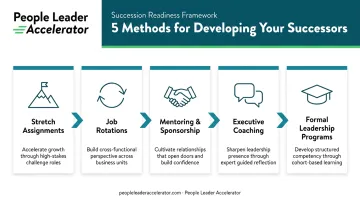
Brandon Hall Group's research identifies this combination of methods as the standard approach for successor development below the C-suite. The key distinction is that IDPs must be tailored to the specific role being prepared for — generic leadership training doesn't close role-specific gaps.
Stage 4: Execute the Succession Decision and Manage the Transition
When a vacancy occurs or is anticipated, the succession decision draws on the readiness matrix built in Stages 2 and 3. Three factors shape that decision:
- Candidate readiness — current level and how recently it was assessed
- Organizational context — timing, urgency, and how the role itself has evolved
- Flight risk — if a top candidate isn't advanced when the opportunity exists, losing them becomes likely
Announcing the new leader is the start of the transition, not the end of it. Effective handoffs include:
- A structured handoff period co-designed with the outgoing leader
- Clear performance milestones for the successor in the first 90–180 days
- Transparent communication with key stakeholders — teams, boards, or clients — to maintain confidence through the change
HR Succession Planning Best Practices
Build Early, Before You Need It
Succession pipelines require years to develop. Mid-level managers identified today become the executive candidates of tomorrow — but only if development starts now. Organizations that treat succession planning as emergency replacement planning are always reactive, cycling through external hires and extended vacancies.
Andrew Bartlow, co-author of Scaling for Success: People Priorities for High-Growth Organizations and Core Faculty at People Leader Accelerator, works directly with PE-backed and high-growth companies on board-level succession questions — precisely because these environments face the most acute leadership continuity pressure and have the least runway to fix it reactively.
That urgency applies broadly. The practices below reflect what separates organizations with functional pipelines from those that are perpetually scrambling.
Integrate with Performance and Talent Management Cycles
Succession planning works best when it's not a separate annual exercise. When succession-readiness data flows from the same conversations as performance reviews and development discussions, HR maintains a continuously updated picture of bench strength.
A succession plan created in January and untouched until the following January becomes obsolete within months — as people leave, roles evolve, and business priorities shift.
Make It a Shared Leadership Accountability
HR designs and facilitates the succession planning process. Senior leaders must own it. That means:
- Actively mentoring and sponsoring identified successors
- Participating honestly in bench-strength reviews
- Accepting accountability for developing their own replacements
Building this expectation into leadership performance criteria — rather than leaving it as a voluntary contribution — is what actually produces follow-through.
Communicate Transparently with Succession Candidates
One common succession planning failure is the candidate being developed for a senior role who wasn't told the timeline slipped — and left for a competitor. Unclear communication about succession timelines, likelihood, and contingencies erodes trust and accelerates the exact departures the plan was designed to prevent.
Transparency doesn't require over-promising. Give candidates an honest picture of:
- Where they currently stand in the pipeline
- What development gaps remain before they're ready
- What factors affect timing, including those outside their control
Measure Bench Strength, Not Process Activity
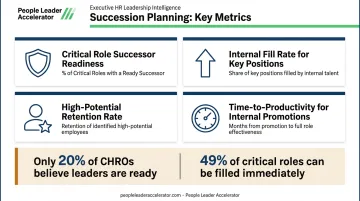
The metrics that matter reflect actual pipeline quality, not how many succession programs were run. Track:
- Percentage of critical roles with at least one ready successor
- Internal fill rate for key positions
- High-potential retention rate
- Time-to-productivity for internally promoted successors
DDI's research found that only 20% of CHROs believe they have leaders ready to fill critical roles, and internal candidates could immediately fill just 49% of critical business leadership roles. If your program is working, these metrics move. If they're flat year over year, the pipeline exists on paper only.
Common Succession Planning Mistakes to Avoid
Even well-intentioned succession plans break down in predictable ways. These are the three most common failure points:
Naming successors without developing them. A succession list that exists only on paper is a liability. Without structured IDPs, active development activities, and regular readiness check-ins, candidates won't be prepared when the moment arrives.
Grooming a single candidate per role. When one "chosen" successor leaves or proves unready, there's no fallback. Maintaining two or three candidates at different readiness levels for each critical position significantly reduces that risk.
Treating the plan as a one-time event. Business strategy shifts, people leave, and roles evolve. Embedding succession reviews into regular leadership cycles — rather than running them as a standalone annual process — is what keeps the plan relevant and actionable.
Frequently Asked Questions
What is succession planning in HR?
Succession planning is the process by which HR identifies critical organizational roles and systematically prepares internal talent to fill them before vacancies occur. It's part of broader talent management and is designed to ensure leadership continuity rather than react to unexpected departures.
What are the key steps of HR succession planning?
The four core stages are: assessing the organization to identify critical roles, evaluating current talent and selecting successors, developing those individuals through structured plans and targeted experiences, and executing the succession decision with a managed transition.
What are the 5 D's of succession planning?
The 5 D's (Death, Disability, Departure, Disagreement, and Disaster) come from business-owner and family-business continuity contexts, not standard organizational HR practice. Corporate HR succession planning centers on proactive talent development for critical roles, not this trigger-based framework.
Is succession planning only for large organizations?
No. Succession planning is relevant for any organization with roles whose vacancy would cause significant disruption — including startups and high-growth companies where key people carry disproportionate institutional knowledge and operational responsibility.
How often should a succession plan be reviewed and updated?
At minimum annually, and also when triggered by significant events: restructuring, rapid growth, or a key leader announcing a departure.
What is the difference between succession planning and talent management?
Talent management covers attracting, developing, and retaining employees across all levels; succession planning is a specific subset focused on keeping critical roles covered by qualified internal candidates. The two work best when integrated — succession readiness data should flow naturally from the same systems and conversations as broader talent management.
Succession planning is fundamentally about building organizational readiness before it's needed. HR professionals who invest in that infrastructure respond to leadership change with confidence rather than scrambling. People Leader Accelerator offers practitioner-led programs designed for high-growth environments. Faculty have built succession pipelines across startups, scale-ups, and PE-backed companies — and teach from that direct experience.