
Introduction
Most companies treat HR as a support function — handling compliance, processing paperwork, and managing benefits administration. Google took a different approach. By rebranding its HR department as "People Operations," Google signaled something deliberate: people decisions deserve the same analytical rigor as product development or financial planning.
Three initiatives illustrate what that looks like in practice:
- Project Oxygen identified specific manager behaviors that drive team performance and translated those findings into training programs
- Structured hiring committees raised the quality bar across thousands of hires
- The Googler-to-Googler (g2g) network scaled peer-to-peer knowledge transfer without ballooning L&D costs
For HR leaders in high-growth organizations, this model offers more than inspiration. It offers a practical blueprint for elevating HR from an administrative function to a genuine business driver.
This guide covers five areas: what makes People Operations distinct, Google's hiring discipline, performance and talent development, workplace culture, and the lessons HR leaders can apply — regardless of company size or budget.
Key Takeaways
- Google treats HR as an evidence-based function, not an administrative support role
- Project Oxygen identified 10 trainable manager behaviors linked to team effectiveness
- Structured interviews save time, improve prediction, and leave rejected candidates more satisfied
- The 20% rule fueled self-directed innovation, though its practical application has evolved over time
- The core principles — structured hiring, data-informed decisions, manager accountability — scale to any organization
What Makes Google's "People Operations" Different from Traditional HR
From Cost Center to Value Generator
Google's decision to call its HR function "People Operations" (People Ops) wasn't just a naming convention. It was a philosophical repositioning. Where traditional HR is often treated as overhead — a compliance function that manages risk and processes — People Ops is framed as a value-generating business unit accountable for measurable outcomes.
That shift shows up in practice: different metrics, different decision-makers, and a fundamentally different mandate for the function.
The Data-Driven Core
The defining feature of Google's People Ops is its commitment to evidence over instinct. Decisions about hiring, management development, and workplace design are informed by employee feedback data, internal surveys, performance metrics, and controlled experiments — not gut feel or industry convention.
Google's People & Innovation Lab (PiLab) operationalized this approach. According to a 2014 report in Behavioral Scientist, PiLab conducted research and developed insights to improve how Google manages and supports employees, including convening an annual Research Summit connecting Google managers with behavioral scientists.
Google re:Work documents three levels of people analytics in practice: descriptive reporting (what happened), predictive metrics (what might happen), and experimental research (what actually causes outcomes). Most HR teams operate at the first level. Google built infrastructure for all three.
Project Oxygen: Proving Managers Matter
The clearest example of Google's data-driven HR philosophy is Project Oxygen. Launched in early 2009, the initiative set out to answer a deceptively simple question: do managers actually matter?
Google analyzed exit interviews, employee surveys, semiannual performance reviews, upward-feedback surveys, and more than 10,000 data points to identify the behaviors that distinguished its most effective managers. The original findings, published in HBR, identified eight behaviors:
- Be a good coach
- Empower the team and avoid micromanaging
- Show genuine interest in team members' success and well-being
- Be productive and results-oriented
- Communicate well — listen and share information
- Support career development
- Have a clear vision and strategy
- Possess technical skills relevant to the team
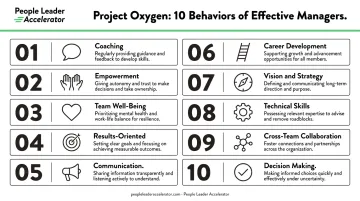
Two behaviors were later added: collaborating across Google, and being a strong decision maker.
These weren't aspirational values. They were observable, measurable behaviors tied to feedback programs and targeted training. Median manager favorability rose from 83% in 2010 to 88% in 2012, with the lowest-scoring managers showing the most improvement.
Structural Hiring Discipline
Identifying what great management looks like was only half the equation — Google also had to ensure it hired the right people in the first place. That meant removing hiring authority from individual managers and placing it with hiring committees. As Laszlo Bock documented in Work Rules!, this design eliminates individual bias and prevents the pressure to fill seats quickly from degrading quality standards. A hiring committee can reject a candidate even when a hiring manager wants to proceed — keeping the bar consistent even during aggressive growth phases.
Google's Hiring Philosophy: Rigor, Data, and No Compromises
The Non-Negotiable Bar
Google's foundational hiring principle: never compromise on quality. In a 2014 Forbes interview, Bock explained that compromising on hiring quality is corrosive — strong employees eventually leave when weaker hires accumulate around them. Roles stay open until the right candidate is found, because Google considers a bad hire more expensive than a vacancy.
Four selection dimensions guide evaluation:
- General cognitive ability — the capacity to learn and problem-solve
- Emergent leadership — stepping up when needed, stepping back when not
- "Googleyness" — intellectual curiosity, comfort with ambiguity, collaborative instincts
- Role-related knowledge — relevant expertise, weighted least of the four
Structured Interviews Over Gut Feel
Google's interview model uses vetted, role-relevant questions for comparable candidates, written evidence, standardized rubrics, and calibrated interviewers. It combines behavioral questions (past conduct) with hypothetical scenarios (how candidates would approach future situations).
According to Google re:Work's structured interviewing guide, the results are measurable:
- Structured interviews are more predictive of job performance than unstructured ones
- They save an average of 40 minutes per interview
- Rejected candidates are 35% more satisfied with the process
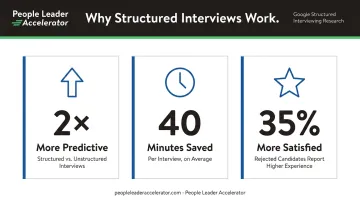
When every interviewer evaluates candidates against the same criteria, decisions shift from "do I like this person?" to "do they meet the requirements for this role?" That shift — from subjective impression to defined standard — is what makes structured interviewing defensible at scale.
Job Description as a Strategic Tool
Structured evaluation doesn't start in the interview room — it starts with how the role is defined. Google's re:Work job description template separates area, role, responsibilities, and qualifications deliberately. Minimum qualifications must be certifiable and non-negotiable; preferred qualifications are qualitative and not mandatory. This distinction produces more targeted searches and prevents qualifications from drifting into wish lists that screen out strong candidates.
Addressing Diversity Through Data
Google has applied its analytical approach to diversity gaps as well. When internal data identified that Black and Latinx US employees left at above-average rates while women globally left at below-average rates, the response was programmatic: retention case managers, mentoring programs for nearly 200 Black and Latinx new hires, and a 500-person State of Black Women event, as documented in Google's 2019 retention report.
By 2014, more than 26,000 Googlers had attended Google's Unconscious Bias @ Work workshop. The pattern holds across all of these efforts: diagnose the problem with data, then design a targeted intervention.
How Google Manages Performance and Develops Talent
Performance Tied to Objectives
Google's performance management approach connects individual evaluation directly to corporate objectives. Managers are assessed through upward-feedback surveys — one of the data sources that fed Project Oxygen. This creates a closed loop: corporate goals inform performance expectations, which inform manager behavior, which is measured and fed back into training.
Google pairs formal review cycles with informal check-ins — including conversations in casual settings — to keep feedback flowing year-round. The intent is ongoing dialogue, not a single annual event. That continuity sets the stage for the kind of development work the g2g program makes possible.
The G2G Peer Learning Network
Google's Googler-to-Googler (g2g) program is one of the clearest examples of scalable talent development. Volunteers from across the organization lead courses, one-on-one coaching, mentoring sessions, and learning-material development. Topics range from Python and sales to leadership and negotiation.
According to Google re:Work's employee-led learning guide, removing general participation barriers doubled facilitator participation within six months while quality remained high — measured through participant feedback. The program works because it taps intrinsic motivation: people teach what they know and care about, and learners get instruction from practitioners with direct experience.

Identifying and Addressing Performance Problems
Google's performance system is designed to surface problems proactively, not reactively. The same data infrastructure that informs manager development also flags issues across two categories:
- Work quality: errors, ineffective techniques, output gaps
- Work behaviors: disengagement, consistent lateness, collaboration breakdowns
Because managers are regularly assessed through upward feedback, team-level problems surface earlier — before they escalate into retention or quality crises.
Google's Workplace Culture, Well-Being, and the 20% Rule
Psychological Safety and Transparency
Google's culture is built around a few structural commitments. Psychological safety — the belief that speaking up won't result in punishment — is treated as a prerequisite for innovation, not a nice-to-have. The TGIF all-hands meetings were the most visible expression of this: weekly sessions where any employee could ask leadership direct questions.
TGIF ran as a weekly meeting for years before shifting to monthly in November 2019, with separate forums for workplace issues. The Washington Post reported that declining attendance and repeated leaks drove the change — a reminder that culture mechanisms require ongoing adaptation, not just initial design.
The 20% Rule: What It Actually Was
Google's 20% rule gave employees permission to spend roughly one day per week on self-directed projects they believed would benefit the company. Larry Page and Sergey Brin referenced it directly in their 2004 IPO founder's letter, explicitly naming AdSense for content and Google News as products that emerged from this policy.
Gmail is frequently cited as a 20% project, but Google's IPO letter doesn't name it — and the primary evidence for that attribution is disputed. Treat it as lore, not confirmed fact.
What is clear is that the policy's application has evolved. Wired reported in 2013 that manager approval requirements and productivity expectations made 20% time harder to access in practice, while a Google spokesperson said the spirit remained alive. The program wasn't formally abolished; it became less uniformly accessible.
Well-Being as Investment, Not Perk
Google's well-being investments — healthcare, meals, fitness, counseling, parental leave, financial benefits — are documented extensively on Google Careers. What's notable is the framing: these are positioned as talent retention and productivity investments, not lifestyle perks.
Perks don't resolve structural tensions. Despite its reputation, Google has faced significant employee pushback:
- In 2018, thousands of employees worldwide walked out over the company's handling of sexual harassment allegations.
- In 2023, hundreds of London employees walked out over layoffs.
A strong culture requires genuine responsiveness to employee concerns — generous benefits alone don't substitute for it.
What HR Leaders Can Apply from Google's Playbook
Google's People Ops model is built on principles that don't require Google's resources to implement. The underlying logic transfers.
Start with Evidence, Not Opinion
The shift from intuition-based to evidence-based HR doesn't require a PiLab. It starts with the data already available: exit interview trends, engagement survey results, performance patterns. Pick one people problem (attrition in a specific team, inconsistency in promotion decisions) and approach it the way Google approached Project Oxygen. Define the question, gather the data, test the intervention.
A useful benchmark: Deloitte's 2017 research found that 71% of companies considered people analytics a high priority, but only 8% reported having usable data. Most organizations aren't starting from zero — they're starting from underused data.
Invest in Structured Hiring
The committee-based, criteria-first hiring model is replicable at any scale. The structure — defining role requirements before sourcing, using consistent interview questions, calibrating evaluators — is what produces consistency and quality. It's not the headcount that matters; it's the discipline.
The business case is straightforward: a structured process reduces mis-hires, and the cost of a bad hire — recruiting, onboarding, lost productivity, potential team disruption — is far higher than the time invested in doing it right.
Develop Managers with Behavioral Specificity
Project Oxygen's most transferable lesson is that manager effectiveness isn't a personality trait — it's a set of observable, learnable behaviors. Regular one-on-ones, specific feedback, genuine interest in career development, psychological safety: all of these are teachable skills, not fixed personality traits.
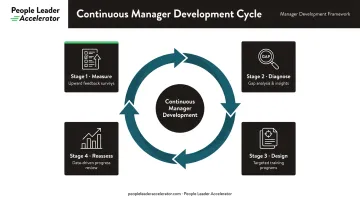
Generic leadership development programs rarely move the needle because they don't target specific behaviors. HR leaders who want to improve manager quality should start by measuring it — upward feedback surveys, team engagement data — and then build development programs around the specific gaps that data reveals.
Build the Strategic Capacity to Operate This Way
The transition from operational HR to strategic partnership requires specific skills: people analytics fluency, culture design frameworks, and the business acumen to influence decisions above the HR function. These aren't developed through general management training — they require deliberate practice against real organizational problems.
For HR professionals building that capacity, People Leader Accelerator offers practitioner-led programs taught by faculty including Marie Szuts (former people leader at Figma) and Andrew Bartlow (co-author of Scaling for Success), who have navigated the exact scaling pressures described throughout this guide. Programs run in cohort format, so participants work through live challenges alongside peers facing the same transitions.
Frequently Asked Questions
How does Google handle HR differently?
Google rebranded HR as "People Operations" and distinguishes the function through rigorous data-driven decision-making, structured hiring committees, and internal experimentation via PiLab. People decisions — hiring, manager development, workplace design — are treated with the same analytical discipline as product or financial decisions.
What is Google's 20% rule?
Google's 20% rule lets employees spend roughly one day per week on self-directed projects outside their primary role, designed to foster creativity and intrinsic motivation. AdSense for content and Google News are both cited as products that emerged from it, though practical accessibility varies by team and has shifted over time.
What HR system does Google use?
Google primarily uses internal tools and Google Workspace products for HR operations, alongside in-house people analytics platforms built by People Ops. It has supplemented these with third-party HRIS tools historically, though the current vendor stack isn't publicly confirmed.
What is Project Oxygen at Google?
Project Oxygen was a Google research initiative launched in 2009 that analyzed over 10,000 internal data points — surveys, performance reviews, and exit interviews — to identify behaviors most correlated with effective management. Findings directly reshaped manager training and evaluation criteria organization-wide.
How does Google approach performance management?
Google's performance management connects individual evaluation to corporate objectives and assesses managers through upward-feedback surveys. It uses a mix of formal review cycles and informal check-ins to keep feedback ongoing, measuring both individual and team-level performance rather than just task completion.
Can smaller companies realistically apply Google's HR practices?
Not every Google practice scales directly, but the underlying principles do. Structured hiring, data-informed decisions, manager accountability, and transparent communication can all be adapted by organizations of any size — frequently requiring structure and discipline more than budget. The structure, not the headcount, is what drives the outcome.